
Close Menu
    Facebook X (Twitter) Instagram
    SciTechDaily
    • Biology
    • Chemistry
    • Earth
    • Health
    • Physics
    • Science
    • Space
    • Technology
    Facebook X (Twitter) Pinterest YouTube RSS
    SciTechDaily
    Home»Technology»Graphene Oxide Polymer Offers a New Mechanism for Multimode Optical Recording
    Technology

    Graphene Oxide Polymer Offers a New Mechanism for Multimode Optical Recording

    By Swinburne University of TechnologyOctober 3, 2013No Comments3 Mins Read
    Facebook Twitter Pinterest Telegram LinkedIn WhatsApp Email Reddit
    Share
    Facebook Twitter LinkedIn Pinterest Telegram Email Reddit
    Graphene Oxide Allows for the Development of Super Discs
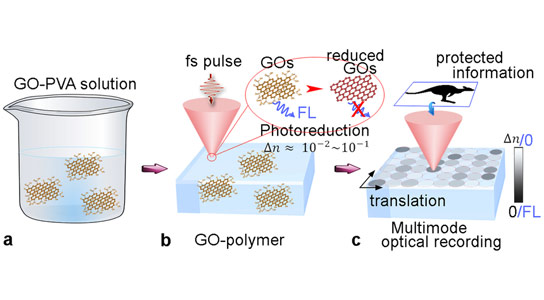
    (a) Mixing GOs with PVA solutions for the preparation of the GO-polymer sample. (b) Illustration of the two-photon reduction induced giant refractive-index modulation and the simultaneous fluorescence (FL) intensity decrease by a fs beam. (c) The giant refractive-index change and FL signals enabled multimode optical recording by laterally translating the sample across the focal plane and controlling the strength of the two-photon reduction. Credit: Xiangping Li, et al., doi:10.1038/srep02819

    By focusing an ultrashort laser beam onto a graphene oxide polymer, researchers have developed a new material for multimode optical recording.

    Swinburne University of Technology researchers have shown the potential of a new material for transforming secure optical information storage.

    In their latest research paper published in Scientific Reports, researchers Xiangping Li, Qiming Zhang, Xi Chen and Professor Min Gu demonstrated the potential to record holographic coding in a graphene oxide polymer composite.

    “Conventionally, information is recorded as binary data in a disc. If the disc is broken, the information cannot be retrieved,” Director of the Center for Micro-Photonics at Swinburne, Professor Min Gu, said.

    “This is a major operation cost in big data centers, which consist of thousands of disc arrays with multiple physical duplicates of data. The new material allows the development of super-discs, which will enable information to be retrieved – even from broken pieces.”

    Graphene oxide is similar to graphene, discovered by Andre Geim and Konstantin Novoselov, who received the 2010 Nobel Prize in Physics for this groundbreaking discovery. Graphene is very strong, light, flexible, nearly transparent, and is an excellent conductor of heat and electricity.

    Graphene oxide has similar properties, but also has a fundamental fluorescent property that can be used in bioimaging and for multimode optical recording.

    By focusing an ultrashort laser beam onto the graphene oxide polymer, the researchers created a 10-100 times increase in the refractive-index of the graphene oxide along with a decrease in its fluorescence. (The refractive index is the measure of the bending of light as it passes through a medium.)

    “The unique feature of the giant refractive-index modulation together with the fluorescent property of the graphene oxide polymer offers a new mechanism for multimode optical recording,” Professor Gu said.

    To demonstrate the feasibility of the mechanism, the researchers encoded the image of a kangaroo in a computer generated hologram. The hologram was then rendered as a three-dimensional recording to the graphene oxide polymer. The encrypted patterns in the hologram could not be seen as a normal microscope image, but could be retrieved in the diffracted mode.

    “The giant refractive index of this material shows promise for merging data storage with holography for security coding,” Professor Gu said.

    “This exciting feature not only boosts the level of storage security, but also helps to reduce the operation costs of big data centers that rely on multiple physical duplicates to avoid data loss.”

    The researchers say it could also revolutionize flat screen TV and solar cell technology.

    “More importantly, graphene has been deemed as a revolutionary replacement for silicon, which is the platform for current information technologies based on electronics,” Dr Xiangping Li said.

    “The giant refractive index we discovered shows the promise of graphene to merge electronics and photonics for the platform of the next generation information technologies.”

    This research has been funded under the Australian Research Council Discovery Project scheme and the Australian Research Council Laureate Fellowship program.

    Reference: “Giant refractive-index modulation by two-photon reduction of fluorescent graphene oxides for multimode optical recording” by Xiangping Li, Qiming Zhang, Xi Chen and Min Gu, 2 October 2013, Scientific Reports.
    DOI: 10.1038/srep02819


    Never miss a breakthrough: Join the SciTechDaily newsletter.
    Follow us on Google and Google News.

    Graphene Materials Science Photonics Swinburne University of Technology
    Share. Facebook Twitter Pinterest LinkedIn Email Reddit

    Related Articles

    Manipulating the Flow of Light in Extreme Ways Using “Magic Angle” Twistronics

    Graphene Photonics Breakthrough Has Potential for Ultrafast Telecommunications

    Researchers Use Graphene in Photodetectors

    A Step Towards 2D Devices, Hybrid Graphene/Hexagonal Boron Nitride

    Controlled Graphene Crumpling Used as Artificial Muscle Actuators

    New 3D Form of Graphene May Lead to Flexible Electronics

    Graphene Membranes May be Used to Filter Water & Biological Samples

    The First All-optical Nanowire Switch

    “Patterned Regrowth” May Lead to Graphene-Based Circuits

    Leave A Reply Cancel Reply

    • Facebook
    • Twitter
    • Pinterest
    • YouTube

    Don't Miss a Discovery

    Subscribe for the Latest in Science & Tech!

    Trending News

    Scientists Discover How Coffee Impacts Memory, Mood, and Gut Health

    Why Did the Neanderthals Disappear? Scientists Reveal Humans Had a Hidden Advantage

    Physicists Propose Strange Experiment Where Time Goes Quantum

    Magnesium Magic: New Drug Melts Fat Even on a High-Fat, High-Sugar Diet

    Weight-Loss Drugs Like Ozempic May Come With an Unexpected Cost

    Mezcal “Worm” in a Bottle Mystery: DNA Testing Reveals a Surprise

    New Research Reveals That Your Morning Coffee Activates an Ancient Longevity Switch

    This Is What Makes You Irresistible to Mosquitoes

    Follow SciTechDaily
    • Facebook
    • Twitter
    • YouTube
    • Pinterest
    • Newsletter
    • RSS
    SciTech News
    • Biology News
    • Chemistry News
    • Earth News
    • Health News
    • Physics News
    • Science News
    • Space News
    • Technology News
    Recent Posts
    • What Happened in Childhood Could Be Causing Your Gut Issues Today
    • Scientists Say This Simple Supplement May Actually Reverse Heart Disease
    • Scientists Just Captured Killer T Cells in Action Inside Tumors
    • Alaska’s Sky Explodes With Swirling Clouds and a Hidden Polar Storm
    • Warming Oceans Could Trigger a Dangerous Methane Surge
    Copyright © 1998 - 2026 SciTechDaily. All Rights Reserved.
    • Science News
    • About
    • Contact
    • Editorial Board
    • Privacy Policy
    • Terms of Use

    Type above and press Enter to search. Press Esc to cancel.