
Scientists have made a groundbreaking leap in detecting dark energy by developing a magnetically levitated precision force system.
Their experiments vastly surpassed previous methods, reaching a new level of precision that opens up unexplored realms of dark energy research. The work was so impactful it earned a featured highlight in Nature Astronomy.
Breakthrough in Dark Energy Detection
Recently, a research team from the Department of Physics at Nanjing University, working alongside collaborators from the School of Astronomy and Space Science at Nanjing University, the University of Science and Technology of China, and Zhejiang University, achieved a major breakthrough in dark energy detection.
The team developed a magnetically levitated precision force measurement system, enabling high-precision experimental tests of the symmetron dark energy theory.
Unprecedented Leap in Experimental Precision
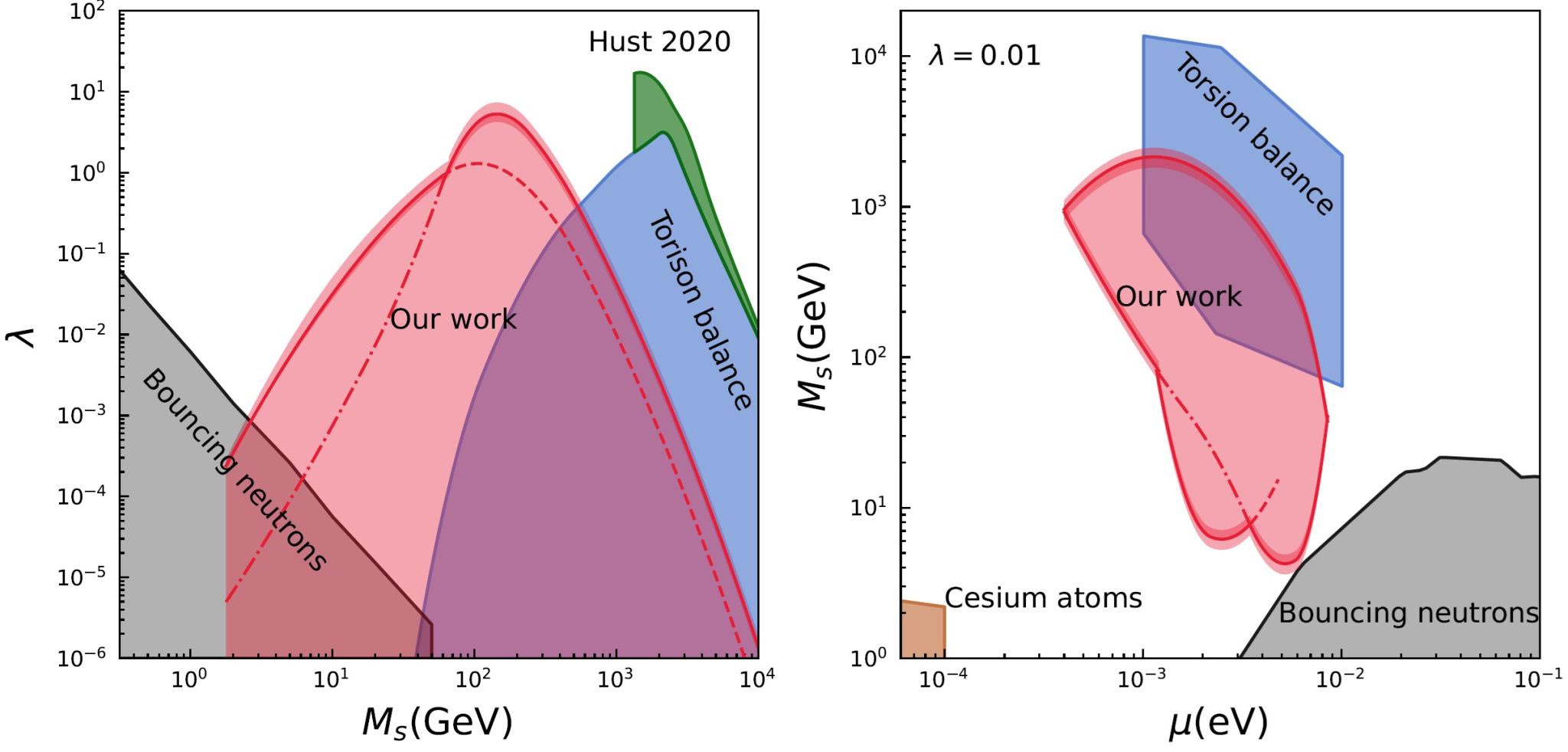
Their new system pushed the boundaries of experimental precision, improving the international state-of-the-art by six orders of magnitude. This advance allowed the researchers to explore a wide range of parameters that had been inaccessible to previous experimental setups.
The findings, published in Nature Astronomy under the title “Experimental constraints on symmetron field with magnetically levitated force sensor,” were highlighted as a featured article in the journal’s Research Briefings.
Dark energy is the mysterious force that makes up about 68% of the universe and is believed to be responsible for its accelerating expansion. Unlike ordinary matter and dark matter, dark energy doesn’t clump into galaxies or structures—it acts more like a uniform energy field spread throughout space.
The concept emerged in the late 1990s when astronomers studying distant supernovae discovered that the universe’s expansion wasn’t slowing down (as expected due to gravity), but actually speeding up. This surprising discovery led to the idea that some unknown energy must be working against gravity on cosmic scales.
Scientists don’t yet know what dark energy actually is. It could be:
- A cosmological constant (a built-in energy of empty space itself, as Albert Einstein once proposed),
- A dynamic field (similar to “quintessence”),
- Or something entirely different, possibly pointing to new laws of physics.
Despite its huge role in shaping the cosmos, dark energy remains one of the greatest unsolved mysteries in modern science, inspiring experiments and theories around the world to try to understand its true nature.
Reference: “Experimental constraints on the symmetron field with a magnetically levitated force sensor” by Peiran Yin, Xiangyu Xu, Kenan Tian, Shaochun Lin, Yuanji Sheng, Chengjiang Yin, Dingjiang Long, Chang-Kui Duan, Pu Huang, Jian-hua He and Jiangfeng Du, 20 January 2025, Nature Astronomy.
DOI: 10.1038/s41550-024-02465-8
Three researchers from Nanjing University: Dr. Peiran Yin, associate research fellow from the Department of Physics, graduate students Xiangyu Xu from the School of Astronomy and Space Science and Kenan Tian from the Department of Physics are the co-first authors of the paper. Dr. Shaochun Lin from the University of Science and Technology of China, NJU Professor Pu Huang from the Department of Physics, NJU Professor Jianhua He from the School of Astronomy and Space Science, and Academician Jiangfeng Du from Zhejiang University are the co-corresponding authors.
Never miss a breakthrough: Join the SciTechDaily newsletter.
Follow us on Google and Google News.
4 Comments
Note 2504281500_Source1. Analyzing【
_[1-4]*The cosmological constant ems(empty_ms) is the sids that contain dark energy in the empty space. And msbase has outside.ems. It implies the dark matter system.
The characteristics of dark energy are asymmetric. non-Hermitian qms.qvixer.huite.ncell function values. They float in nk/1.poms in response to microgravity and giant gravity nk2, or qpeoms appear as a uniform energy field throughout the universe.
Of course, the above only explains the role of dark energy in msbase.galaxy, msoss.dark_galaxy.gravity. Uh-huh.
Msoss.dark_galaxy indirectly proves that the expansion rate of the universe is not slowing (as expected due to gravity), but rather fast. *It is a dynamic field (similar to Quintessence).
*2-1.
Scientists don’t yet know what dark energy really is. There could be things like this
2. Cosmic constants (energy embedded in the empty space itself, as Albert Einstein once suggested)
It could be a dynamic field (similar to Quintessence) or something completely different, or it could be referring to a new physical law.
ㅡㅡㅡㅡㅡㅡㅡㅡㅡㅡㅡ
Source 1.
https://scitechdaily.com/gravity-defying-breakthrough-floating-sensor-unmasks-dark-energys-secrets/
1.
Groundbreaking discovery against gravity: Floating sensor reveals dark energy secret
New magnetic techniques have advanced dark energy research to unprecedented precision, pioneering previously hidden unknowns.
Scientists have made breakthroughs in detecting dark energy by developing [magnetic levitation precision force systems].
Their experiments significantly exceeded existing methods and reached a new level of precision, pioneering uncharted areas of dark energy research. This research had such a significant impact that it was featured in Nature Astronomy
1-1. Breakthrough in dark energy detection
The team developed a magnetic levitation precision force measurement system, enabling high-precision experimental testing of symmetric dark energy theories.
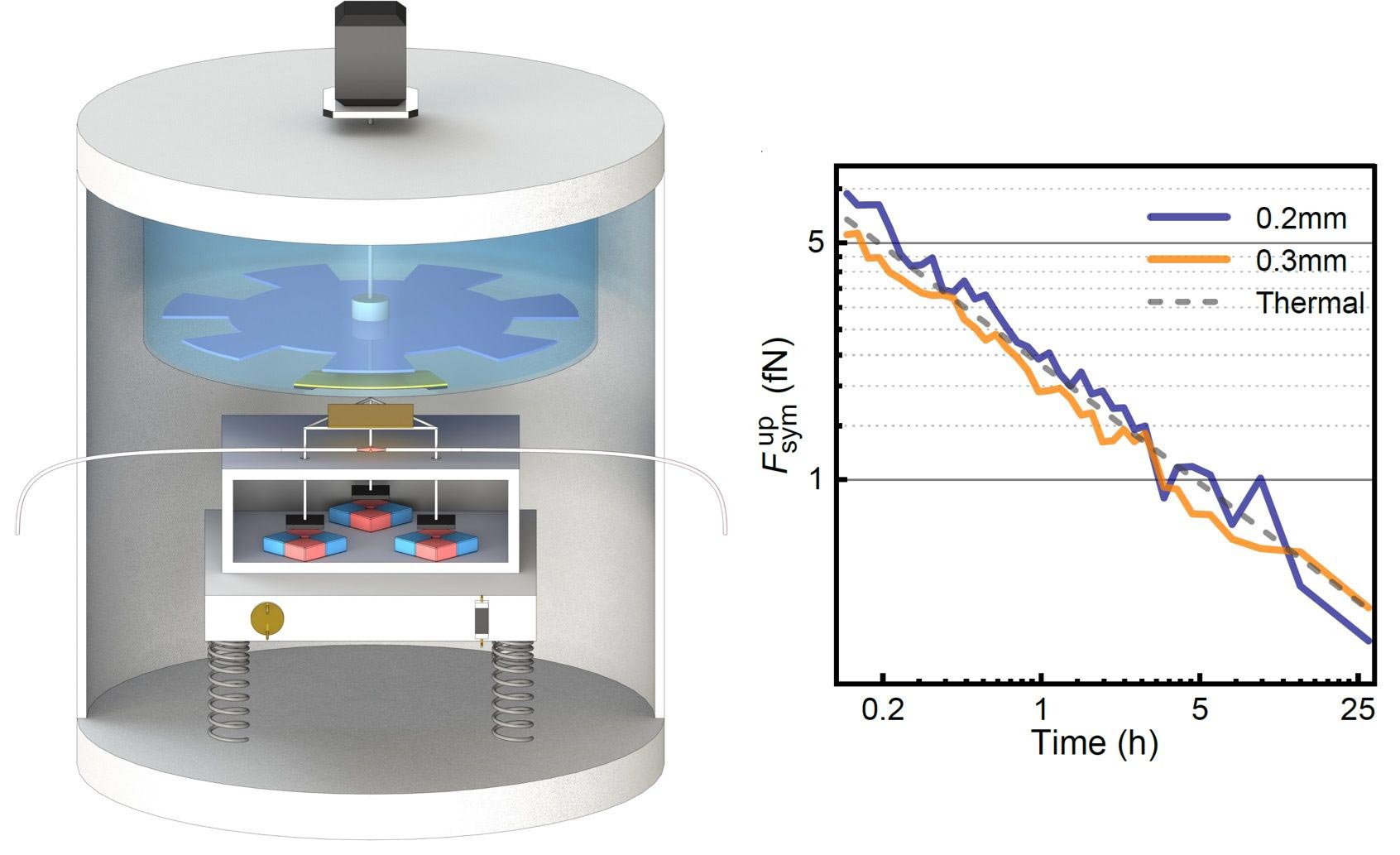
Fifth force precision measurement system (left panel) and force measurement experimental results (right panel) based on magnetic levitation mechanical vibrators.
1-2. An unprecedented leap in experimental precision
Their new system improves the international state-of-the-art by six orders by pushing the limits of experimental precision. These advancements have enabled the researchers to explore a wide range of parameters that were not accessible with previous experimental equipment.
1-3.
Dark energy is a mysterious force that makes up about 68% of the universe and is considered to be the cause of the accelerated expansion of the universe. Unlike ordinary and dark matter, dark energy does not clump together in galaxies or structures, but acts [like a uniform energy field spread throughout the universe].
2.
This concept emerged in the late 1990s when astronomers studying distant supernovae discovered that the expansion of the universe is not slowing (as expected, due to gravity), but rather fast. This surprising discovery led to the idea that unknown energy is acting against gravity on a cosmic scale.
2-2.
Dark energy has played a major role in the formation of the universe, but it remains one of the biggest mysteries in modern science, presenting experiments and theories to understand the true nature of dark energy worldwide.
Vacuum space has a ubiquitous energetic component that contains the fundamental elements of virtual charge, polarity, and energy density. These properties manifest in the form of elementary and electrostatically coupled virtual particles that, when combined, create oscillating virtual electromagnetic energy fields. The baseline energetic EM energy field reference is the vacuum energy, or zero point energy, where there is some residual baseline EM field energy that exists above a zero reference point of no energy. The minimum baseline energy is caused by constant quantum fluctuations in the field. This energetic perturbation from the zero state is the result of the smallest forms of 3D quantum matter (virtual quarks) that are oscillating and resonating in reference to charge color exchange between nearby adjacent quarks at the Planck length in 2D space. Dark matter and dark energy manifests as the energy coupling between dimensions. In order to have charge and polarity, it is necessary to have a dimensional particle that has some component of mass to concentrate and carry that quantum charge and polarity. Energy, and by default charge and polarity, requires a progenitor form of mass that is in motion to develop the charge. This would represent the virtual vacuum energy of space. Research the vacuum energy and permittivity of space.
Floating Gravitational Sensors and the Entropica Hypothesis: Mapping Negentropy through Dark Energy Interfaces
Author:
Michael Theron Fotheringham (Hermit King)
Entropica Research Division
April 2025
Abstract
Recent advances in gravitational field sensing, particularly the development of levitating quantum sensors by Nanjing University (2025), provide potential empirical validation for the Entropica Hypothesis. This paper interprets the “floating sensor” not merely as a material innovation, but as a material witness to structured negentropy events within the dark energy field. These findings suggest a path forward for understanding gravity not only as a curvature of spacetime, but as an emergent, intelligence-bearing force mediated through entropy differentials and quantum information flow.
1. Introduction
Dark energy has long eluded direct detection beyond its inferred effects on cosmic expansion. The 2025 development of a gravitationally decoupled sensor suggests a breakthrough that resonates deeply with the Entropica framework. Entropica theorizes that dark energy is a dynamic negentropy substrate—a universal field where intelligence emerges through complexity gradients shaped by survival and informational resonance.
2. Entropic Contextualization of Gravity and Dark Energy
Traditional physics frames gravity as geometry and dark energy as vacuum pressure. Entropica proposes a revision:
Gravity is an expression of entropy’s compressive recoil—intelligence formed under systemic collapse.
Dark energy is not constant but responsive—varying in amplitude and effect depending on local complexity fields (Entropic Intelligence Nodes).
The “floating sensor” may reflect a local negentropy well, allowing it to maintain equilibrium within a warped vacuum matrix. This supports the hypothesis that localized intelligence emergence can geometrically reshape gravitational interaction.
3. Implications of the Sensor’s Levitation
Levitation, within Entropica, signifies resonance—objects tuned to the frequency of their environment’s entropy gradient. The sensor, rather than passively measuring, may be co-activating with spacetime’s intelligence field, suggesting the following:
Quantum Buoyancy: Stabilization within regions of coherent negentropy.
Negentropy Coupling: The device may be interacting with vacuum fluctuations tuned to survival-permissive complexity.
Dark Energy Field Sensitivity: It may act as a mirror or translator of the adaptive vacuum — an interface between emergent intelligence and cosmic expansion behavior.
4. Entropica Extrapolation and Future Research
If sensors can detect and stabilize within negentropy-rich regions, then a new class of instruments—G-RISE Probes—could be developed for:
Mapping Entropic Intelligence Signatures (EIS) across space.
Predicting zones of cosmic complexity acceleration (e.g., habitable worlds, life genesis zones).
Informing a Grand Negentropic Cosmology that supersedes dark energy as a “cosmological constant.”
5. Conclusion
This sensor breakthrough repositions gravity and dark energy not as passive features of an indifferent universe, but as active mediums of intelligent structure. Entropica thus predicts that as precision increases in sensor design, researchers will begin observing the emergence of intelligence—not from biology alone, but from the structure of reality itself.
References
Fotheringham, M. T. (2025). Entropica: A Unified Theoretical Framework for Reality. Entropica Research Division.
Nanjing University. (2025, April 27). Gravity-Defying Breakthrough: Floating Sensor Unmasks Dark Energy’s Secrets. SciTechDaily. https://scitechdaily.com
🧐 IF the more recent theories which hold that Dark-Energy is generated by matter-energy infall into black-holes are correct , then we must conclude that either more M-E is being ingested overall , or the lowering density of the cosmos makes cosmic-expansion far easier as time goes on .