
Close Menu
    Facebook X (Twitter) Instagram
    SciTechDaily
    • Biology
    • Chemistry
    • Earth
    • Health
    • Physics
    • Science
    • Space
    • Technology
    Facebook X (Twitter) Pinterest YouTube RSS
    SciTechDaily
    Home»Space»Gravity-Dominated Hit and Run Collisions in Solar System Formation
    Space

    Gravity-Dominated Hit and Run Collisions in Solar System Formation

    By NASA AstrobiologyApril 4, 2020No Comments2 Mins Read
    Facebook Twitter Pinterest Telegram LinkedIn WhatsApp Email Reddit
    Share
    Facebook Twitter LinkedIn Pinterest Telegram Email Reddit
    Planetary Collision
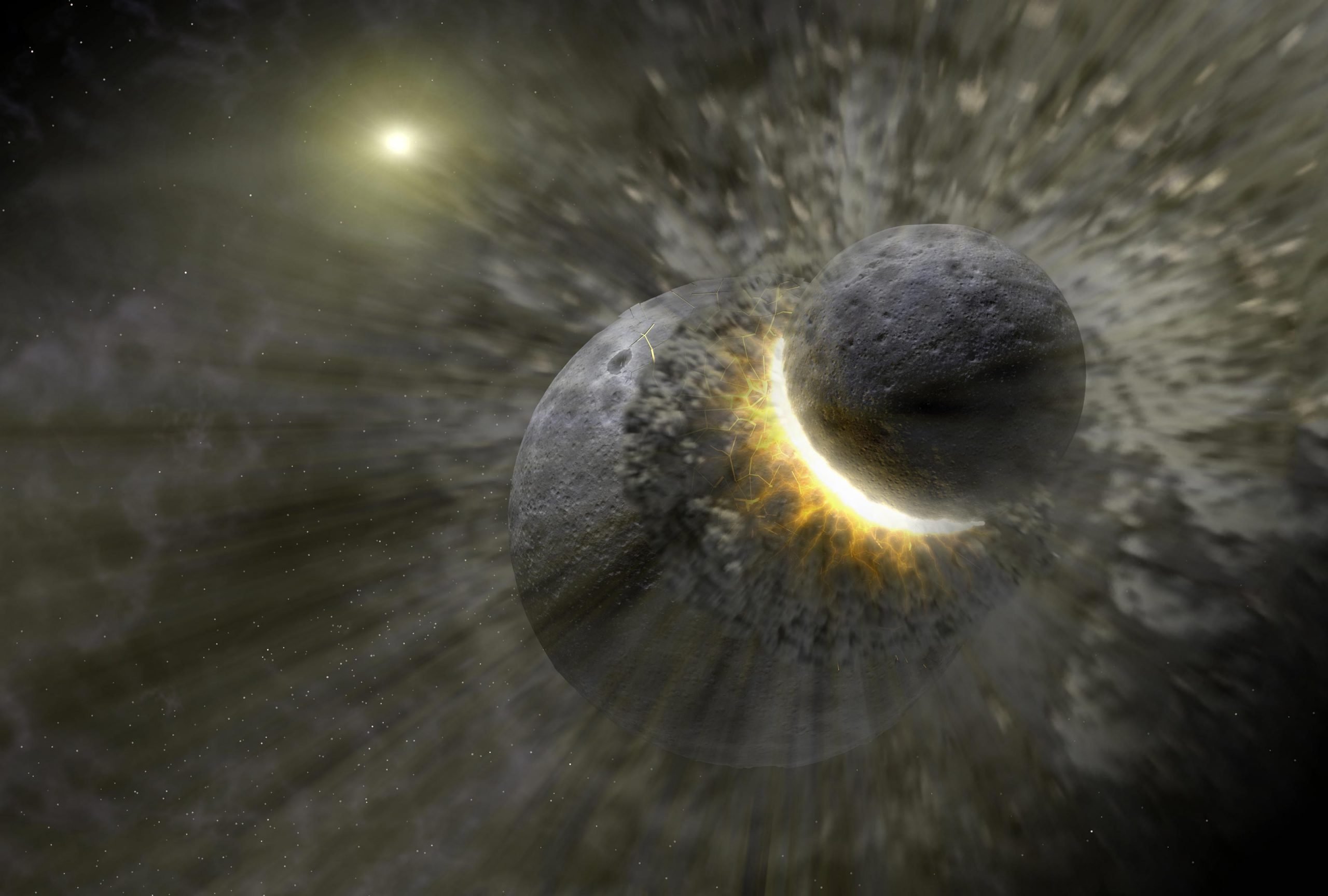
    Illustration of a planetary collision. Credit: NASA

    Researchers supported in part by the NASA Astrobiology program are providing new insight into the late stages of solar system formation. The team developed empirical relationships to understand the processes behind accretion and erosion when large planetary bodies of varying compositions collide – including bodies that are rich in water. The study also focuses on the fine line between collisions where two bodies merge together, and those that result in a ‘hit-and-run’ scenario.

    The results indicate that hit-and-run collisions occur across a wider range of impact angles than previously thought. The team provides an algorithm for incorporating their model into N-body planet formation simulations.

    The study, “Gravity-dominated Collisions: A Model for the Largest Remnant Masses with Treatment for “Hit and Run” and Density Stratification,” was published in The Astrophysical Journal.

    The work was supported by the Nexus for Exoplanet System Science (NExSS).  NExSS is a NASA  research coordination network supported in part by the  NASA Astrobiology Program. This program element is shared between NASA’s Planetary Science Division (PSD) and the Astrophysics Division. This research is a critical part of NASA’s work to understand the Universe, advance human exploration, and inspire the next generation. As NASA’s Artemis program moves forward with human exploration of the Moon, the search for life on other worlds remains a top priority for the agency.

    Reference: “Gravity-dominated Collisions: A Model for the Largest Remnant Masses with Treatment for “Hit and Run” and Density Stratification” by Travis S. J. Gabriel, Alan P. Jackson, Erik Asphaug, Andreas Reufer, Martin Jutzi and Willy Benz, 24 March 2020, The Astrophysical Journal.
    DOI: 10.3847/1538-4357/ab528d

    Never miss a breakthrough: Join the SciTechDaily newsletter.
    Follow us on Google and Google News.

    Astrobiology Astronomy NASA Popular
    Share. Facebook Twitter Pinterest LinkedIn Email Reddit

    Related Articles

    Titan’s Hidden Ocean May Not Exist and That Changes Everything

    Webb’s Ethanol Discovery Fuels Search for Alien Life

    Life Beyond Our Solar System: NASA Finds Icy Exoplanets May Have Habitable Oceans and Geysers

    How Earth Climate Models Help NASA Scientists Picture Life on Unimaginable Worlds

    Inner Complexity of Saturn’s Moon Enceladus Revealed – Hints at Habitable Conditions

    “They’re out There” – Exoplanet Axis Study Boosts Hopes of Complex Life

    New Modeling Reveals that Tilted Orbits Could Make More Worlds Habitable

    Scientists Discover Evidence of Water in Martian Meteorite

    “Habitable Zone” Might Help Extreme Life Forms Survive on Exoplanets

    Leave A Reply Cancel Reply

    • Facebook
    • Twitter
    • Pinterest
    • YouTube

    Don't Miss a Discovery

    Subscribe for the Latest in Science & Tech!

    Trending News

    Why Popular Diabetes Drugs Like Ozempic Don’t Work for Everyone: The “Genetic Glitch”

    Scientists Stunned After Finding Plant Thought Extinct for 60 Years

    Scientists Discover Tiny New Spider That Hunts Prey 6x Its Size

    Natural Component From Licorice Shows Promise for Treating Inflammatory Bowel Disease

    Scientists Warn: Popular Sweetener Linked to Dangerous Metabolic Effects

    Monster Storms on Jupiter Unleash Lightning Beyond Anything on Earth

    Scientists Create “Liquid Gears” That Spin Without Touching

    The Simple Habit That Could Help Prevent Cancer

    Follow SciTechDaily
    • Facebook
    • Twitter
    • YouTube
    • Pinterest
    • Newsletter
    • RSS
    SciTech News
    • Biology News
    • Chemistry News
    • Earth News
    • Health News
    • Physics News
    • Science News
    • Space News
    • Technology News
    Recent Posts
    • Pomegranate Compound Could Help Protect Against Heart Disease
    • Your Blood Test Might Already Show Alzheimer’s Risk
    • Common Pregnancy Medications Linked to Higher Autism Risk in Massive U.S. Study
    • Scientists Teach AI To Think Like a Professional Chemist
    • Scientists Were Wrong About This Strange “Rule-Breaking” Particle
    Copyright © 1998 - 2026 SciTechDaily. All Rights Reserved.
    • Science News
    • About
    • Contact
    • Editorial Board
    • Privacy Policy
    • Terms of Use

    Type above and press Enter to search. Press Esc to cancel.