
Extreme stars may possess mountains similar to those found on moons in our solar system, potentially creating detectable oscillations in space and time.
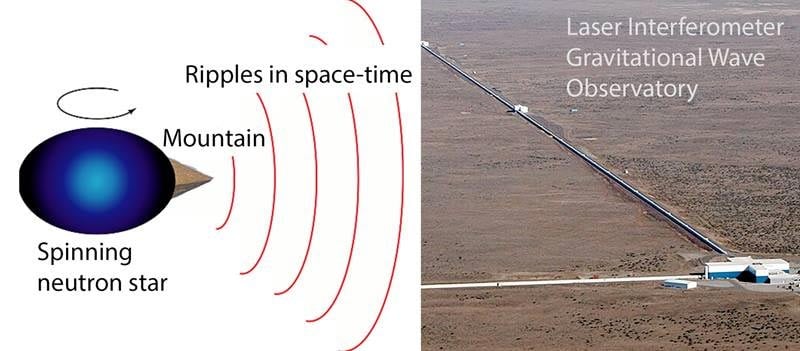
Neutron stars may have mountain-like structures that impact their rotational speeds and can emit continuous gravitational waves, observable by LIGO. By studying analogous surface features on moons and planets, scientists can predict and search for these signals, opening new insights into the universe’s densest objects and the laws governing them.
Neutron Star Mountains
Neutron stars, the remnants of collapsed stars, are extraordinarily dense—about a trillion times denser than lead. Despite their significance, little is known about their surface features. Drawing parallels from mountain-building mechanisms observed on moons and planets in our solar system, researchers suggest that neutron stars could have “mountains.”
These mountains, far more massive than any on Earth, would generate immense gravitational forces capable of producing small ripples in the fabric of space and time. These ripples, known as gravitational waves, are now being sought by the Laser Interferometer Gravitational Wave Observatory (LIGO).
Searching for Space-Time Oscillations
The study of these neutron star mountains plays a key role in the search for continuous gravitational waves, which are faint and require highly sensitive, precisely calibrated detection methods. Detecting these waves for the first time would not only provide groundbreaking insights into the structure and behavior of neutron stars—among the densest objects in the universe short of black holes—but also offer a new way to test fundamental physical laws. Such discoveries could reshape our understanding of the universe and the forces that govern it.
Analogies With Solar System Bodies
Mountains or non-axisymmetric deformations of rotating neutron stars efficiently radiate gravitational waves. Nuclear theorists at Indiana University considered analogies between neutron star mountains and surface features of solar system bodies. Both neutron stars and certain moons such as Jupiter’s moon Europa or Saturn’s moon Enceladus have thin crusts over deep oceans, while Mercury has a thin crust over a large metallic core. Thin sheets may wrinkle in universal ways. Europa has linear features, Enceladus has tiger-like stripes, and Mercury has curved, step-like structures.
Implications for Neutron Star Research
Neutron stars with mountains may have analogous types of surface features that could be discovered by observing continuous gravitational wave signals. The innermost inner core of the Earth is anisotropic with a shear modulus that depends on direction. If neutron star crust material is also anisotropic, a mountain-like deformation will result, and its height will increase as the star spins faster. Such a surface feature could explain the maximum spin observed for neutron stars and a possible minimum deformation of radio-emitting neutron stars known as millisecond pulsars.
Reference: “Anisotropic neutron star crust, solar system mountains, and gravitational waves” by J. A. Morales and C. J. Horowitz, 5 August 2024, Physical Review D.
DOI: 10.1103/PhysRevD.110.044016
This research was primarily funded by the Department of Energy Office of Science, Nuclear Physics program. Additional funding was provided by the National Science Foundation.
Never miss a breakthrough: Join the SciTechDaily newsletter.
Follow us on Google and Google News.
1 Comment
It might helpful to readers to understand that a mountain on a neutron star is dramatically smaller than a mountain on a planet or moon… measured in millimeters?
I have not seen the latest… so I am curious. It sounds like a rapidly spinning neutron star could sustain taller mountains, but hard to see them taller than a few feet….