
Close Menu
    Facebook X (Twitter) Instagram
    SciTechDaily
    • Biology
    • Chemistry
    • Earth
    • Health
    • Physics
    • Science
    • Space
    • Technology
    Facebook X (Twitter) Pinterest YouTube RSS
    SciTechDaily
    Home»Technology»Harnessing the Sea’s Hidden Energy: New Nano-Device Turns Seawater Into Electricity
    Technology

    Harnessing the Sea’s Hidden Energy: New Nano-Device Turns Seawater Into Electricity

    By University of Illinois Grainger College of EngineeringNovember 23, 20232 Comments3 Mins Read
    Facebook Twitter Pinterest Telegram LinkedIn WhatsApp Email Reddit
    Share
    Facebook Twitter LinkedIn Pinterest Telegram Email Reddit
    Electricity Energy Harvesting Concept
    A novel nanodevice developed by the University of Illinois Urbana-Champaign team can generate electricity from the salinity differences between seawater and freshwater, showing potential for scalable power generation and applications in various fields.

    The world’s coastlines harbor a largely untapped energy source: the salinity difference between seawater and freshwater. A new nanodevice can harness this difference to generate power.

    A team of researchers at the University of Illinois Urbana-Champaign has reported a design for a nanofluidic device capable of converting ionic flow into usable electric power in the journal Nano Energy. The team believes that their device could be used to extract power from the natural ionic flows at seawater-freshwater boundaries.

    Concept and Potential Applications

    “While our design is still a concept at this stage, it is quite versatile and already shows strong potential for energy applications,” said Jean-Pierre Leburton, a U. of I. professor of electrical & computer engineering and the project lead. “It began with an academic question – ‘Can a nanoscale solid-state device extract energy from ionic flow?’ – but our design exceeded our expectations and surprised us in many ways.”
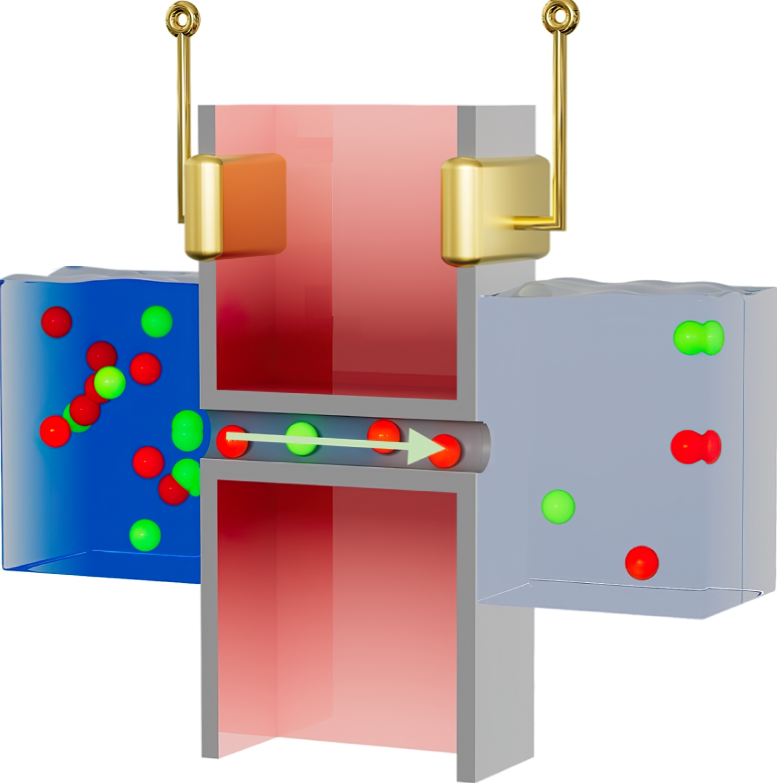
    Nanofluidic Device Generates Power With Saltwater
    Nanofluidic device generates power with saltwater graphic. Credit: The Grainger College of Engineering at University of Illinois Urbana-Champaign

    When two bodies of water with different salinity meet, such as where a river empties into an ocean, salt molecules naturally flow from higher concentration to lower concentration. The energy of these flows can be harvested because they consist of electrically charged particles called ions that form from the dissolved salt.

    Nanoscale Semiconductor Device

    Leburton’s group designed a nanoscale semiconductor device that takes advantage of a phenomenon called “Coulomb drag” between flowing ions and electric charges in the device. When the ions flow through a narrow channel in the device, electric forces cause the device charges to move from one side to the other creating voltage and electric current.

    The researchers found two surprising behaviors when they simulated their device. First, while they expected that Coulomb drag would primarily occur through the attractive force between opposite electric charges, the simulations indicated that the device works equally well if the electric forces are repulsive. Both positively and negatively charged ions contribute to drag.

    “Just as noteworthy, our study indicates that there is an amplification effect,” said Mingye Xiong, a graduate student in Leburton’s group and the study’s lead author. “Since the moving ions are so massive compared to the device charges, the ions impart large amounts of momentum to the charges, amplifying the underlying current.”

    Device’s Versatility and Material Independence

    The researchers also found that these effects are independent of the specific channel configuration as well as the choice of materials, provided the channel diameter is narrow enough to ensure proximity between the ions and the charges.

    The researchers are in the process of patenting their findings, and they are studying how arrays of these devices could scale for practical power generation.

    “We believe that the power density of a device array could meet or exceed that of solar cells,” Leburton said. “And that’s not to mention the potential applications in other fields like biomedical sensing and nanofluidics.”

    Reference: “Ionic coulomb drag in nanofluidic semiconductor channels for energy harvest” by Mingye Xiong, Kewei Song and Jean-Pierre Leburton, 3 September 2023, Nano Energy.
    DOI: 10.1016/j.nanoen.2023.108860

    Never miss a breakthrough: Join the SciTechDaily newsletter.
    Follow us on Google and Google News.

    Energy Engineering Seawater University of Illinois at Urbana-Champaign Water
    Share. Facebook Twitter Pinterest LinkedIn Email Reddit

    Related Articles

    New MIT Device Can Harvest Water From Desert Air

    No More Blackouts? New Framework Guarantees the Stability of Microgrids

    New Aluminum Batteries Increase the Range of UUVs Tenfold

    MIT Engineers Look Toward All-Solid Lithium Batteries

    Engineers Design Calcium-Based Multi-Element for Liquid Batteries

    Sustainable Power Sources Based on High Efficiency Thermopower Wave Devices

    New Material Can Store Solar Energy During the Day and Release it Later as Heat

    Thermal-Imaging Quickly Tracks Energy Leaks in Homes and Buildings

    Power Conserving Chip May Increase Smartphone Battery Life

    2 Comments

    1. allan on November 24, 2023 8:25 am

      For any alleged new energy source, it is mostly meaningless to write about it without estimating the amount of power that might be produced (joules) and the potential size of the mechanism. Who cares if it ends up being a few milliwatts per sq. meter per hour.

      Reply
    2. Chris Cha on November 24, 2023 8:40 pm

      Will that intervention screw up the creation of fresh water supply for our planet?

      Reply
    Leave A Reply Cancel Reply

    • Facebook
    • Twitter
    • Pinterest
    • YouTube

    Don't Miss a Discovery

    Subscribe for the Latest in Science & Tech!

    Trending News

    New “Nanozyme Hypothesis” Could Rewrite the Story of Life’s Origins

    Anatomy Isn’t Finished: The Human Body Still Holds Secrets

    “Pretty Close to Home”: The Hidden Earthquake Threat Beneath Seattle

    The Surprising Reason You Might Want To Sleep Without a Pillow

    Scientists Say This Natural Hormone Reverses Obesity by Targeting the Brain

    35-Million-Year-Old Mystery: Strange Arachnid Discovered Preserved in Amber

    Is AI Really Just a Tool? It Could Be Altering How You See Reality

    JWST Reveals a “Forbidden” Planet With a Baffling Composition

    Follow SciTechDaily
    • Facebook
    • Twitter
    • YouTube
    • Pinterest
    • Newsletter
    • RSS
    SciTech News
    • Biology News
    • Chemistry News
    • Earth News
    • Health News
    • Physics News
    • Science News
    • Space News
    • Technology News
    Recent Posts
    • These New Molecules Could Change How We Treat Lupus and Arthritis
    • Saunas May Do More Than Raise Body Temperature – They Activate Your Immune System
    • Exercise in a Pill? Metformin Shows Surprising Effects in Cancer Patients
    • Saturn’s Magnetic Shield Isn’t What Scientists Expected
    • Hidden Oceans of Magma Could Be Protecting Alien Life
    Copyright © 1998 - 2026 SciTechDaily. All Rights Reserved.
    • Science News
    • About
    • Contact
    • Editorial Board
    • Privacy Policy
    • Terms of Use

    Type above and press Enter to search. Press Esc to cancel.