
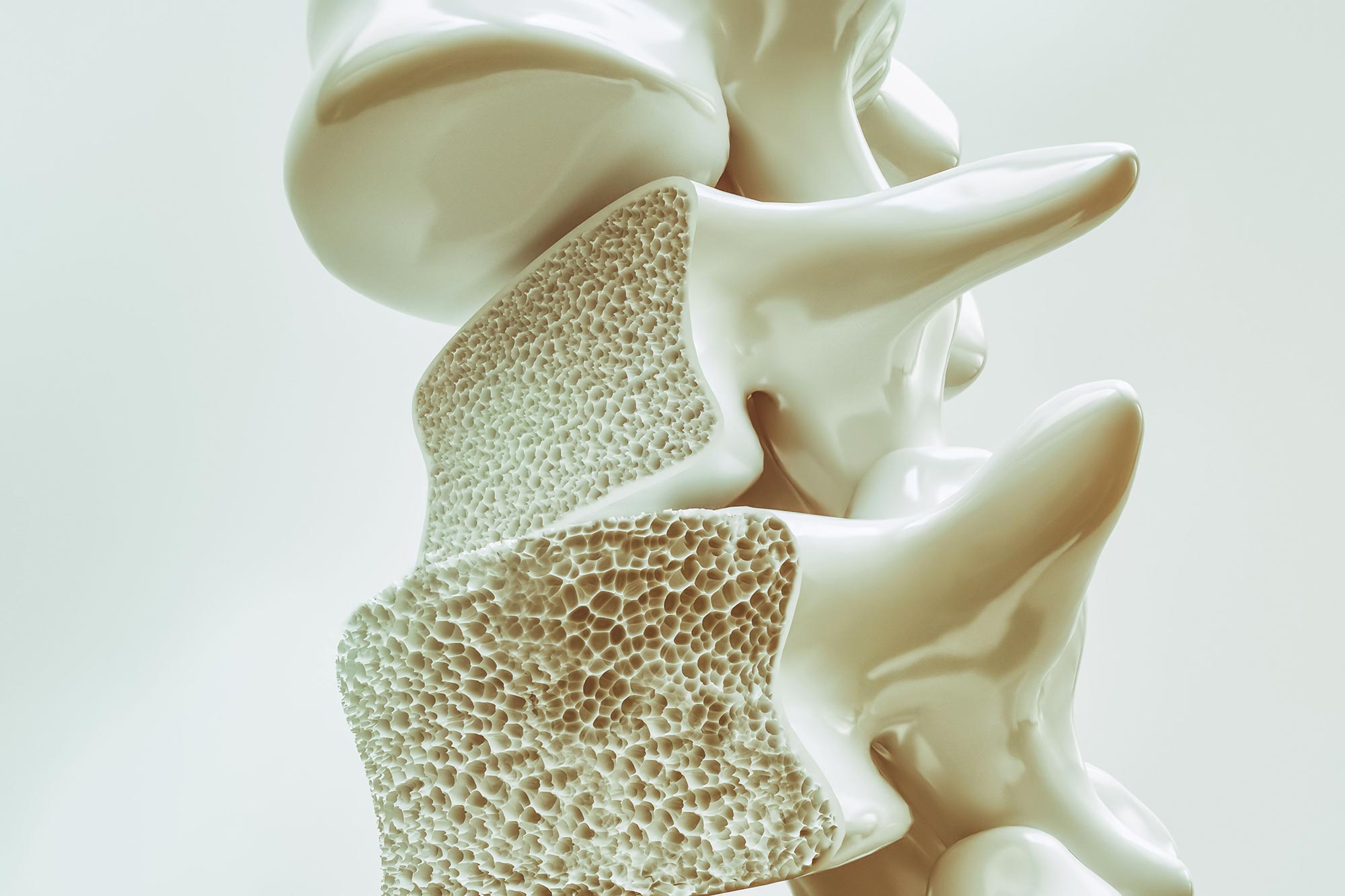
Researchers have found that age-related bone loss occurs independently of the gut microbiome, challenging previous beliefs and steering future osteoporosis treatments away from microbial solutions.
A study by Harvard Medical School demonstrated that bone deterioration in mice was consistent regardless of their microbiome status, suggesting that other genetic, hormonal, or environmental factors may be more significant in managing bone health.
Bone Health and Microbiome
Age-related bone loss happens independently of the gut microbiome, a surprising discovery that upends previous beliefs. Researchers studied bone health in both germ-free and microbiome-colonized mice and found that gut bacteria have little influence on bone deterioration with age. This breakthrough may pave the way for new directions in osteoporosis treatment.
Current Challenges in Osteoporosis Treatment
Osteoporosis is a significant global health issue, especially among older adults. While pharmacological treatments exist, they often come with side effects, high costs, and accessibility challenges, leading many patients to discontinue use. Recently, the gut microbiome has been spotlighted for its possible role in bone metabolism. However, aging complicates the microbiome’s stability and its effects on health, highlighting the need to explore other factors driving bone loss. To address this, researchers focused on uncovering non-microbial contributors to age-related bone deterioration.
A collaborative study led by Harvard Medical School, published in Bone Research on November 8, 2024, tackled this question. Using advanced genetic sequencing and metabolomic tools, scientists examined bone health in CB6F1 mice under germ-free and microbiome-colonized conditions to assess the microbiome’s impact on bone loss during aging.

Key Findings on Microbiome and Bone Health
The study revealed that bone loss in germ-free mice mirrored that of their microbiome-colonized counterparts, debunking the belief that gut microbes significantly influence age-related bone deterioration. Over 21 months, both groups exhibited comparable declines in trabecular bone volume and cortical thickness, underscoring that bone loss occurs independently of gut microbiota. Although age-related shifts in microbial composition and function were observed—such as increased amino acid and protein biosynthesis—these changes did not affect bone health. Even microbiota transplants from young or old donors into germ-free mice had no discernible impact, regardless of donor age or colonization duration. These findings redirect attention to other biological pathways as potential drivers of osteoporosis.
Implications for Future Osteoporosis Treatments
Dr. Xiaomeng You, lead researcher, remarked, “This study overturns long-standing beliefs about the gut microbiome’s role in age-related bone loss. By refocusing on other mechanisms, we aim to open new pathways for effective osteoporosis treatments.” The team highlighted the microbiome’s influence on other health aspects but emphasized its limited role in bone health during aging.
These results pave the way for rethinking osteoporosis interventions, suggesting that genetic, hormonal, or environmental factors may hold greater significance. Future research could leverage these insights to develop innovative therapies, ultimately improving care for aging populations. While the microbiome remains a crucial research frontier, this study underscores the importance of broadening the lens to fully understand bone health.
Reference: “Bone loss with aging is independent of gut microbiome in mice” by Xiaomeng You, Jing Yan, Jeremy Herzog, Sabah Nobakhti, Ross Campbell, Allison Hoke, Rasha Hammamieh, R. Balfour Sartor, Sandra Shefelbine, Melissa A. Kacena, Nabarun Chakraborty and Julia F. Charles, 11 November 2024, Bone Research.
DOI: 10.1038/s41413-024-00366-0
This work was supported by NIH grants R01 AG046257 (JFC), the Orthopaedic Scholar Fund, the Department of Orthopaedic Surgery, Brigham and Women’s Hospital, P30 AR075042 and the Joint Biology Consortium funded by P30-AR070253. Gnotobiotic studies were performed at National Gnotobiotic Rodent Resource Center at University of North Carolina at Chapel Hill, funded by P40-OD010995, P30-DK034987, and Crohn’s and Colitis Foundation.
Never miss a breakthrough: Join the SciTechDaily newsletter.
Follow us on Google and Google News.
9 Comments
So im taking vit D +calcium 2xday after removal of 1 parathyroid removal.
Plus have a prolia injection twice yearly.
Plus I have RA
Plus I have TMAU small intestine problem.
I am 69
Fingers crossed no b.bones.)
Be careful, Sherrie, not to inadvertently cause yourself a very serious phosphorus deficiency by taking too much calcium carbonate as a supplement. It’s known to bind with phosphorus and be excreted by the kidneys. I learned the hard way. More details on the “About” page of my video channel: (https://odysee.com/@charlesgshaver:d?view=about). Have a great new year.
I have never heard of any functional medicine Dr. or any of the periodicals about health that I read mention the microbiome as having any effect on bone strength or density. What does is nutrition and weight bearing exercise. If your gut isn’t affecting your absorption of key nutrients in the amount needed to keep bones strong then it is a non-issue. Diet high in the nutrients to support bone health & density and the right type of exercise are the only things I have ever heard about in the discussion about bone health. Gut health is a none issue, unless through nutritional profile your blood work shows a deficiency in a nutrient needed for bone health and a persons diet indicates that they should not be deficient would you look into the causes inhibiting the absorption and ability to use those nutrients.
I’ve had Graves disease. So I take a weekly Vit D pill. I have high calcium levels in my blood. So I don’t supplement. My bones seem strong & at 74, so far no joint pain. I do have other age/thyroid related issues; hair loss, dry skin & fatigue. Really interested in weight bearing exercise & stretching.
Vit k to direct calcium to bones
Having hyperparathyroidism under sensipar treatment
PTH level under 50
Can I discontinue taking the meds?
There’s danger in the wording of the title and text of a misapprehension of the role the microbiome in mice and the potential for treatment with microbiome-modifying protocols for h u m a n s . The paper itself is careful to leave the latter open, as its purpose is not to debunk any such understanding. Eg.
“Moreover, in various preclinical models, it has been shown that bone loss resulting from sex steroid deficiency, glucocorticoid treatments and continuous PTH treatments is microbiome-dependent. Supplementation with probiotics (e.g Lactobacillus) prevented impaired bone growth due to chronic undernutrition, and exhibit beneficial effects on the bone loss induced by antibiotics, as well as in several preclinical osteoporosis models. These findings clearly suggest an important role of the gut microbiome in regulating bone mass, bone quality, and bone strength. Thus, the gut microbiome is emerging as a promising target for the prevention and treatment of age-related bone loss and osteoporosis.”
I have oestopenia and my doctor insists on continue giving me Prolia injections twice a year. I am very hesitant in continuing them for I noticed I have been having hair loss.
Bones are 40% protein with minerals embedded. People tend to get too little protein in their diet. Vitamins D3 and K2 are critical as well.