
Close Menu
    Facebook X (Twitter) Instagram
    SciTechDaily
    • Biology
    • Chemistry
    • Earth
    • Health
    • Physics
    • Science
    • Space
    • Technology
    Facebook X (Twitter) Pinterest YouTube RSS
    SciTechDaily
    Home»Physics»Helium Bath Splash: Physicists Discover Surprising Phenomenon
    Physics

    Helium Bath Splash: Physicists Discover Surprising Phenomenon

    By University of InnsbruckJanuary 5, 2022No Comments3 Mins Read
    Facebook Twitter Pinterest Telegram LinkedIn WhatsApp Email Reddit
    Share
    Facebook Twitter LinkedIn Pinterest Telegram Email Reddit
    Helium Nanodroplet Ions
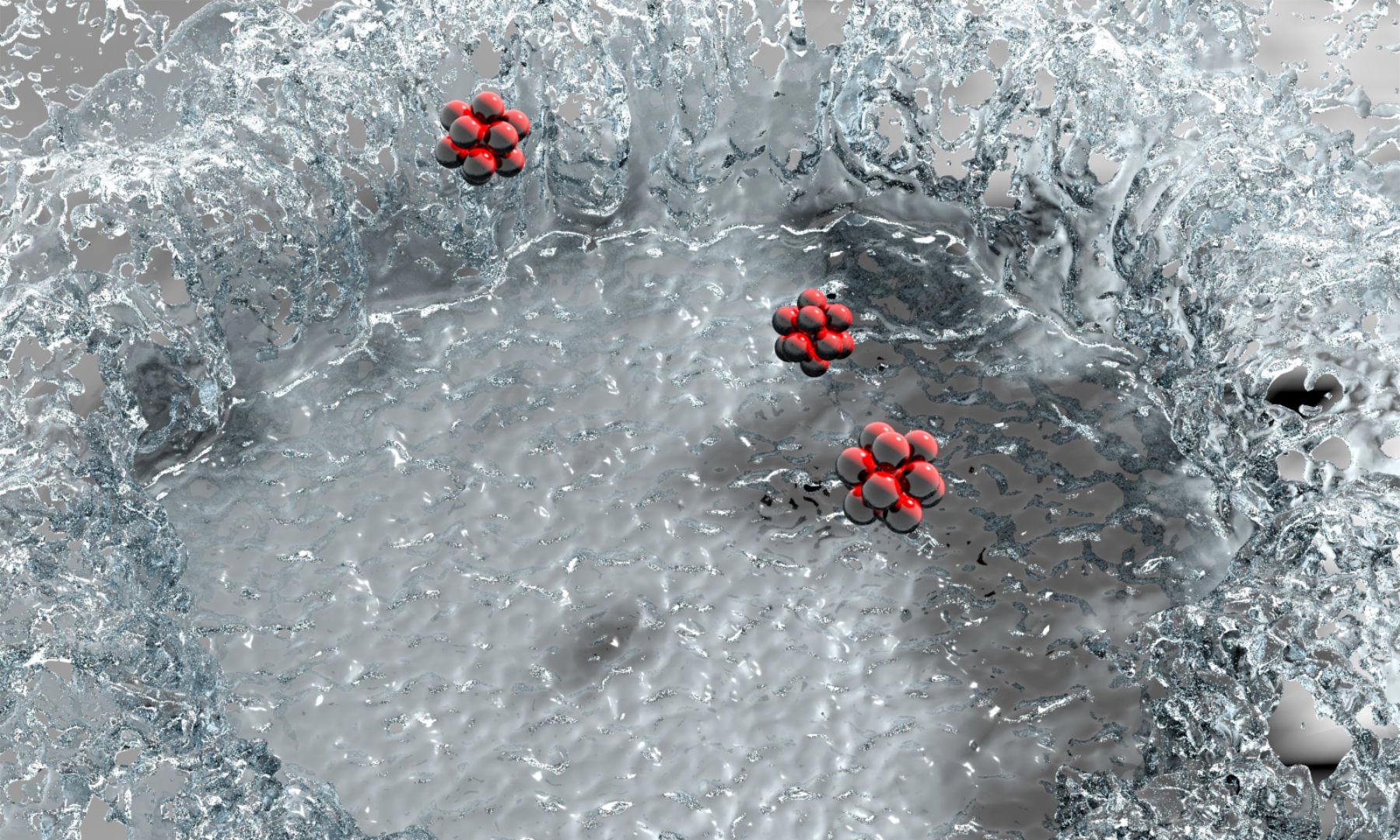
    Ions packed in a helium nanodroplet remain protected on impact. Credit: Uni Innsbruck

    While working with helium nanodroplets, scientists have come across a surprising phenomenon: When the ultracold droplets hit a hard surface, they behave like drops of water. Ions with which they were previously doped thus remain protected on impact and are not neutralized.

    At the University of Innsbruck Department of Ion Physics and Applied Physics, Paul Scheier’s research group has been using helium nanodroplets to study ions with methods of mass spectrometry for around 15 years. Using a supersonic nozzle, tiny, superfluid helium nanodroplets can be produced with temperatures of less than one degree Kelvin (-458 degrees Fahrenheit). They can very effectively be doped with atoms and molecules. In the case of ionized droplets, the particles of interest are attached to the charges, which are then measured in the mass spectrometer.

    During their experiments, the scientists have now stumbled upon an interesting phenomenon that has fundamentally changed their work. “For us, this was a gamechanger,” says Fabio Zappa from the nano-bio-physics team. “Everything at our lab is now done with this newly discovered method.” The researchers have now published the results of their studies in Physical Review Letters.

    A Surprising Phenomenon

    When charged particles are fired at a metal plate, the particles are normally neutralized by the many free electrons on the metal surface. They can then no longer be measured in the mass spectrometer. But when the ions are packed in a helium nanodroplet, they remain protected on impact and fly off in all directions with a few weakly bound helium atoms.

    “The ions are apparently protected by the helium,” Zappa says.

    He doesn’t yet fully understand the underlying mechanism. “But there is some evidence that the helium loses its superfluid property before impact and then behaves like a liquid, splashing away from the surface and only then partially evaporates.”

    Another possible reason could be that the first droplets evaporate at the surface, forming a layer of gas that slows down subsequent droplets and, in this way protects them from evaporation. Only further investigations will show if one of these explanations is correct or if there are other reasons. The fact that this method also works with negative ions, which are normally very fragile, indicates to the scientists a strong effect of the previously unknown phenomenon.

    Nanotechnology Benefits

    With this discovery, Paul Scheier’s team not only improved their own measurement method, but also gained important insights for other research groups that, for example, deal with the deposition of nanoparticles on surfaces.

    “Metal nanoparticles are a great example of this,” Scheier recounts. “In many modern technologies, metal nanoparticles are found that have very specific properties.” The fact that the generation of such nanofilms can often be very inefficient could also be related to the phenomenon now discovered in Innsbruck.

    Reference: “Splashing of Large Helium Nanodroplets upon Surface Collisions” by Paul Martini, Simon Albertini, Felix Laimer, Miriam Meyer, Michael Gatchell, Olof Echt, Fabio Zappa and Paul Scheier, 23 October 2021, Physical Review Letters.
    DOI: 10.1103/PhysRevLett.127.263401

    The work was financially supported, among others, by the Austrian Science Fund FWF and the province of Tyrol within the framework of a K-Regio project.

    Never miss a breakthrough: Join the SciTechDaily newsletter.
    Follow us on Google and Google News.

    Helium Nanotechnology University of Innsbruck
    Share. Facebook Twitter Pinterest LinkedIn Email Reddit

    Related Articles

    Exploring Nanotube Growth and a Self-Healing Mechanism

    Scientists Switch On and Off Magnetism Using Quantum Mechanics

    Physicists Realize New Quasiparticle in Ultracold Quantum Gas

    Physicists Create a Condensate of Erbium

    New Nanofabrication Process for Metamaterials

    Researchers Explain Mysterious Nanoscale Crop Circles

    Researchers Discover Electrical Switch for Magnetic Current

    Researchers Create Electron Vortex Beams Inside Electron Microscopes

    Two-Dimensional Polymers Created for the First Time

    Leave A Reply Cancel Reply

    • Facebook
    • Twitter
    • Pinterest
    • YouTube

    Don't Miss a Discovery

    Subscribe for the Latest in Science & Tech!

    Trending News

    Could Low Vitamin D Be Making Your Pain Worse?

    Scientists Discover Once-Weekly Workout That Melts Belly Fat Surprisingly Effectively

    Scientists Just Tested a Thruster Powerful Enough for Human Missions to Mars

    Doctors Say Your Ice Pack Might Be Making Injuries Worse

    Scientists Discover 43-Foot Sea Reptile Twice the Size of a Great White Shark

    Bees and Birds Are Drinking Alcohol From Flowers

    Scientists Discover How Obesity May Trigger Alzheimer’s Disease

    Scientists Confirm Alcohol Causes Widespread Health Damage

    Follow SciTechDaily
    • Facebook
    • Twitter
    • YouTube
    • Pinterest
    • Newsletter
    • RSS
    SciTech News
    • Biology News
    • Chemistry News
    • Earth News
    • Health News
    • Physics News
    • Science News
    • Space News
    • Technology News
    Recent Posts
    • Scientists Stop Pancreatic Cancer Before It Starts in Landmark Preclinical Study
    • Scientists Discover Surprising Anti-Aging Power Hidden in Aged Garlic
    • Just Minutes of Intense Exercise Could Slash Disease Risk by 50%
    • People Who Stop Ozempic Often Don’t Gain the Weight Back
    • Why More People in Their 30s Are Suddenly Getting Colon Cancer
    Copyright © 1998 - 2026 SciTechDaily. All Rights Reserved.
    • Science News
    • About
    • Contact
    • Editorial Board
    • Privacy Policy
    • Terms of Use

    Type above and press Enter to search. Press Esc to cancel.