
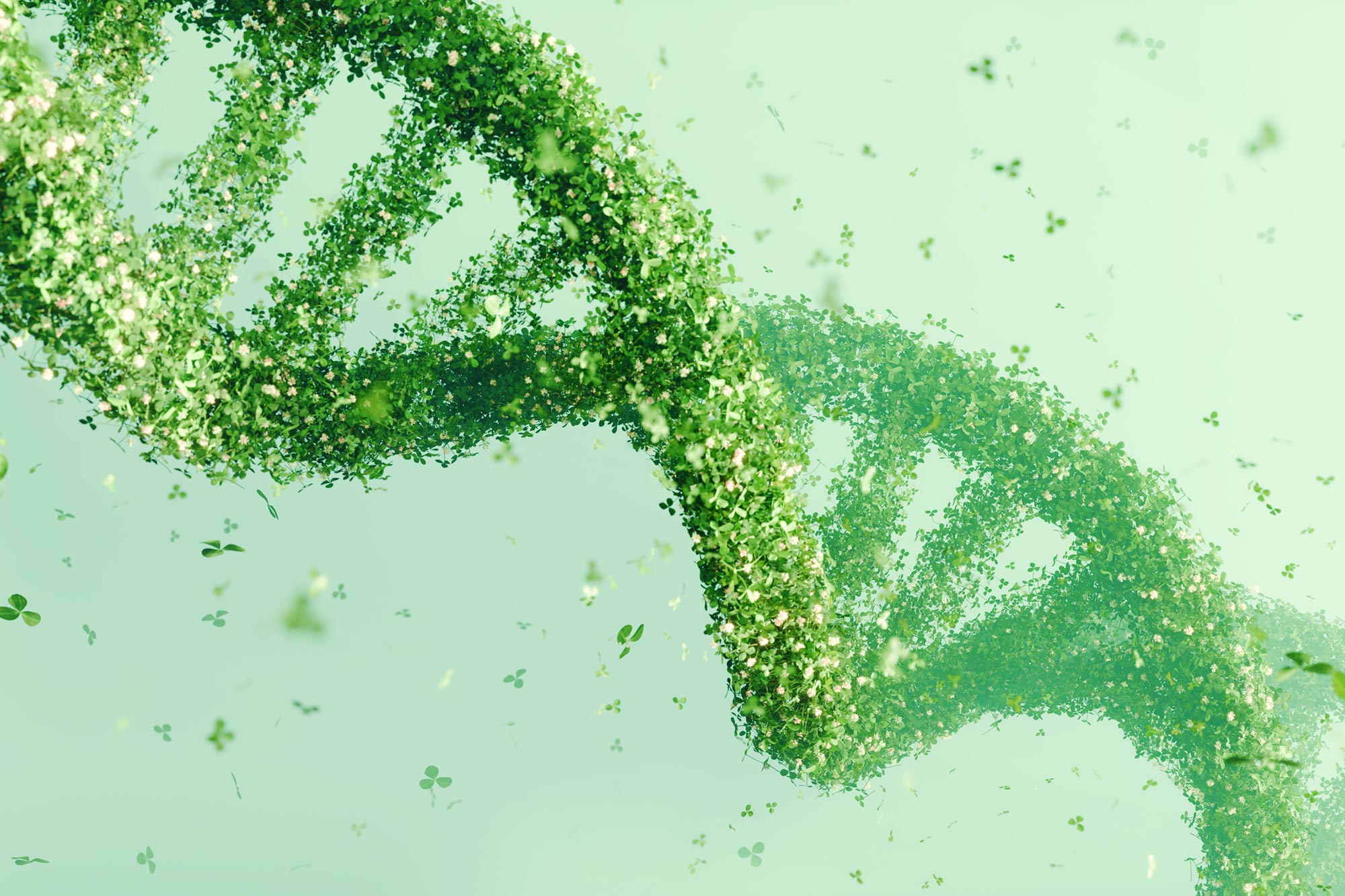
Researchers uncovered millions of ancient plant DNA switches—some older than flowering plants themselves—revealing a hidden evolutionary blueprint stretching back 400 million years.
Most people have heard the phrase deep space, but scientists also study something known as deep time. Modern genetics now allows researchers to trace biological history far deeper into the past than once thought possible. Even so, many puzzles remain. One of the most persistent questions has challenged biologists for decades.
Across both plants and animals, many genes and their functions remain remarkably similar across species, even after hundreds of millions of years. But this pattern does not hold when scientists look at DNA that regulates how genes turn on and off. Researchers have struggled to determine whether this type of DNA, known as regulatory DNA, remains conserved in plants at all. For years, some scientists suspected that plants might not preserve these regulatory elements across long evolutionary periods. New research now shows that assumption was wrong.
Discovery of Ancient Regulatory DNA in Plants
A study published today (March 12) in Science by Cold Spring Harbor Laboratory (CSHL) and collaborators around the world reports the identification of more than 2.3 million regulatory DNA sequences shared across 314 plant genomes representing 284 species. These elements, called conserved non-coding sequences (CNSs), were detected using a new computational tool named Conservatory. The software was developed through collaboration among the laboratories of Idan Efroni at Hebrew University, Madelaine Bartlett at Sainsbury Laboratory, Cambridge University, and Zachary Lippman at CSHL.
The researchers were surprised to find that some of these conserved sequences date back to a period before flowering plants diverged from their non-flowering ancestors more than 400 million years ago.
A New Approach to Comparing Plant Genomes
How did the team uncover so many hidden regulatory sequences?
Their method focused on closely examining the structure and arrangement of gene groups across hundreds of plant genomes. By comparing the organization of these genes from one ancestor to another at a very fine scale, the scientists were able to detect patterns that earlier approaches had missed.
CSHL postdoc Anat Hendelman, a co-first author of the study, said the team was astonished by how many of these regulatory sequences had been present all along. “Picking apart and genetically editing these CNSs confirmed they’re essential for developmental function,” Hendelman says.
Three Rules of Conserved DNA Evolution
The study also uncovered three key principles that describe how CNSs evolve in plant genomes.
First, although the physical distance between these sequences can vary, their order along chromosomes tends to remain consistent. Second, when plant genomes undergo rearrangements, these regulatory sequences can begin interacting with different genes. Third, ancient CNSs frequently persist after genes are duplicated, an important process that drives the expansion of plant genomes and gene families.
“This was actually one reason CNSs could not be discovered using the same approaches used in animals,” Lippman explains. “We didn’t just find CNSs using this innovative approach. We found that new regulatory sequences often come from old CNSs that were modified after gene duplication. This helps explain how novel regulatory elements emerge.”
A New Atlas for Plant Biology and Crop Science
The Conservatory project now provides plant scientists with what researchers describe as a “comprehensive atlas of regulatory conservation across plants, including dozens of crop species and their wild ancestors.” The resource is available to plant biologists such as CSHL collaborator David Jackson.
For crop researchers and breeders, the database could prove especially valuable. Understanding how these regulatory DNA elements work may help scientists develop plants that can better withstand challenges like drought or global food shortages.
The discovery also has broader implications for evolutionary biology. As Lippman puts it, “It’s a new window into the evolution of life across eons and a new opportunity to more efficiently engineer or fine-tune crop traits.”
Reference: “A deep-time landscape of plant cis-regulatory sequence evolution” by Kirk R. Amundson, Anat Hendelman, Danielle Ciren, Hailong Yang, Amber E. de Neve, Shai Tal, Adar Sulema, David Jackson, Madelaine E. Bartlett, Zachary B. Lippman and Idan Efroni, 12 March 2026, Science.
DOI: 10.1126/science.adt8983
Never miss a breakthrough: Join the SciTechDaily newsletter.
Follow us on Google and Google News.