

New research reveals that voluntary exercise restores STAT3 levels in the amygdala, helping to prevent stress-induced hypertension.
Hypertension, or high blood pressure, is a serious health condition and a leading cause of premature death worldwide. While chronic stress is known to contribute to hypertension, the precise biochemical pathways linking stress to elevated blood pressure remain unclear. Gaining a deeper understanding of these mechanisms could help in developing targeted therapies for hypertension.
A recent study from Juntendo University in Japan, led by Professor Hidefumi Waki, Dr. Keisuke Tomita, and Dr. Ko Yamanaka, provides new insights into this connection. Published online in Acta Physiologica on January 13, 2025, the study demonstrates that voluntary exercise can prevent stress-induced hypertension by restoring the function of signal transducer and activator of transcription 3 (Stat3) in the amygdala. This gene plays a crucial role in maintaining the normal function of the amygdala, a brain region involved in processing emotions.
“In the amygdala, the gene Stat3 is involved in the regulation of blood pressure and possibly plays a role in blood pressure elevation in response to chronic stress. It might also be involved in the improvement of stress by voluntary exercise,” explains Prof. Waki while elaborating on the role of STAT3.
Exercise as a Protective Factor
The amygdala is a key player in the body’s cardiovascular response. When exposed to prolonged stress, this region triggers an increase in blood pressure, heightening the risk of heart disease. To understand how exercise influences this process, researchers subjected rats to three weeks of chronic stress, with one group engaging in voluntary wheel running. Subsequently, they analyzed blood pressure levels and the levels of various genes using gene expression analysis in the amygdala to identify changes at the molecular level.
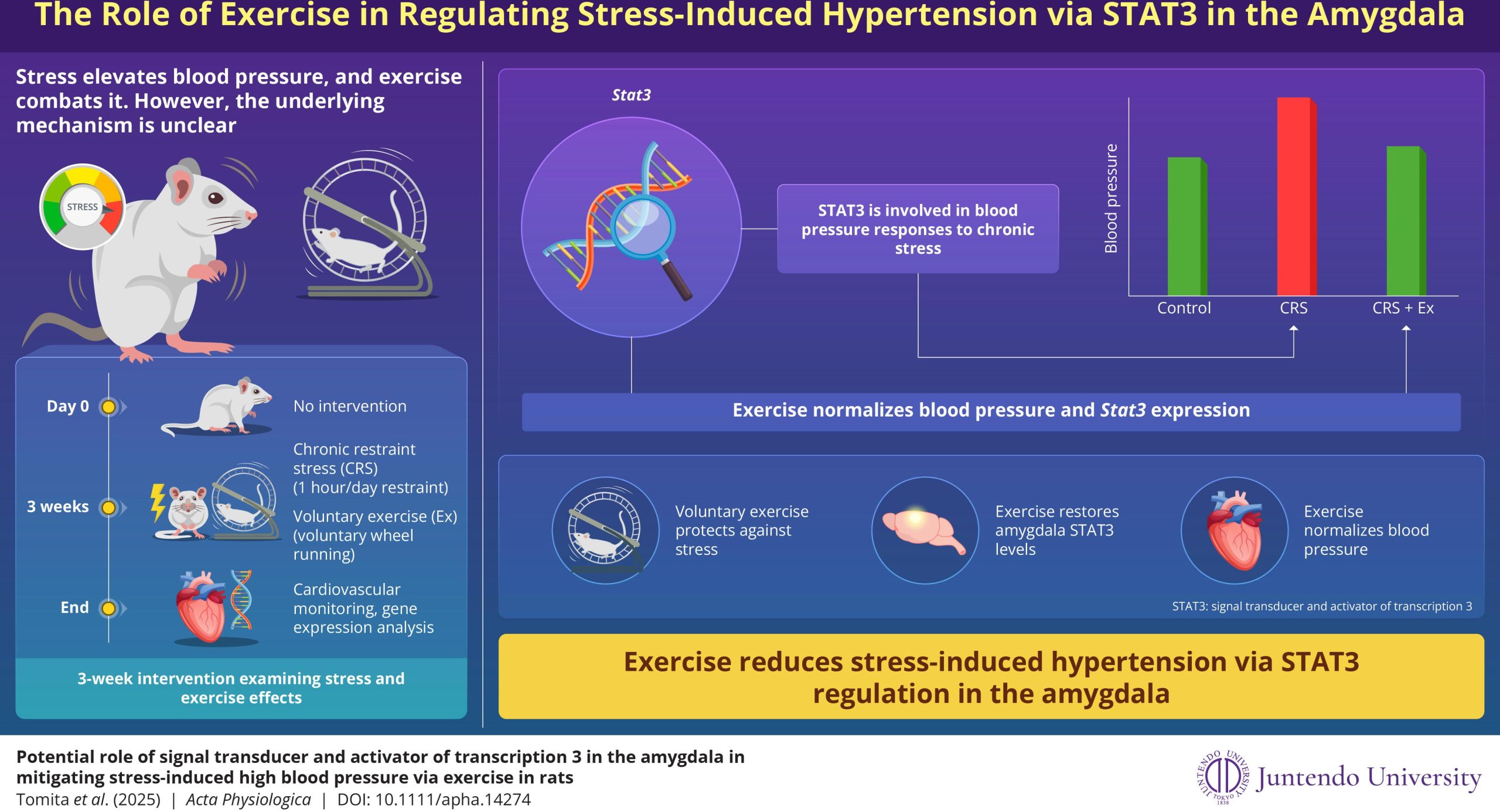
The study found that chronic stress led to a marked increase in blood pressure. Moreover, gene expression analysis revealed decreased Stat3 gene expression in the amygdala. However, when stressed rats underwent daily exercise, their blood pressure was normal, and STAT3 levels rebounded.
Subsequent experiments demonstrated that Stat3 expression blockade in the amygdala, in the absence of stress, produced an increase in blood pressure, underlining its important function in cardiovascular control.
“The improvement of cardiovascular dynamics after exercise is attributed to the rescue of Stat3 expression possibly because of mechanisms such as neuroprotection and anti-inflammation,” explains Prof. Waki while elaborating on the underlying mechanism.
Future Research and Implications
The findings of the study highlight a previously unknown brain-based mechanism behind exercise’s ability to combat high blood pressure. While regular physical activity is already recommended for heart health, this study suggests it may also serve as a non-drug therapy for stress-induced hypertension and related conditions like anxiety. However, researchers caution that more studies are needed to confirm these findings in humans and to explore whether therapies targeting STAT3 could offer new treatments for hypertension.
“STAT3 plays a potential role in arterial pressure elevation in response to chronic stress and its improvement through exercise, both of which need to be clarified in future studies,” concludes Prof. Waki.
Next, the team plans to explore whether specific types of exercise—or even pharmacological approaches—can enhance STAT3 activity in the amygdala to offer protection against hypertension.
Overall, their research reinforces a simple yet powerful message: exercise is not just for your body—it’s for your brain too.
Reference: “Potential role of signal transducer and activator of transcription 3 in the amygdala in mitigating stress-induced high blood pressure via exercise in rats” by Keisuke Tomita, Ko Yamanaka, Thu Van Nguyen, Jimmy Kim, Linh Thuy Pham, Toru Kobayashi, Sabine S. Gouraud and Hidefumi Waki, 13 January 2025, Acta Physiologica.
DOI: 10.1111/apha.14274
Never miss a breakthrough: Join the SciTechDaily newsletter.
Follow us on Google and Google News.