

Excessive sedentary time during growth increases systolic blood pressure, while three hours of daily light physical activity can mitigate this risk, as shown by a groundbreaking study spanning childhood to young adulthood.
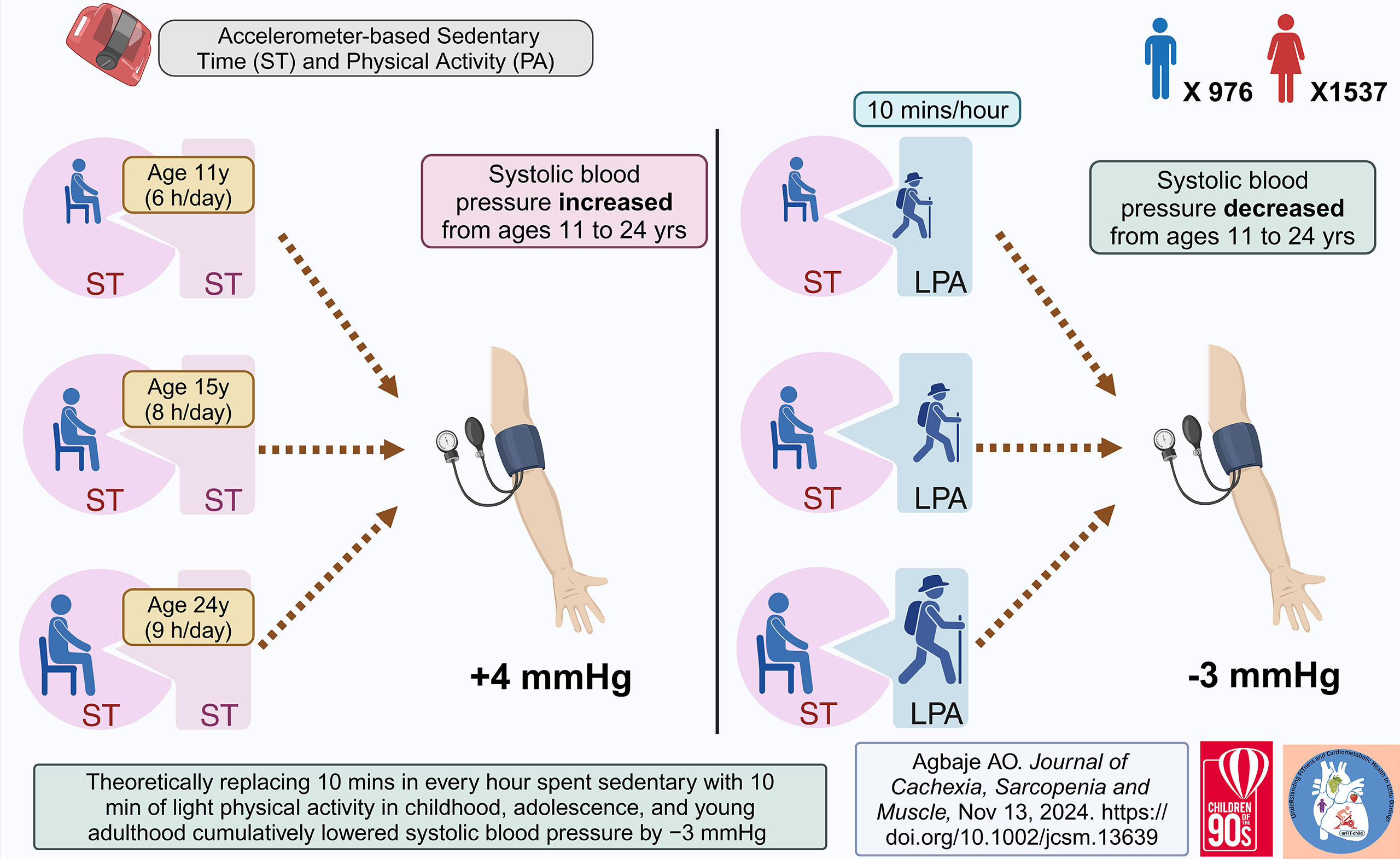
A new study reveals that spending more than six hours a day in sedentary activities during the transition from childhood to young adulthood may lead to an excess increase of 4 mmHg in systolic blood pressure. However, regularly participating in light physical activity (LPA) was found to significantly reduce this rise in blood pressure. The research was a joint effort by the Universities of Bristol and Exeter in the UK and the University of Eastern Finland, with findings published in the renowned Journal of Cachexia, Sarcopenia and Muscle.
In the present study, 2,513 children drawn from the University of Bristol’s Children of the 90s cohort were followed up from age 11 until 24 years. At baseline, the children spent six hours per day sedentary, six hours per day engaging in LPA, and approximately 55 minutes per day in moderate-to-vigorous physical activity (MVPA). At follow-up in young adulthood, nine hours per day were spent sedentary, three hours per day in LPA, and approximately 50 minutes per day in MVPA.
The average blood pressure in childhood was 106/56 mmHg which increased to 117/67 mmHg in young adulthood, partly due to normal physiological development. Persistent increase in sedentary time from age 11 through 24 years was associated with an average of 4 mmHg excess increase in systolic blood pressure. Participating in LPA from childhood lowered the final level by 3 mmHg, but engaging in MVPA had no blood pressure-lowering effect.
Benefits of Replacing Sedentary Time with LPA
“Furthermore, when 10 minutes out of every hour spent sedentary was replaced with an equal amount of LPA from childhood through young adulthood in a simulation model, systolic blood pressure decreased by 3 mmHg and diastolic blood pressure by 2 mmHg.
This is significant, as it has been reported in adults that a systolic blood pressure reduction of 5 mmHg decreases the risk of heart attack and stroke by ten percent,” says Andrew Agbaje, an award-winning physician and associate professor (docent) of Clinical Epidemiology and Child Health at the University of Eastern Finland.
The current study is the largest and the longest follow-up of accelerometer-measured movement behavior and blood pressure progression in youth in the world. Measurements of blood pressure, sedentary time, LPA, and, MVPA were taken at ages 11, 15, and 24 years.
The children’s fasting blood samples were also repeatedly measured for low-density lipoprotein cholesterol, high-density lipoprotein cholesterol, triglycerides, glucose, insulin, and high-sensitivity C-reactive protein. Heart rate, socio-economic status, family history of cardiovascular disease, smoking status as well as dual-energy X-ray absorptiometry measured fat mass and lean mass were accounted for in the analyses.
Implications for Public Health
“We have earlier shown that elevated blood pressure and hypertension in adolescence increase the risk of premature cardiac damage in young adulthood. The identification of childhood sedentariness as a potential cause of elevated blood pressure and hypertension with LPA as an effective antidote is of clinical and public health significance. Several MVPA-based randomized controlled trials in the young population have been unsuccessful in lowering blood pressure. We noted an MVPA-induced increase in muscle mass enhanced a physiologic increase in blood pressure explaining why earlier MVPA-based randomized clinical trials were unsuccessful,” says Agbaje.
“The World Health Organization estimates that 500 million new cases of physical inactivity-related non-communicable diseases would occur by 2030 and half would result from hypertension. At least three hours of LPA per day is critical to preventing and reversing elevated blood pressure and hypertension. Examples of LPA are long walks, house chores, swimming, and bicycling. We all, parents, pediatricians, and policymakers included, should encourage children and adolescents to participate in LPA to keep their blood pressure in a healthy range,” Agbaje concludes.
Reference: “Lean Mass Longitudinally Confounds Sedentary Time and Physical Activity With Blood Pressure Progression in 2513 Children” by Andrew O. Agbaje, 13 November 2024, Journal of Cachexia, Sarcopenia and Muscle.
DOI: 10.1002/jcsm.13639
Agbaje’s research group (urFIT-child) is supported by research grants from Jenny and Antti Wihuri Foundation, the Finnish Cultural Foundation Central Fund, the Finnish Cultural Foundation North Savo Regional Fund, the Orion Research Foundation, the Aarne Koskelo Foundation, the Antti and Tyyne Soininen Foundation, the Paulo Foundation, the Yrjö Jahnsson Foundation, the Paavo Nurmi Foundation, the Finnish Foundation for Cardiovascular Research, Ida Montin Foundation, Eino Räsänen Fund, Matti and Vappu Maukonen Fund, Foundation for Pediatric Research, Alfred Kordelin Foundation and Novo Nordisk Foundation.
Never miss a breakthrough: Join the SciTechDaily newsletter.
Follow us on Google and Google News.