
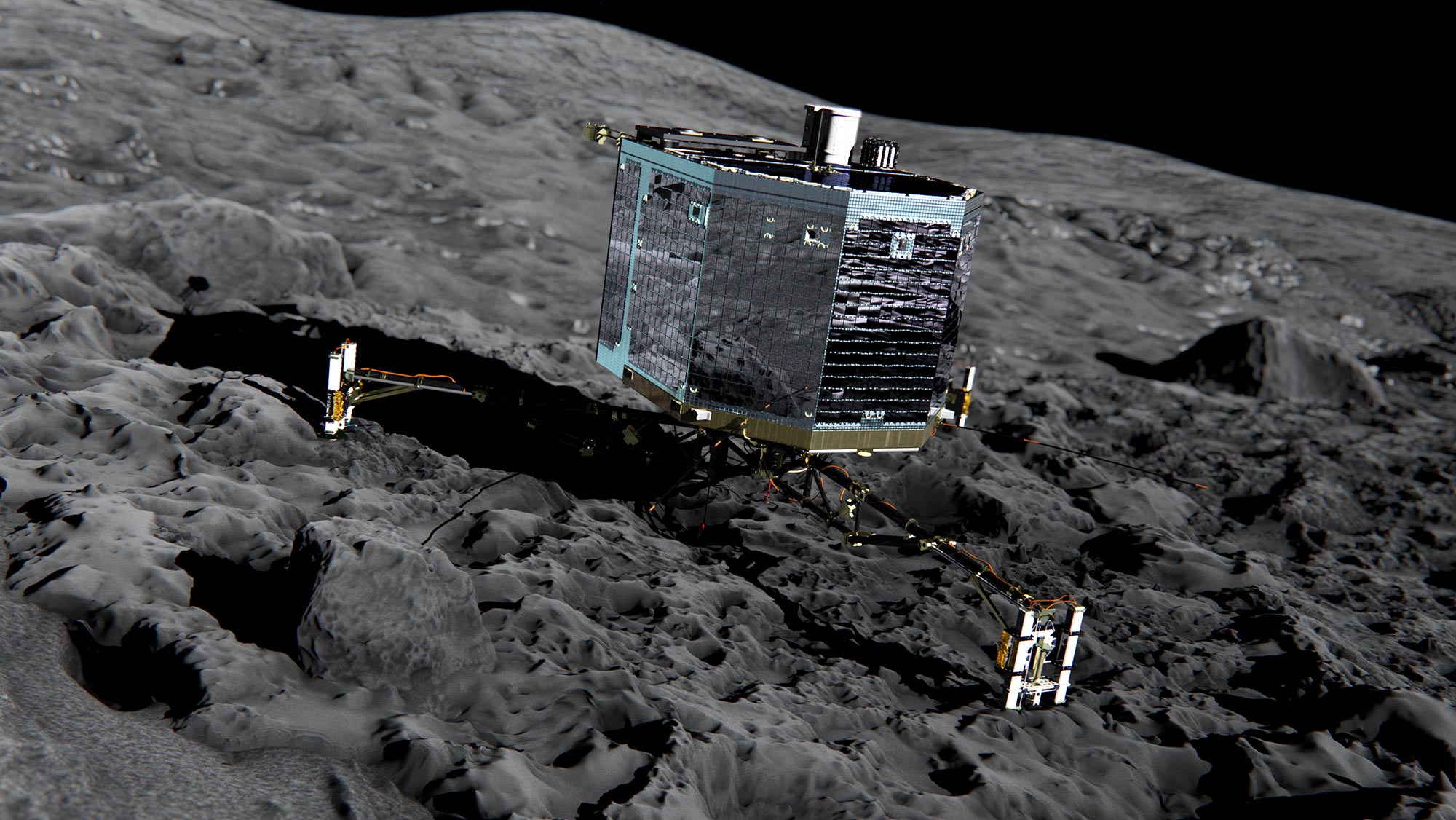
Philae’s historic landing on Comet 67P in 2014 provided crucial data on the comet’s surface and internal composition, despite technical setbacks.
The mission revealed organic molecules and temperature variations, offering insights into the ancient materials forming our solar system. This landmark achievement has set the stage for future exploratory missions to other cometary and asteroid bodies.
Historic Touchdown
On November 12, 2014, after a decade-long journey spanning the Solar System and over 500 million kilometers, Rosetta’s lander, Philae, made history by becoming the first spacecraft to touch down on a comet. As the European Space Agency (ESA) marks the tenth anniversary of this groundbreaking achievement, they honor Philae’s remarkable contributions to space exploration at Comet 67P/Churyumov-Gerasimenko.

Choosing the Landing Site
When Rosetta arrived at Comet 67P on August 6, 2014, the mission team immediately began the race to select a suitable landing site for Philae. The site had to strike a careful balance between safety and scientific potential.
Using high-resolution images captured by Rosetta, scientists meticulously analyzed and debated various candidate sites. After weeks of deliberation, they chose a smooth-looking region on the smaller of the comet’s two lobes. This location was named Agilkia, and it offered the best combination of stability and opportunities for groundbreaking science.
Intense preparations followed, but the night before landing, a problem was identified: Philae’s active descent system, which would provide a downward thrust to prevent rebound at touchdown, could not be activated. Philae would have to rely on harpoons and ice screws in its three feet to fix it to the surface.
Nonetheless, the green light was given and after separating from Rosetta, Philae began its seven-hour descent to the surface of the comet. During the descent, Philae began ‘sensing’ the environment around the comet, taking stunning imagery as the first landing site came into view.

First Contact With a Comet
Philae’s touchdown at Agilkia was spot-on. The sensors on Philae’s feet felt the touchdown vibrations, generating the first recording of contact between a human-made object and a comet. But it soon became clear that Philae’s harpoons hadn’t fired and it had taken flight again.
In the end, Philae made contact with the surface four times. Thanks to an automatic sequence that was triggered by the first touchdown signal, Philae’s instruments were operating while in flight, collecting unique data that would later yield important results. It was also an unexpected bonus that data were collected at more than one location, providing the first direct measurements of surface characteristics and allowing comparisons between the touchdown sites.
For example, Philae ‘felt’ the difference in surface texture and hardness as it bounced from one site to another. At the first landing site, it detected a soft layer several centimeters thick, milliseconds later encountering a much harder layer.
After colliding with a cliff, Philae scraped through its second touchdown site, providing the first in situ measurement of the softness of the icy-dust interior of a boulder on a comet. The simple action of Philae ’stamping’ an imprint in billions-of-years-old ice revealed the boulder to be fluffier than froth on a cappuccino, equivalent to a porosity of about 75%.

The Philae lander featured 10 instruments:
APXS: Alpha Proton X-ray Spectrometer (studying the chemical composition of the landing site and its potential alteration during the comet’s approach to the Sun)
CIVA: Comet Nucleus Infrared and Visible Analyser (six cameras to take panoramic pictures of the comet surface)
CONSERT: COmet Nucleus Sounding Experiment by Radiowave Transmission (studying the internal structure of the comet nucleus with Rosetta orbiter)
COSAC: The COmetary SAmpling and Composition experiment (detecting and identifying complex organic molecules)
PTOLEMY: Using MODULUS protocol (Methods Of Determining and Understanding Light elements from Unequivocal Stable isotope compositions) to understand the geochemistry of light elements, such as hydrogen, carbon, nitrogen and oxygen.
MUPUS: MUlti-PUrpose Sensors for Surface and Sub-Surface Science (studying the properties of the comet surface and immediate sub-surface)
ROLIS: Rosetta Lander Imaging System (providing the first close-up images of the landing site)
ROMAP: Rosetta Lander Magnetometer and Plasma Monitor (studying the magnetic field and plasma environment of the comet)
SD2: Sampling, drilling and distribution subsystem (drilling up to 23 cm depth and delivering material to onboard instruments for analysis)
SESAME: Surface Electric Sounding and Acoustic Monitoring Experiment (probing the mechanical and electrical parameters of the comet)
Credit: ESA/ATG medialab
The Scientific Harvest
Philae then ‘hopped’ about 30 meters to the final touchdown site, named Abydos, where its CIVA cameras provided the first image of a human-made object touching a 4.6 billion year old Solar System relic. The exact location on the comet would remain hidden from view for almost two years.
In this location, Philae’s MUPUS hammer penetrated a soft layer before encountering an unexpectedly hard surface a few centimeters below the surface. Philae ‘listened’ to the hammering with its feet, recording the vibrations that passed through the comet. This was the first time since the Apollo 17 mission to the Moon in 1972 that active seismic measurements were conducted on a celestial body.
MUPUS also carried a thermal sensor, which measured the local changes in temperature from about -180ºC to 145ºC, in sync with the comet’s 12.4 hour day – the first time the temperature cycle of a comet had been measured at its surface.
Meanwhile the CONSERT experiment, which passed radio waves between Rosetta and Philae through the comet in the first cometary sounding experiment, revealed the interior of the comet to be a very loosely compacted mixture of dust and ice, with a high porosity of 75–85%.

In-Flight Discoveries
During the bouncing, Philae’s COSAC and Ptolemy instruments ‘sniffed’ the comet’s gas and dust, important tracers of the raw materials present in the early Solar System. COSAC revealed a suite of 16 organic compounds comprising numerous carbon and nitrogen-rich compounds, including methyl isocyanate, acetone, propionaldehyde, and acetamide that had never before been detected in comets. The complex molecules detected by both COSAC and Ptolemy play a key role in the synthesis of the ingredients needed for life.
Philae’s bouncing also allowed it to measure the magnetic field at different heights above the surface, showing the comet is remarkably non-magnetic. Detecting the magnetic field of comets has proven difficult in previous missions, which have typically flown past at high speeds, relatively far from comet nuclei. It took the proximity of Rosetta’s orbit around the comet and the measurements made much closer to and at the surface by Philae, to provide the first detailed investigation of the magnetic properties of a comet nucleus.

In the end some 80% of Philae’s planned science sequence was completed in the 64 hours following separation from Rosetta and before the lander fell into hibernation.
While Philae hibernated, Rosetta continued returning an unprecedented wealth of information from the comet as it orbited around the Sun, watching the comet’s activity reach a peak and then slowly subside again. Philae would be heard from briefly in June–July 2015 but could not be reactivated. Then, as Rosetta’s mission was drawing to its planned end with its own daring descent to the surface at a site named Sais, Philae’s final landing site was revealed in orbiter imagery, a final twist in what had become one of the greatest stories of space exploration.
Paving the Way for Future Missions
ESA has an impressive legacy in small body exploration, with the Rosetta-Philae double-act inspiring the next generation of comet and asteroid-chasers.
ESA’s Giotto mission to fly by Comet Halley in 1986 was the first mission to image a comet surface. The Rosetta mission was a natural next step, becoming the first to orbit a comet, as well as deploying a lander to its surface. Rosetta was also the first to follow a comet around the Sun, monitoring its activity as it made its closest approach to the Sun.
Rosetta paves the way for the upcoming Comet Interceptor mission, which unlike its predecessors, will probe a comet visiting our Solar System for the first time. As such, the comet will contain material that has undergone minimal processing, offering a ‘cleaner’ look at pristine material from the dawn of the Solar System, before it is sculpted by the heat of the Sun. The mission will consist of a primary craft and two probes, providing a multi-angled view of the comet.

ESA is also visiting asteroids, with its flagship ‘planetary defender’ Hera on its way to survey Dimorphos following NASA’s impact experiment to alter its trajectory, a grand-scale test of planetary defense techniques. Hera’s orbit scheme is borrowed directly from Rosetta, and the mission’s two smaller satellites carry radar and dust-measuring instruments based on those designed for Rosetta.
Meanwhile Ramses will accompany asteroid Apophis as it makes an exceptionally close flyby of Earth in 2029. And suitcase-sized M-Argo will be the smallest spacecraft to perform its own independent mission in space when it rendezvous with a small near-Earth asteroid later this decade.
Rosetta and Philae’s legacy also lives on in the hearts and minds of people, as revealed in our new online exhibition celebrating this uniquely inspiring mission.
Rosetta was an ESA mission with contributions from its Member States and NASA. Philae was provided by a consortium led by DLR, MPS, CNES and ASI.
Never miss a breakthrough: Join the SciTechDaily newsletter.
Follow us on Google and Google News.
1 Comment
Incredible