

Temperature-responsive gels stabilize oscillation periods, mimicking circadian temperature compensation.
Circadian rhythms are natural, internal oscillations that synchronize an organism’s behaviors and physiological processes with their environment. These rhythms normally have a period of 24 hours and are regulated by internal chemical clocks that respond to cues from outside the body, such as light.
Although well studied in animals, plants, and bacteria, circadian rhythms all share an enigmatic property—the oscillation period is not significantly affected by temperature, even though the rate of most biochemical reactions changes exponentially with temperature. This clearly indicates that some sort of temperature-compensation mechanism is at play. Interestingly, some scientists have managed to replicate such temperature-invariant qualities in certain oscillating chemical reactions. However, these reactions are often troublesome and require extremely precise adjustments on the reacting chemicals.
But what if there was a simpler way to achieve temperature compensation in an oscillating chemical reaction? In a recent study published in Scientific Reports, a team of researchers including Assistant Professor Yuhei Yamada of Tokyo Institute of Technology (Tokyo Tech), Japan, came up with a clever idea for a temperature compensation mechanism using a reaction called the Belousov–Zhabotinsky (BZ) oscillating reaction.
Temperature-Responsive Gels
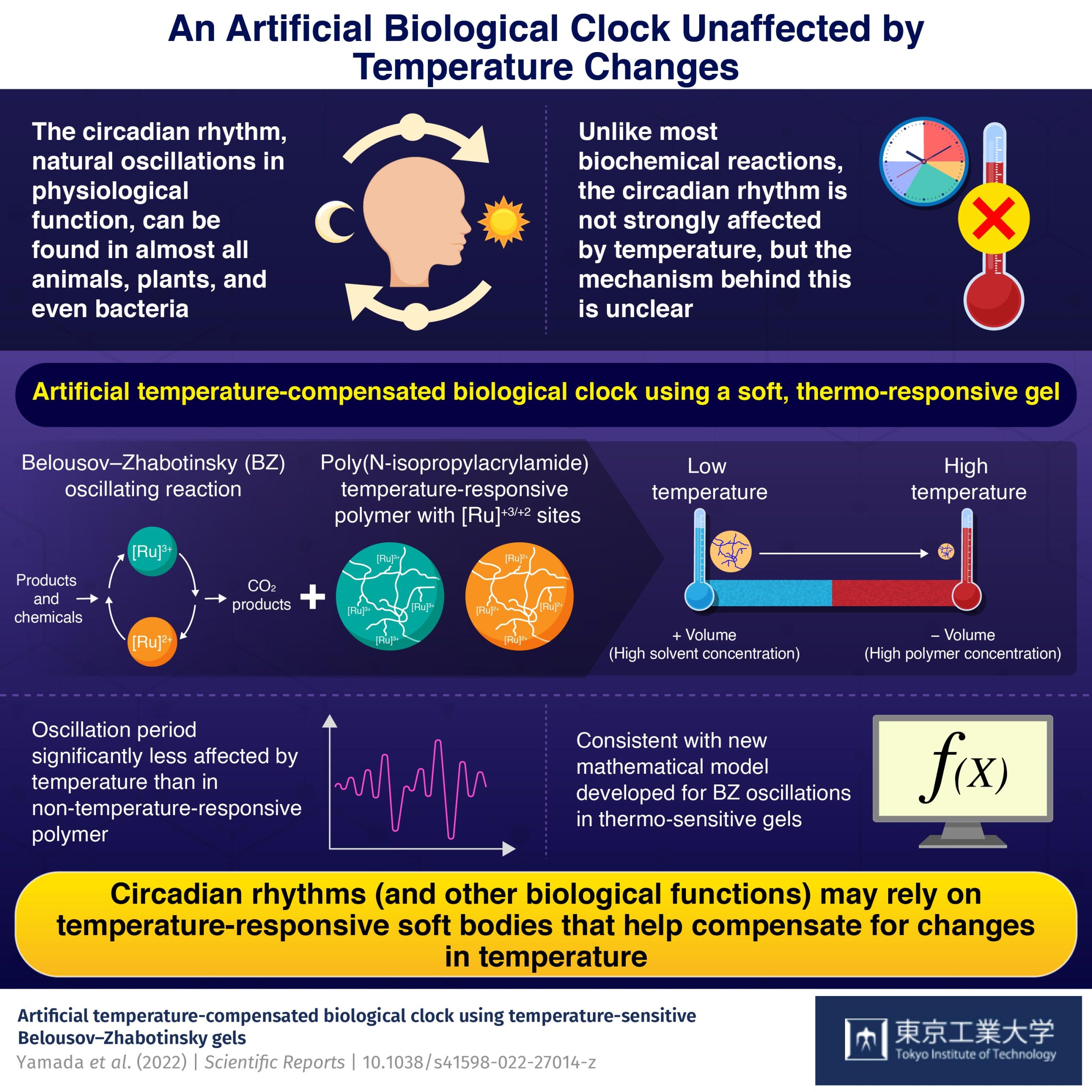
The key to their approach lies in soft, temperature-responsive gels made from poly(N-isopropylacrylamide), or ‘PNIPAAm’ for short, in which the BZ reaction can occur. These gels consist of polymeric strands that can accommodate a certain volume of solvent. However, because these gels shrink as temperature increases, the amount of solvent contained in the gel decreases as temperature rises.
The researchers exploited this property of PNIPAAm gels by adding ruthenium (Ru) sites on its constituent polymers. The periodic nature of the particular BZ reaction the researchers studied relies partially on the back-and-forth oxidation and reduction of ruthenium (Ru) ions. Thus, the speed of this reaction is affected by the relative concentrations of solvent and Ru. Because the PNIPAAm gels can accommodate less solvent when they shrink, the relative concentration of Ru in the gels increases with temperature.
A Breakthrough Using BZ Reactions
As the research team demonstrated through experimental measurements and a thorough mathematical analysis, the abovementioned effects combine to form a temperature-compensation mechanism that renders the period of the BZ reaction unaffected by shifts in temperature. “The prepared BZ gels exhibited temperature compensability just like the circadian rhythms observed in living organisms,” remarks Yamada.
Overall, this study demonstrates a completely new way to achieve temperature compensation in artificial biological clocks based on periodic reactions. Intriguingly, it’s even possible that similar temperature-compensation mechanisms using temperature-responsive soft bodies exist in biological systems in nature, as Yamada explains: “Our study suggests that temperature compensation can be naturally self-sustainable through the output system of circadian machinery. This may explain why temperature compensation is a universal property of circadian rhythms seen in animals, plants, and bacteria, regardless of the molecular species involved.”
Let us hope further studies can help us clarify the mysteries behind our internal clocks!
Reference: “Artificial temperature-compensated biological clock using temperature-sensitive Belousov–Zhabotinsky gels” by Yuhei Yamada, Hiroshi Ito and Shingo Maeda, 27 December 2022, Scientific Reports.
DOI: 10.1038/s41598-022-27014-z
Never miss a breakthrough: Join the SciTechDaily newsletter.
Follow us on Google and Google News.