
How does a single cell reliably build one of the most complex structures known in nature? New research suggests the answer may not depend solely on chemical signals, as long assumed.
Your brain begins as a single cell. By the end of development, it contains an extraordinarily complex network of roughly 170 billion cells. How does this vast system organize itself with such precision?
Neuroscientists at Cold Spring Harbor Laboratory (CSHL) have proposed a surprisingly simple explanation—one that could have far-reaching implications for developmental biology and artificial intelligence.
Stan Kerstjens, a postdoc in Professor Anthony Zador’s lab, frames the question in terms of positional information. “The only thing a cell ‘sees’ is itself and its neighbors,” he explains. “But its fate depends on where it sits. A cell in the wrong place becomes the wrong thing, and the brain doesn’t develop right. So, every cell must solve two questions: Where am I? And who do I need to become?”
In a study published in Neuron, Kerstjens, Zador, and collaborators at Harvard University and ETH Zürich propose a new theory explaining how the brain organizes itself during development.
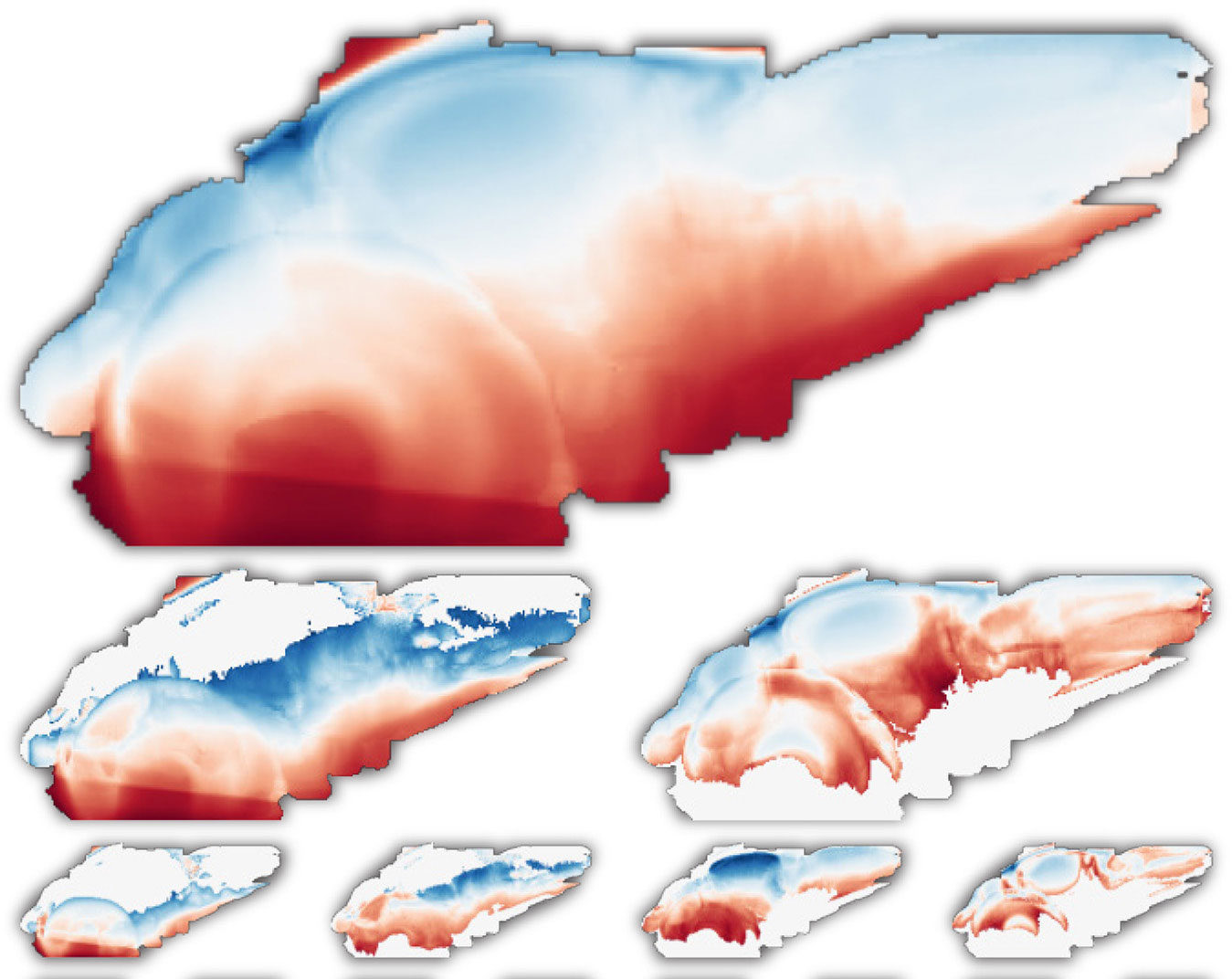
For decades, researchers believed that cells primarily exchanged positional information through chemical signals. Such signaling mechanisms can effectively coordinate small groups of cells. However, the brain is composed of billions of neurons, each of which must migrate to and function in precisely the correct location.
Chemical signals weaken over distance, raising a fundamental question: How do cells located deep within a growing brain determine their position accurately?
A Lineage-Based Solution
Kerstjens suggests that part of the answer lies in cellular ancestry. “Consider how human populations spread across a country over generations,” he says. “Descendants settle near their parents, so people who share ancestry end up in neighboring regions, producing large-scale geographic structures without long-range communication. We argue that a similar principle operates in the developing brain. Cells that descend from the same progenitor tend to remain near one another.”
In this view, spatial organization emerges naturally from patterns of cell division and migration. Rather than relying solely on long-range chemical gradients, cells may inherit positional context through lineage relationships.
To investigate this possibility, the researchers developed what they describe as a “lineage-based model of scalable positional information.” They began with mathematical modeling to determine whether lineage patterns alone could generate organized structures. They then analyzed gene expression in individual cells and groups of cells in developing mouse brains. Finally, they confirmed their findings in zebrafish, demonstrating that the model applies to brains of different sizes.
Their results indicate that chemical signaling does not act alone. Instead, it appears to work alongside lineage-related mechanisms to guide cells to their proper positions. Although the study focuses on brain development, the same principle could apply to other growing tissues, including tumors. The concept may even inform the design of self-replicating AI systems that transfer information from one generation to the next, similar to the way brain cells pass along developmental instructions.
Perhaps most importantly, showing how a single cell grows into a complex organ could help scientists solve fundamental mysteries of the mind. “The brain somehow makes us intelligent,” Kerstjens says. “How did it manage to accumulate this capability, not just over its developmental time, but over evolutionary time? This is one piece in that big puzzle.”
Reference: “A lineage-based model of scalable positional information in vertebrate brain development” by Stan Kerstjens, Florian Engert, Rodney J. Douglas and Anthony M. Zador, 2 March 2026, Neuron.
DOI: 10.1016/j.neuron.2025.12.043
Funding: Mathers Foundation, ETH Zürich
Never miss a breakthrough: Join the SciTechDaily newsletter.
Follow us on Google and Google News.