
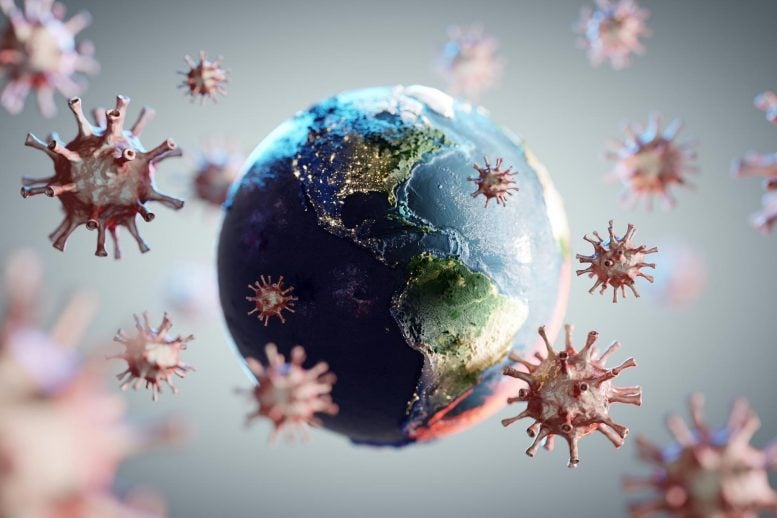
Massive livestock farming and reduced genetic diversity have created the perfect conditions for pandemics. Experts urge global changes to prevent future disease outbreaks.
The way that many of us live has created the “perfect storm” for the evolution and transmission of infectious diseases like COVID-19 according to a researcher at the University of East Anglia.
A new editorial published today describes how the world’s vast population of people, pets, and livestock has created an ideal breeding ground for infectious diseases which are passed between humans and animals.
It shows how we urgently need to control the transmission of pathogens such as SARS-CoV-2 by using vaccination passports, maximizing genetic variation in livestock, and reducing how much meat we eat.
Prof Cock Van Oosterhout, from UEA’s School of Environmental Sciences, said: “We humans have been living in a non-sustainable way over the past few centuries. We now have a vast population size — not only of humans but also of domesticated animals and livestock.
“This makes an ideal breeding ground for the evolution and transmission of zoonotic infectious diseases that jump from an animal to a human host.”
Prof Van Oosterhout’s article shows how the world’s biomass of livestock is more than 10 times higher than that of all wildlife combined.
Low Genetic Diversity Weakens Resistance to Pathogens
‘Genetic effective size’ determines how much genetic variation can be maintained in the population, and this genetic variation is critical to counter the evolution of infectious diseases.
But the genetic effective size of the world’s livestock is 80 times lower than the minimum viable population size of free-living species.
Prof Van Oosterhout said: “The combination of high livestock biomass and low genetic variation has tipped the co-evolutionary balance with zoonotic pathogens.
Human Activity Creates Conditions for Viral Spillover
“Habitat destruction, illegal wildlife trade, and other human activities have brought many species into contact with each other — and this facilitates a spill-over, spillback, and hybridization of the pathogens.
“Given that we are in close contact with our domesticated animals and livestock, there are many opportunities for the spill-over of viruses from animals to humans, and spillback from humans back to animals.
“Altogether, these conditions have created a perfect storm for the evolution and transmission of zoonotic infectious diseases.
Combating Future Pandemics: What Needs to Change
“COVID-19 has shown us that humans are not immune to the evolutionary processes that drive the adaptations of pathogens.
“We urgently need to reset this co-evolutionary imbalance and control the transmission of pathogens such as SARS-CoV-2 by using vaccination passports, maximizing genetic variation in livestock, and reducing our consumption of animal protein. We also need to be aware of pathogen reservoirs, both locally and globally.
“It is time that we start to recognize that our health, the environment, and our global economy are all closely interlinked. Pathogens like SARS-CoV-2 will continue to evolve when allowed to infect humans, anywhere in the world. In turn, this poses a threat to the human population at large, also in countries that have the infection under control.
“Our society is facing significant threat, and we all need to do what we can both at an individual and societal level to improve our long term prospects as a species. These changes needs to be implemented globally to effectively combat pandemics,” he added.
Reference: “Mitigating the threat of emerging infectious diseases; a coevolutionary perspective” by Cock van Oosterhout, 7 May 2021, Virulence.
DOI: 10.1080/21505594.2021.1920741
This work was supported by the Earth and Life Systems Alliance (ELSA) of the Norwich Research Park.
Never miss a breakthrough: Join the SciTechDaily newsletter.
Follow us on Google and Google News.
4 Comments
Yea, it’s called Gain of Function. Ask Fauci.
We all know where this virus came from
https://zenodo.org/record/4642956
“… and reducing how much meat we eat.”
Yes, it has been demonstrated the cats can catch COVID-19. However, there aren’t many people who eat cats.
It reads like some vegans have found another reason to whine about people eating meat.
I’m wondering how vaccination passports will prevent future pandemics. Even science reporting leaves out the 5 Was of good journalism, just stating opinions with no backup.