
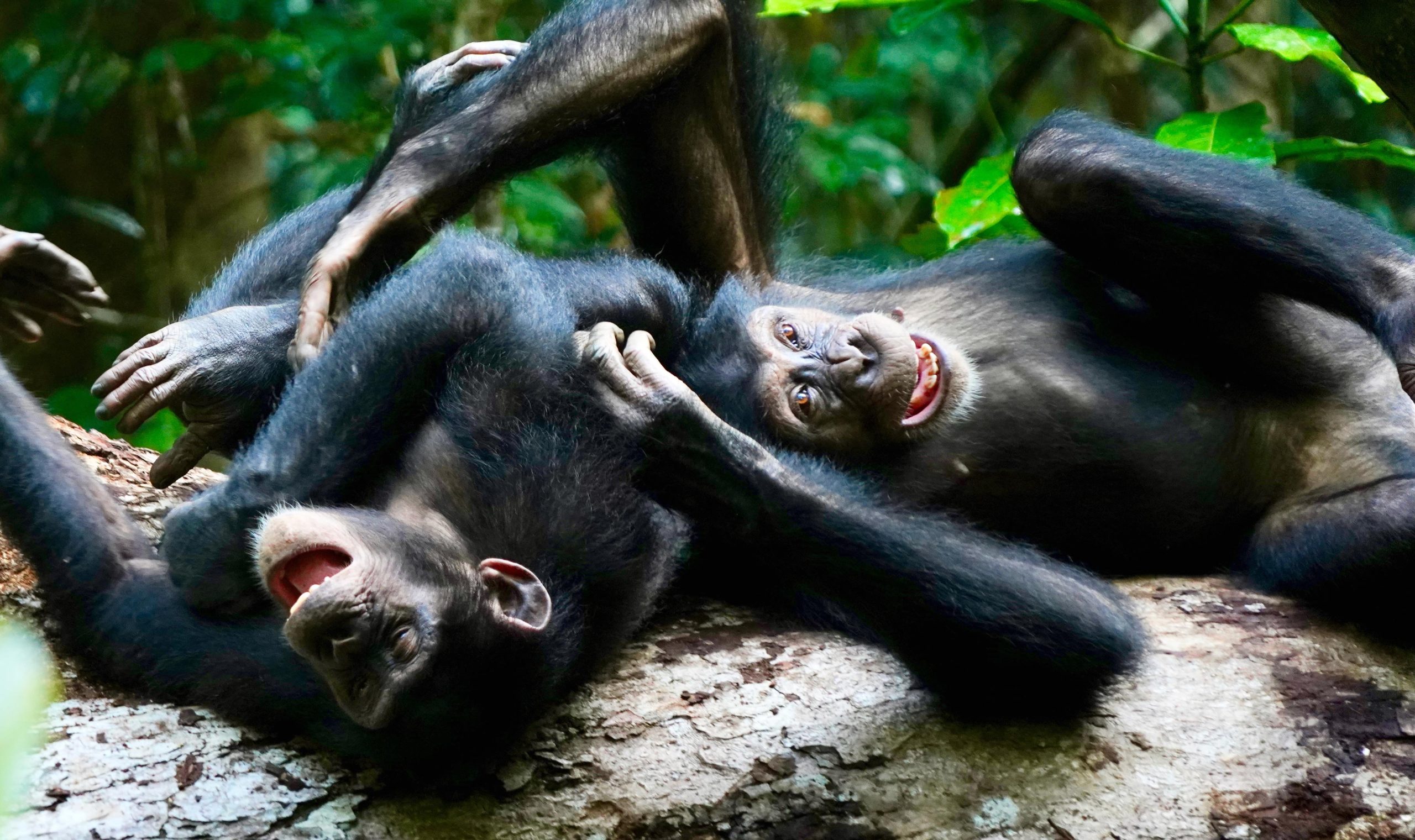
Adult chimpanzees in the Taï Forest demonstrate that social play is crucial for cooperation and conflict resolution.
Through playful interactions, they strengthen bonds and prepare for collective activities, showing similarities to human social play.
Adult Play and Social Cohesion
While adults play less often than children, social play in adulthood remains a universal human trait. Play fosters tolerance, cohesion, bonding, and cooperation. In other species, adult play is typically rare. However, a new study published today (November 21) in Current Biology reveals that some chimpanzees, much like humans, continue to engage in play throughout their lives, particularly before activities that require teamwork and cooperation.
“We show that adult social play in chimpanzees can foster a range of cooperative behaviors, from dyadic interactions to complex, risky activities requiring the coordination of multiple individuals,” explains Liran Samuni of the German Primate Center in Göttingen, Germany, and the Taï Chimpanzee Project in Côte d’Ivoire. “We have identified a strong link between this positive social behavior, known to elicit joyous emotions, and some of the more intricate forms of cooperation seen in non-human species.”
Observations From the Taï Forest
Samuni and her colleagues have been studying three cohesive groups of chimpanzees living in the Taï Forest of Côte d’Ivoire. While earlier studies of play in wild adult chimpanzees had been lacking, they recognized that adult males and females in these groups play together regularly. Their play often involves physical actions like wrestling, mock biting, slapping, pulling, and chasing. The positive nature of these interactions is emphasized through “play faces” and panting vocalizations, which the researchers liken to human smiles and laughter.
“Though adult-adult social play was not a daily occurrence, it consistently emerged under specific conditions,” Samuni says.
Insights Into Play and Chimpanzee Social Dynamics
To understand better how play functions in chimpanzee society, they studied the play of 57 adult chimpanzees. The researchers found that adult chimpanzees were more likely to engage in social play before participating in group activities, such as monkey hunting or territorial defense against hostile outsiders. Those who played together were more likely to collaborate in these endeavors, indicating that play can signal cooperative motivation and enhance collective cooperation.
When chimpanzees played with only one other individual, it often involved close social partners, illustrating the strong connection between play, familiarity, and trust. Play also happened more often during times of increased social tension, such as during competition for mates or following recent disputes, suggesting to the researchers that play might offer a means to relieve tension and resolve conflicts.
Behavioral Diversity and Future Research Directions
The findings in the chimpanzees under study may or may not reflect play in other populations of chimpanzees. Samuni explains that’s because chimpanzees are behaviorally diverse and flexible, with different populations displaying unique strategies and behaviors. The prevalence of adult play in this especially cohesive population may strengthen the notion that “societies characterized by cohesion and tolerance also exhibit higher frequencies of adult play,” Samuni says.
In future work, they’d like to learn more about how play in the Taï Forest chimpanzees compares to that in other chimpanzee groups. They also are curious to know whether chimpanzees consciously decide to play as an intentional strategy to foster engagement or if the positive effects of play naturally promote cooperation without the chimpanzees meaning to do so.
Reference: “Social play fosters cooperation in wild adult chimpanzees” by Liran Samuni, Alexander Mielke, Catherine Crockford and Roman M. Wittig, 21 November 2024, Current Biology.
DOI: 10.1016/j.cub.2024.10.058
Never miss a breakthrough: Join the SciTechDaily newsletter.
Follow us on Google and Google News.