
Close Menu
    Facebook X (Twitter) Instagram
    SciTechDaily
    • Biology
    • Chemistry
    • Earth
    • Health
    • Physics
    • Science
    • Space
    • Technology
    Facebook X (Twitter) Pinterest YouTube RSS
    SciTechDaily
    Home»Space»Hubble Image of the Week – Elegance Conceals an Eventful Past
    Space

    Hubble Image of the Week – Elegance Conceals an Eventful Past

    By SciTechDailyApril 19, 20161 Comment2 Mins Read
    Facebook Twitter Pinterest Telegram LinkedIn WhatsApp Email Reddit
    Share
    Facebook Twitter LinkedIn Pinterest Telegram Email Reddit
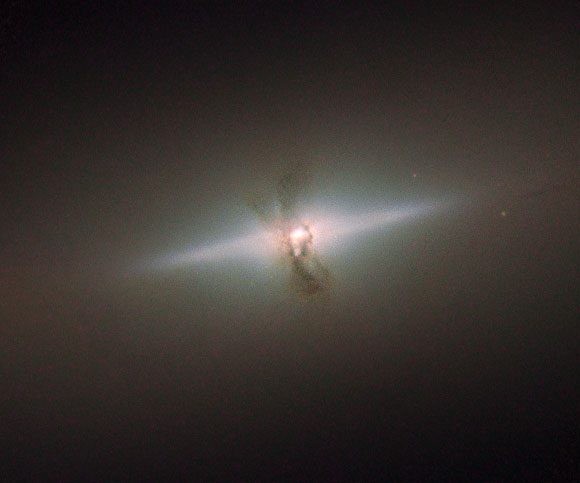
    Hubble Views NGC 4111
    NGC 4111 is a lenticular, or lens-shaped, galaxy, lying about 50 million light-years from us in the constellation of Canes Venatici (The Hunting Dogs). Credit: ESA/Hubble & NASA, Acknowledgment: Judy Schmidt

    This newly released Hubble image shows lenticular galaxy NGC 4111.

    The elegant simplicity of NGC 4111, seen here in this image from the NASA/ESA Hubble Space Telescope, hides a more violent history than you might think. NGC 4111 is a lenticular, or lens-shaped, galaxy, lying about 50 million light-years from us in the constellation of Canes Venatici (The Hunting Dogs).

    Lenticular galaxies are an intermediate type of galaxy between an elliptical and a spiral. They host aged stars like ellipticals and have a disk like a spiral. However, that’s where the similarities end: they differ from ellipticals because they have a bulge and a thin disk, but are different from spirals because lenticular discs contain very little gas and dust, and do not feature the many-armed structure that is characteristic of spiral galaxies. In this image, we see the disc of NGC 4111 edge-on, so it appears as a thin sliver of light on the sky.

    At first sight, NGC 4111 looks like a fairly uneventful galaxy, but there are unusual features that suggest it is not such a peaceful place. Running through its center, at right angles to the thin disc, is a series of filaments, silhouetted against the bright core of the galaxy. These are made of dust, and astronomers think they are associated with a ring of material encircling the galaxy’s core. Since it is not aligned with the galaxy’s main disc, it is possible that this polar ring of gas and dust is actually the remains of a smaller galaxy that was swallowed up by NGC 4111 long ago.

    Never miss a breakthrough: Join the SciTechDaily newsletter.
    Follow us on Google and Google News.

    Astronomy Cosmology Hubble Space Telescope NASA
    Share. Facebook Twitter Pinterest LinkedIn Email Reddit

    Related Articles

    Hubble Image of the Week – Dwarf Galaxy Leo A

    Hubble Image of the Week – Swimming in Sculptor

    Astronomers Measure the Farthest Galaxy Ever Seen in the Universe

    Hubble Image of the Week – Peculiar Galaxy NGC 1487

    Hubble Image of the Week: Infant Star’s Artistic Outburst

    Hubble Views Turbulent Birthing Ground Orion B Molecular Cloud Complex

    Magnified Image Reveals the Faintest Known Galaxy from the Early Universe

    Hubble Image of the Week: Quadruple Star System DI Cha

    Hubble Image of the Week – Evolution in Slow Motion

    1 Comment

    1. Dan on April 21, 2016 12:56 pm

      Nice “artwork” must be from either NASA or some other globalist source. We won’t be fooled any longer. Perceptions, frequency and high collect consciousness have already shifted.

      Reply
    Leave A Reply Cancel Reply

    • Facebook
    • Twitter
    • Pinterest
    • YouTube

    Don't Miss a Discovery

    Subscribe for the Latest in Science & Tech!

    Trending News

    Scientists May Have Discovered How To Heal Damaged Kidneys

    Interstellar Visitor 3I/ATLAS Is Bursting With an Unexpected Chemical

    Scientists Just Found All 5 Genetic “Letters” of DNA and RNA on an Asteroid

    The 4,000-Year-Old City That Defied History’s Rules on Wealth and Power

    The World’s Biggest Population Fear Has Flipped – and It Could Change Everything

    This “Fake” Pill Improved Memory and Physical Performance in Just 3 Weeks

    Scientists Say Frequent Ejaculation May Improve Sperm Quality and Fertility

    Scientists Have Found “The Heaven Sword” After Years of Looking

    Follow SciTechDaily
    • Facebook
    • Twitter
    • YouTube
    • Pinterest
    • Newsletter
    • RSS
    SciTech News
    • Biology News
    • Chemistry News
    • Earth News
    • Health News
    • Physics News
    • Science News
    • Space News
    • Technology News
    Recent Posts
    • Scientists Create Tiny “Mini Livers” That Could One Day Replace Liver Transplants
    • This Surprising Factor May Predict Heart Disease Decades Before It Strikes
    • New Nonsurgical Knee Treatment Delivers Lasting Pain Relief
    • Scientists Discover Hidden Rule That Could Make Fuel Cells Cheaper and More Powerful
    • New Water-Harvesting Jacket Pulls up to 30 Ounces of Drinking Water From the Air Daily
    Copyright © 1998 - 2026 SciTechDaily. All Rights Reserved.
    • Science News
    • About
    • Contact
    • Editorial Board
    • Privacy Policy
    • Terms of Use

    Type above and press Enter to search. Press Esc to cancel.