
Close Menu
    Facebook X (Twitter) Instagram
    SciTechDaily
    • Biology
    • Chemistry
    • Earth
    • Health
    • Physics
    • Science
    • Space
    • Technology
    Facebook X (Twitter) Pinterest YouTube RSS
    SciTechDaily
    Home»Space»Hubble Image of the Week – Super Star Cluster Westerlund 1
    Space

    Hubble Image of the Week – Super Star Cluster Westerlund 1

    By SciTechDailyMarch 6, 2017No Comments2 Mins Read
    Facebook Twitter Pinterest Telegram LinkedIn WhatsApp Email Reddit
    Share
    Facebook Twitter LinkedIn Pinterest Telegram Email Reddit
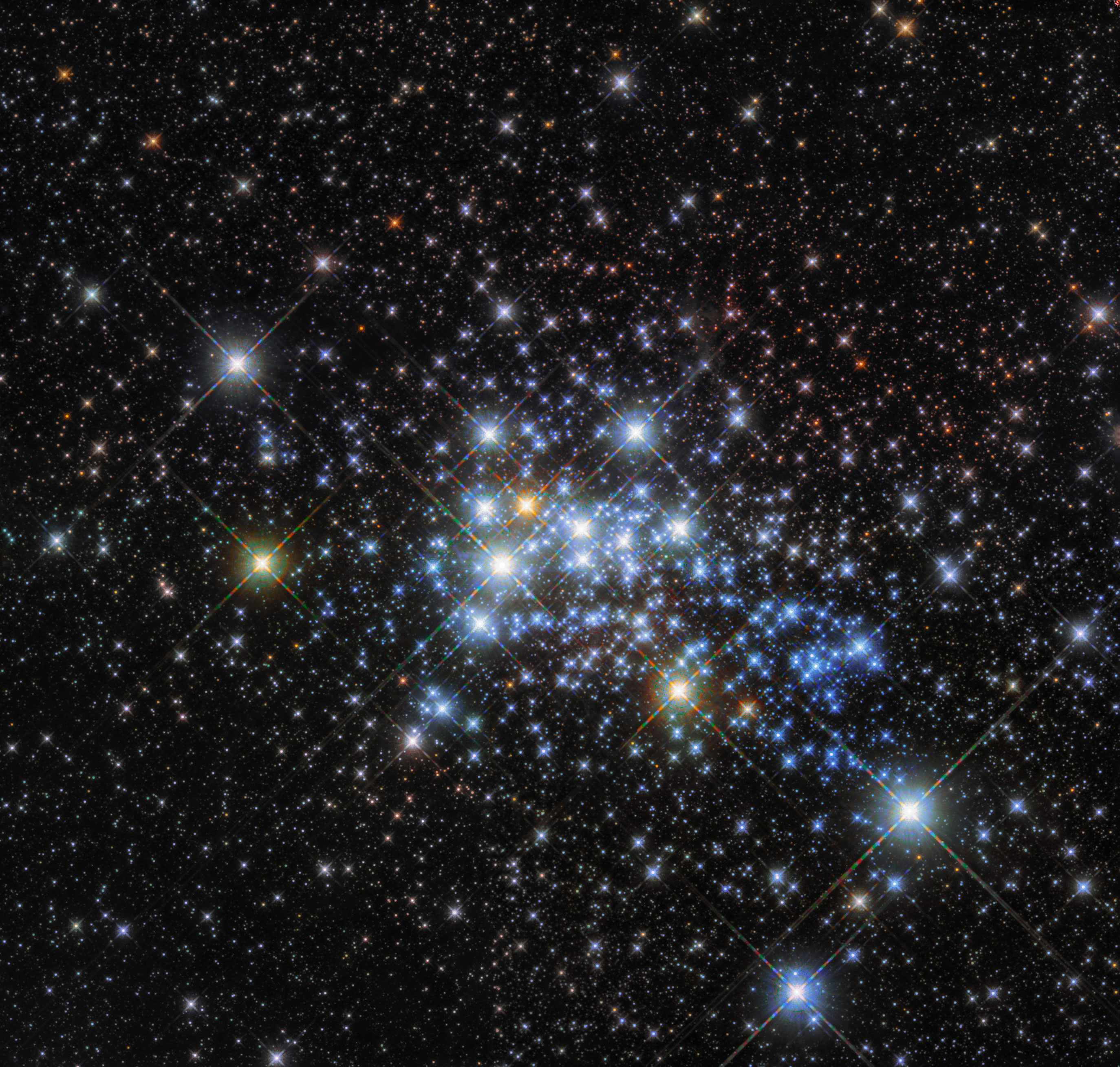
    Hubble Views Star Cluster Westerlund 1
    Located 15,000 light-years away, Westerlund 1 is a super star cluster that harbors one of the most massive stars ever identified. Credit: ESA/Hubble & NASA

    This newly released Hubble image shows star cluster Westerlund 1, which is located 15,000 light-years away.

    Light travels through space at just under 300,000 kilometers (186,400 miles) per second! This staggering speed is used to calculate astronomical distances; although often misinterpreted as a unit of time (due to its misleading name), a light-year is actually a unit of astronomical distance, and is defined as the distance that light travels in a year. For reference, this is around nine trillion kilometers (5 trillion miles)… but it’s a little tricky to visualize!

    With this in mind, 15,000 light-years may sound like a truly huge distance, but compared to the vastness of the cosmos, it’s really quite nearby. In fact, an object sitting 15,000 light-years away would not even be outside our home galaxy, the Milky Way. This is roughly the distance between us and a young super star cluster known as Westerlund 1, home to one of the largest stars ever discovered.

    Stars are classified according to their spectral type, surface temperature, and luminosity. While studying and classifying the cluster’s constituent stars, astronomers discovered that Westerlund 1 is home to one of the largest stars ever discovered, originally named Westerlund 1-26. It is a red supergiant (although sometimes classified as a hypergiant) with a radius over 1500 times that of our Sun. If Westerlund 1-26 were placed where our Sun is in our Solar System, it would extend out beyond the orbit of Jupiter.

    Most of Westerlund 1’s stars are thought to have formed in the same burst of activity, meaning that they have similar ages and compositions. The cluster is relatively young in astronomical terms —at around three million years old it is a baby compared to our own Sun, which is some 4.6 billion years old.


    Never miss a breakthrough: Join the SciTechDaily newsletter.
    Follow us on Google and Google News.

    Astronomy Cosmology Hubble Space Telescope
    Share. Facebook Twitter Pinterest LinkedIn Email Reddit

    Related Articles

    Hubble Image of the Week: Starburst Galaxy Messier 94

    ESO and Hubble Reveal Fast-Moving, Wave-Like Features in the Debris Disk Around AU Microscopii

    New Phoenix Cluster Observations Provide A Fresh Perspective

    Hubble Image of Arp 194 – Cosmic Optical Illusions in Ursa Major

    Hubble Image of the Week – Evolution in Slow Motion

    Hubble Explores the Wings of the Twin Jet Nebula

    Astronomers Discover Supernovae in ‘Wrong Place at Wrong Time’

    Hubble Reveals Diffusion of Stars Through the Core of the Globular Cluster 47 Tucanae

    Study Suggest Spiral Galaxies Are Larger Than Previously Thought

    Leave A Reply Cancel Reply

    • Facebook
    • Twitter
    • Pinterest
    • YouTube

    Don't Miss a Discovery

    Subscribe for the Latest in Science & Tech!

    Trending News

    Millions Take These IBS Drugs, But a New Study Finds Serious Risks

    Scientists Unlock Hidden Secrets of 2,300-Year-Old Mummies Using Cutting-Edge CT Scanner

    Bread Might Be Making You Gain Weight Even Without Eating More Calories

    Scientists Discover Massive Magma Reservoir Beneath Tuscany

    Europe’s Most Active Volcano Just Got Stranger – Here’s Why Scientists Are Rethinking It

    Alzheimer’s Symptoms May Start Outside the Brain, Study Finds

    Millions Take This Popular Supplement – Scientists Discover a Concerning Link to Heart Failure

    The Universe Is Expanding Too Fast and Scientists Can’t Explain Why

    Follow SciTechDaily
    • Facebook
    • Twitter
    • YouTube
    • Pinterest
    • Newsletter
    • RSS
    SciTech News
    • Biology News
    • Chemistry News
    • Earth News
    • Health News
    • Physics News
    • Science News
    • Space News
    • Technology News
    Recent Posts
    • Scientists Say a Hidden Structure May Exist Inside Earth’s Core
    • Doctors Surprised by the Power of a Simple Drug Against Colon Cancer
    • Why Popular Diabetes Drugs Like Ozempic Don’t Work for Everyone: The “Genetic Glitch”
    • Scientists Create Improved Insulin Cells That Reverse Diabetes in Mice
    • Scientists Stunned After Finding Plant Thought Extinct for 60 Years
    Copyright © 1998 - 2026 SciTechDaily. All Rights Reserved.
    • Science News
    • About
    • Contact
    • Editorial Board
    • Privacy Policy
    • Terms of Use

    Type above and press Enter to search. Press Esc to cancel.