
Close Menu
    Facebook X (Twitter) Instagram
    SciTechDaily
    • Biology
    • Chemistry
    • Earth
    • Health
    • Physics
    • Science
    • Space
    • Technology
    Facebook X (Twitter) Pinterest YouTube RSS
    SciTechDaily
    Home»Space»Hubble Space Telescope Captures a Star-Forming Chamaeleon
    Space

    Hubble Space Telescope Captures a Star-Forming Chamaeleon

    By NASA's Goddard Space Flight CenterFebruary 1, 20221 Comment2 Mins Read
    Facebook Twitter Pinterest Telegram LinkedIn WhatsApp Email Reddit
    Share
    Facebook Twitter LinkedIn Pinterest Telegram Email Reddit
    Chamaeleon Cloud Complex
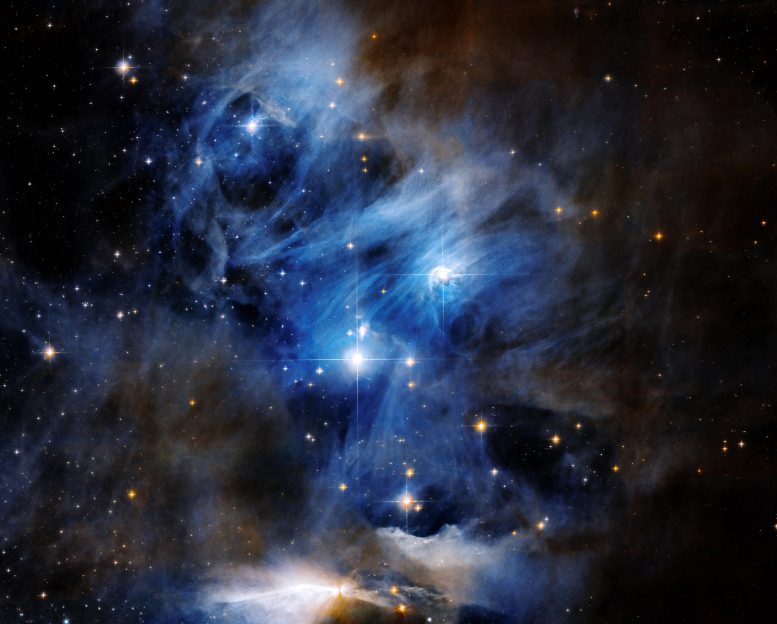
    Hubble Space Telescope image of Chamaeleon Cloud I (a segment of the Chamaeleon Cloud Complex), reveals dusty-dark clouds where stars are forming, dazzling reflection nebulae glowing by the light of bright-blue young stars, and radiant knots called Herbig-Haro objects. Credit: NASA, ESA, K. Luhman and T. Esplin (Pennsylvania State University), et al., and ESO; Processing: Gladys Kober (NASA/Catholic University of America)

    Herbig-Haro objects, such as HH 909A seen in the image, are created by jets of hot gas ejected from young protostars, which interact with interstellar gas.

    This NASA Hubble Space Telescope image captures one of three segments that comprise a 65-light-year-wide star-forming region named the Chamaeleon Cloud Complex. The segment in this Hubble composite image, called Chamaeleon Cloud I (Cha I), reveals dusty-dark clouds where stars are forming, dazzling reflection nebulae glowing by the light of bright-blue young stars, and radiant knots called Herbig-Haro objects.

    Herbig-Haro objects are bright clumps and arcs of interstellar gas shocked and energized by jets expelled from infant “protostars” in the process of forming. The white-orange cloud at the bottom of the image hosts one of these protostars at its center. Its brilliant white jets of hot gas are ejected in narrow torrents from the protostar’s poles, creating the Herbig-Haro object HH 909A.

    The cross-like spikes around bright stars in the image occur when light waves from a very bright point source (like a star) bend around Hubble’s cross-shaped struts that support the telescope’s secondary mirror. As the light waves pass these struts, they coalesce on the other side, creating the bright, spikey starburst effect we see.

    Hubble studied Cha I as part of a search for extremely dim, low-mass brown dwarfs. These “failed stars” lie somewhere in size between a large planet and a small star (10 to 90 times the mass of Jupiter), and do not have enough mass to ignite and sustain nuclear fusion in their cores. Hubble’s search found six new low-mass brown dwarf candidates that are helping astronomers better understand these objects.

    This 315-million-pixel composite image is comprised of 23 observations made by Hubble’s Advanced Camera for Surveys. Gaps between those observations were filled by 20 Wide Field and Planetary Camera 2 images. Any remaining gaps were filled with ground-based data from ESO’s VISTA VIRCAM. To download the full high-resolution version of this image, visit Hubble Captures Chamaeleon Cloud I.

    Never miss a breakthrough: Join the SciTechDaily newsletter.
    Follow us on Google and Google News.

    Astronomy Hubble Space Telescope NASA NASA Goddard Space Flight Center Popular
    Share. Facebook Twitter Pinterest LinkedIn Email Reddit

    Related Articles

    Historic Discovery: Twin Titans Clash As NASA Unveils Closest Supermassive Black Hole Duo

    The Great Escape: NASA’s Hubble and MAVEN Help Solve Mystery of Mars’ Vanishing Water

    Webb and Hubble Unite: A Breathtaking 3D Journey Through the Pillars of Creation

    Stellar Sleuths: Citizen Scientists and AI Uncover Hidden Asteroids With Hubble

    Stellar Fireworks: Hubble Revisits a Strange Star’s 40-Year Nova Mystery

    Cosmic Geode: Hubble Captures the Birth of a Sun-like Star

    Jupiter Unveiled: Hubble Captures the Giant’s Roaring Storms and Volcanic Moon Io

    Cyclones in Space? See How Hubble Uncovered Extreme Weather on a Distant Planet

    Saturn’s Seasonal Spectacle: Hubble’s Ultra-Sharp Vision Unveils Ring Spoke Phenomenon

    1 Comment

    1. Vrijesh Patel on February 5, 2022 12:27 am

      Is it possible ? if any asteroid came into the earth gravitational force and which is moving around to the earth ?

      Reply
    Leave A Reply Cancel Reply

    • Facebook
    • Twitter
    • Pinterest
    • YouTube

    Don't Miss a Discovery

    Subscribe for the Latest in Science & Tech!

    Trending News

    Bone-Strengthening Discovery Could Reverse Osteoporosis

    Scientists Uncover Hidden Trigger Behind Stem Cell Aging

    Scientists Find Way to Reverse Fatty Liver Disease Without Changing Diet

    Could Humans Regrow Limbs? New Study Reveals Promising Genetic Pathway

    Scientists Reveal Eating Fruits and Vegetables May Increase Your Risk of Lung Cancer

    Scientists Reverse Brain Aging With Simple Nasal Spray

    Scientists Uncover Potential Brain Risks of Popular Fish Oil Supplements

    Scientists Discover a Surprising Way To Make Bread Healthier and More Nutritious

    Follow SciTechDaily
    • Facebook
    • Twitter
    • YouTube
    • Pinterest
    • Newsletter
    • RSS
    SciTech News
    • Biology News
    • Chemistry News
    • Earth News
    • Health News
    • Physics News
    • Science News
    • Space News
    • Technology News
    Recent Posts
    • Men vs. Women: Scientists Uncover Dramatic Differences in How the Immune System Ages
    • Eating Chili Peppers Linked to Longer Life
    • Bread Might Be Making You Gain Weight Even Without Eating More
    • 4,000-Year-Old Tablets Reveal Lost Magic, Medicine, and Ancient Kings
    • AI Meets Quantum Computing and the Predictions Get Scary Accurate
    Copyright © 1998 - 2026 SciTechDaily. All Rights Reserved.
    • Science News
    • About
    • Contact
    • Editorial Board
    • Privacy Policy
    • Terms of Use

    Type above and press Enter to search. Press Esc to cancel.