
Close Menu
    Facebook X (Twitter) Instagram
    SciTechDaily
    • Biology
    • Chemistry
    • Earth
    • Health
    • Physics
    • Science
    • Space
    • Technology
    Facebook X (Twitter) Pinterest YouTube RSS
    SciTechDaily
    Home»Space»Hubble Unveils Explosive Supernova in Stunning Spiral Galaxy
    Space

    Hubble Unveils Explosive Supernova in Stunning Spiral Galaxy

    By ESA/HubbleNovember 5, 20243 Comments3 Mins Read
    Facebook Twitter Pinterest Telegram LinkedIn WhatsApp Email Reddit
    Share
    Facebook Twitter LinkedIn Pinterest Telegram Email Reddit
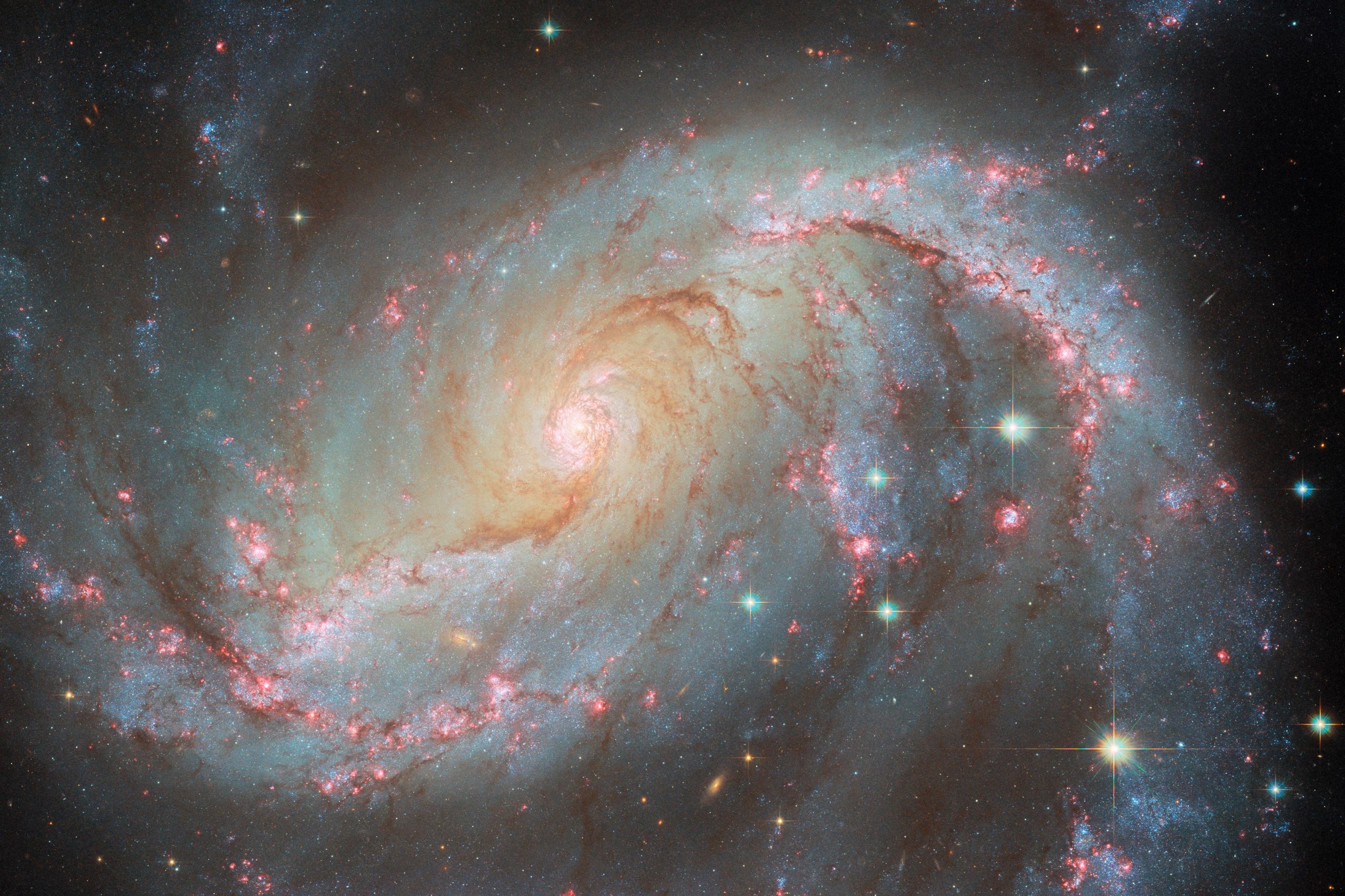
    Spiral Galaxy NGC 1672
    NGC 1672, a barred spiral galaxy featured in this Hubble Space Telescope image, exhibits an extraordinary light display from hydrogen gas, newly-formed hot stars, and a bright active galactic nucleus surrounding a supermassive black hole. A brief supernova, SN 2017GAX, adds a fleeting highlight. Credit: ESA/Hubble & NASA, O. Fox, L. Jenkins, S. Van Dyk, A. Filippenko, J. Lee and the PHANGS-HST Team, D. de Martin (ESA/Hubble), M. Zamani (ESA/Hubble)

    NGC 1672, a stunning barred spiral galaxy located 49 million light-years away in the constellation Dorado, puts on a dazzling light show, courtesy of Hubble’s detailed imaging.

    This mesmerizing Hubble Space Telescope image features NGC 1672, a barred spiral galaxy located 49 million light-years away in the constellation Dorado. NGC 1672 puts on a dazzling celestial light show, showcasing various types of cosmic lights. Like other spiral galaxies, its disk is filled with billions of stars that create a stunning glow. Along its two prominent spiral arms, clouds of hydrogen gas emit a vivid red glow, energized by the intense radiation of young, forming stars.

    Closer to the galaxy’s center are some particularly striking, newly-formed stars. Extremely hot, they sit within a ring of hot gas and emit powerful X-rays. At the very core lies the brightest X-ray source of all: an active galactic nucleus formed by the heated material spiraling into NGC 1672’s supermassive black hole, classifying NGC 1672 as a Seyfert galaxy.

    NGC 1672 Supernova SN 2017GAX
    In this collage two images of the spiral galaxy NGC 1672 are compared: one showing supernova SN 2017GAX as a small green dot, and the other without. The difference between the images is that both have been created by processing multiple individual Hubble images, each taken to capture a specific wavelength of visible light, and combining them to make a full-colour image. In one of those filtered frames, taken in 2017, the fading supernova is still visible; the second image does not use that frame, instead using some older Hubble data. The result is this spot-the-difference game – a game that astronomers have to play to see supernovae in the first place, and they don’t get a guide! Credit: ESA/Hubble & NASA, O. Fox, L. Jenkins, S. Van Dyk, A. Filippenko, J. Lee and the PHANGS-HST Team, D. de Martin (ESA/Hubble), M. Zamani (ESA/Hubble)

    But a highlight of this image is the most fleeting and temporary of these lights: supernova SN 2017GAX, visible in just one of the six Hubble images that make up this composite image. This was a Type I supernova caused by the core collapse and subsequent explosion of a giant star, going from invisibility to a new light in the sky in just a matter of days.

    In that image from later that year, the supernova is already fading, and so is only just visible here as a small green dot, just below the crook of the spiral arm on the right side. In fact, this was on purpose, as astronomers wanted to look for any companion star that the supernova progenitor may have had — something impossible to spot beside a live supernova! For a closer look at the supernova’s appearance, you can compare the two images with this slider tool.

    Recently, NGC 1672 was also among a crop of galaxies imaged with the James Webb Space Telescope (JWST), showing the ring of gas and the structure of dust in its spiral arms.

    Never miss a breakthrough: Join the SciTechDaily newsletter.
    Follow us on Google and Google News.

    Astronomy European Space Agency Hubble Space Telescope
    Share. Facebook Twitter Pinterest LinkedIn Email Reddit

    Related Articles

    A Diamond Necklace of Cosmic Proportions

    Hubble Snaps a Stunning Close-Up of a Magnificent Spiral Galaxy

    Extraordinary Hubble Image: Light Bends From the Beyond

    Hubble Space Telescope Sees Volcanic Activity Reforming the Atmosphere on a Rocky Exoplanet

    Hubble Spies a Luminous Heart With Dark Tendrils

    Spectacular Return to the Veil Nebula

    Hubble Spots a Peculiar Sight: Unusual Spiral Galaxy With a Heavy Arm

    A Flash of Life: Hubble Spies an Unusual Planetary Nebula

    Through the Cosmic Clouds: Hubble Spots a Beautiful Stellar Nursery

    3 Comments

    1. Jojo on November 5, 2024 1:12 am

      “Like other spiral galaxies, its disk is filled with billions of stars that create a stunning glow. ”
      —
      That “glow” is from a prodigious amount of light energy put out by massed stars in that galaxy, which makes it visible 49 MILLION light years away!

      Reply
      • Samuel Bess. on November 6, 2024 11:22 am

        My, how that knowledge benefits me? Millions of light years?
        How long ago did that event occur if we are just now seeing it?
        Let’s not get arrogant since we are living in a goldilocks planet of insignificance compared to the created heavens.

        Reply
    2. Sabrina Green on November 5, 2024 1:47 pm

      It’s amazing how beautiful the depth of space is yet we have so much more to study, find and learn . Thank you for being a great and hungry mind of space.

      Reply
    Leave A Reply Cancel Reply

    • Facebook
    • Twitter
    • Pinterest
    • YouTube

    Don't Miss a Discovery

    Subscribe for the Latest in Science & Tech!

    Trending News

    Artificial Sweeteners May Harm Future Generations, Study Suggests

    Splashdown! NASA Artemis II Returns From Record-Breaking Moon Mission

    What If Consciousness Exists Beyond Your Brain

    Scientists Finally Crack the 100-Million-Year Evolutionary Mystery of Squid and Cuttlefish

    Beyond “Safe Levels”: Study Challenges What We Know About Pesticides and Cancer

    Researchers Have Found a Dietary Compound That Increases Longevity

    Scientists Baffled by Bizarre “Living Fossil” From 275 Million Years Ago

    Your IQ at 23 Could Predict Your Wealth at 27, Study Finds

    Follow SciTechDaily
    • Facebook
    • Twitter
    • YouTube
    • Pinterest
    • Newsletter
    • RSS
    SciTech News
    • Biology News
    • Chemistry News
    • Earth News
    • Health News
    • Physics News
    • Science News
    • Space News
    • Technology News
    Recent Posts
    • What if Dark Matter Has Two Forms? Bold New Hypothesis Could Explain a Cosmic Mystery
    • Researchers Expose Hidden Chemistry of “Ore-Forming” Elements in Biology
    • Geologists Reveal the Americas Collided Earlier Than We Thought
    • 20x Difference: Study Reveals True Source of Airborne Microplastics
    • Scientists Uncover Hidden Force Powering Yellowstone’s Supervolcano
    Copyright © 1998 - 2026 SciTechDaily. All Rights Reserved.
    • Science News
    • About
    • Contact
    • Editorial Board
    • Privacy Policy
    • Terms of Use

    Type above and press Enter to search. Press Esc to cancel.