
Close Menu
    Facebook X (Twitter) Instagram
    SciTechDaily
    • Biology
    • Chemistry
    • Earth
    • Health
    • Physics
    • Science
    • Space
    • Technology
    Facebook X (Twitter) Pinterest YouTube RSS
    SciTechDaily
    Home»Space»Hubble’s Stellar Detective Work: Unmasking the Milky Way’s Hidden Jewel
    Space

    Hubble’s Stellar Detective Work: Unmasking the Milky Way’s Hidden Jewel

    By NASA's Goddard Space Flight CenterNovember 9, 2023No Comments4 Mins Read
    Facebook Twitter Pinterest Telegram LinkedIn WhatsApp Email Reddit
    Share
    Facebook Twitter LinkedIn Pinterest Telegram Email Reddit
    Glittering Globular Cluster Terzan 12
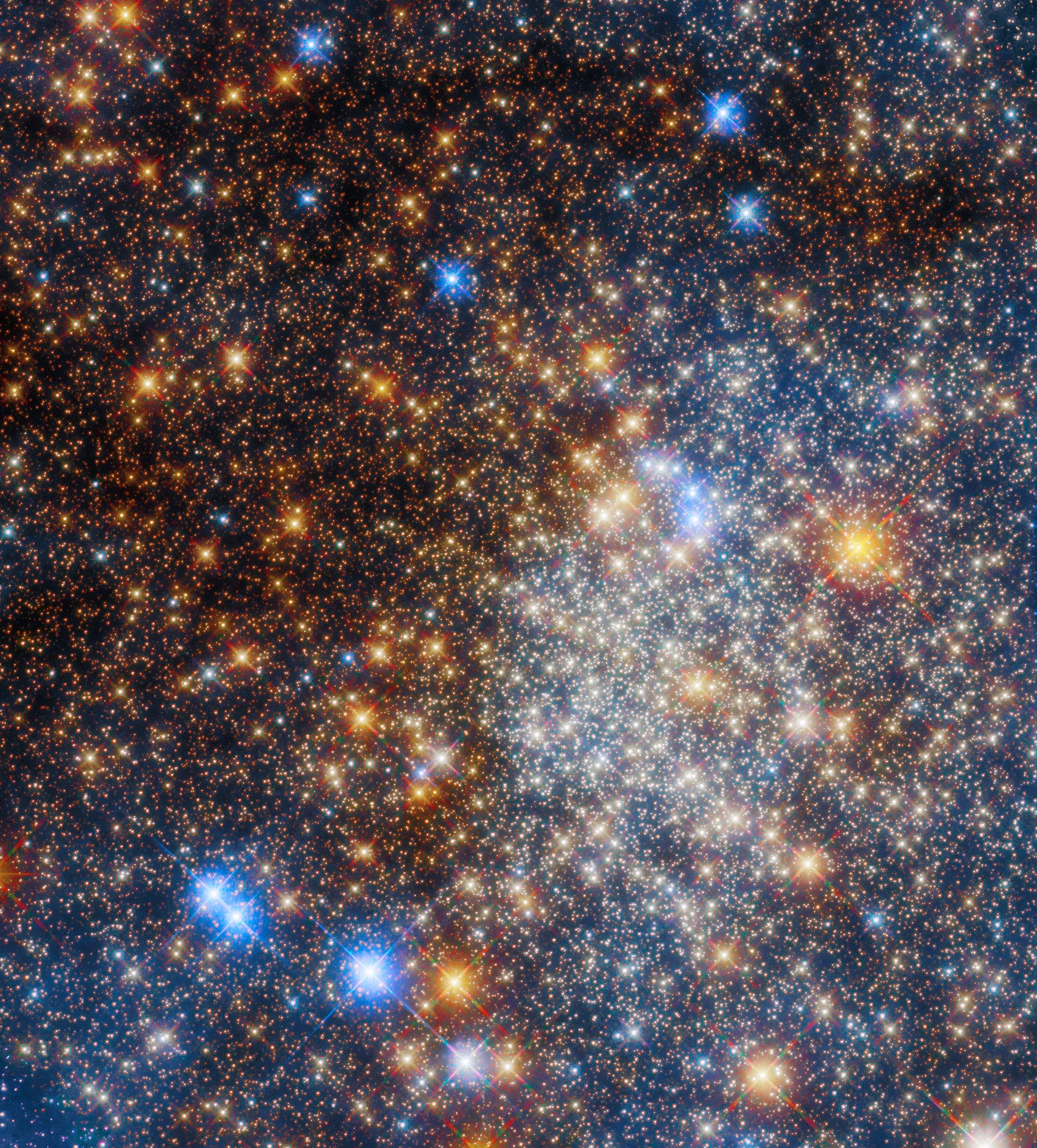
    This image captured by the Hubble Space Telescope features the dazzling Terzan 12, a dense assembly of stars bound together by gravity. This observation is part of a focused effort to study the globular clusters near the heart of our galaxy, including this one in the Sagittarius constellation. Deep within the Milky Way, clusters like Terzan 12 are often obscured by clouds of gas and dust. These clouds can obscure or change the starlight that we see from these clusters. Credit: ESA/Hubble & NASA, R. Cohen (Rutgers University)

    The Hubble Space Telescope has captured a vivid image of the globular star cluster Terzan 12, illustrating how space dust can affect starlight.

    This colorful image of the globular star cluster Terzan 12 is a spectacular example of how dust in space affects starlight coming from background objects.

    A globular star cluster is a conglomeration of stars, arranged in a spheroidal shape. Stars in globular clusters are bound together by gravity, with a higher concentration of stars towards the center. The Milky Way has about 150 ancient globular clusters at its outskirts. These clusters orbit around the galactic center, but far above and below the pancake-flat plane of our galaxy, like bees buzzing around a hive.

    Dust’s Play on Starlight

    The location of this globular cluster, deep in the Milky Way in the constellation Sagittarius, means that it is shrouded in gas and dust which absorb and alter the starlight emanating from Terzan 12. The cluster is about 15,000 light-years from Earth. This location leaves a lot of room for intervening interstellar dust particles between us and the cluster to scatter blue light, causing only the redder wavelengths to come through to Earth. The interstellar dust clouds are mottled so that different parts of the cluster look redder than other parts along our line of sight.

    The brightest red stars in the photo are bloated, aging giants, many times larger than our Sun. They lie between Earth and the cluster. Only a few may actually be members of the cluster. The very brightest hot, blue stars are also along the line of sight and not inside the cluster, which only contains aging stars.
    Hubble Sees a Glittering Globular Cluster Embedded Inside Our Milky Way
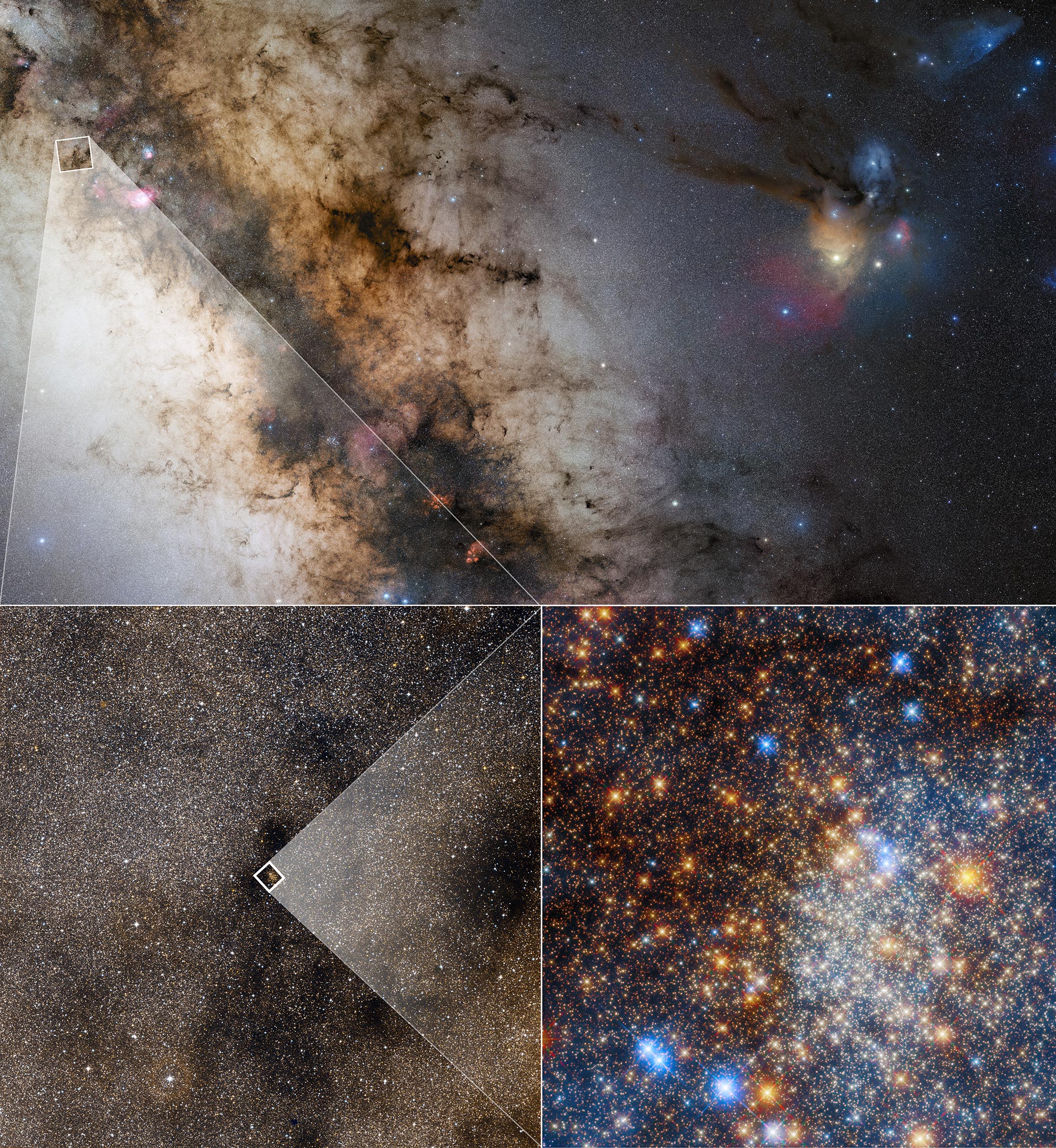
    This composite image shows the location of the globular star cluster Terzan 12 as seen by the NASA/ESA Hubble Space Telescope.
    Top: A view of a section of our Milky Way in the direction of the constellation Sagittarius. Dense clouds of dust are etched across a whitish background of stars. The object at upper right is the Rho Ophiuchi cloud complex.
    Bottom left: Photo of a small portion of the Milky Way which is only one-degree across – twice the angular diameter of the full moon. The globular cluster is in the image center.
    Bottom Right: A new Hubble Space Telescope image of the dense cluster Terzan 12. Intervening dust scatters starlight to create multiple reddish hues. The brightest red stars in the photo are bloated, aging giants, many times larger than our Sun. They lie between Earth and the cluster. Only a few may actually be members of the cluster. The very brightest hot, blue stars are also along the line of sight and not inside the cluster, which only contains aging stars. The cluster is about 15,000 light-years from Earth.
    Credit: NASA, ESA, Stéphane Guisard, ESO, Digitized Sky Survey, ESA/Hubble, Roger Cohen (Rutgers University), Joseph DePasquale (STScI)

    The Legacy of Terzan and Hubble’s Contribution

    Terzan 12 is one of 11 globular clusters discovered by the Turkish-Armenian astronomer Agop Terzan approximately a half-century ago. With its sharp vision, Hubble has revolutionized the study of globular clusters ever since its launch in 1990. Hubble observations have shed light on the relation between age and composition in the Milky Way galaxy’s innermost globular clusters.

    The Hubble Space Telescope is a project of international cooperation between NASA and ESA. NASA’s Goddard Space Flight Center in Greenbelt, Maryland, manages the telescope. The Space Telescope Science Institute (STScI) in Baltimore, Maryland, conducts Hubble science operations. STScI is operated for NASA by the Association of Universities for Research in Astronomy, in Washington, D.C.

    Never miss a breakthrough: Join the SciTechDaily newsletter.
    Follow us on Google and Google News.

    Astronomy Hubble Space Telescope NASA Space Telescope Science Institute
    Share. Facebook Twitter Pinterest LinkedIn Email Reddit

    Related Articles

    What Are These Weird Structures Hubble Spotted Near a Monster Black Hole?

    A Star’s Unexpected Heatwave: FU Orionis Challenges Astrophysics Models

    NASA’s Hubble Reveals How the LMC Defied Galactic Destruction

    Legendary Star’s Smooth Disk Mystifies Astronomers, Challenges Planet Formation Theories

    Cosmic Horror Unveiled: NASA Reveals “Blood-Soaked Eyes” Staring From Deep Space [Video]

    Spanning 248 Billion Miles: Stunning Hubble Timelapse Captures a Star’s Violent Eruptions

    Jupiter’s Great Red Spot Enigma: Unexplained Oscillations Baffle Astronomers

    Unlocking Uranus: NASA’s Dual Observations Pave the Way to Discovering New Worlds

    Astronomers Baffled by Black Hole Jets Igniting Star Explosions

    Leave A Reply Cancel Reply

    • Facebook
    • Twitter
    • Pinterest
    • YouTube

    Don't Miss a Discovery

    Subscribe for the Latest in Science & Tech!

    Trending News

    Your Blood Pressure Reading Could Be Wrong Because of One Simple Mistake

    Astronomers Stunned by Ancient Galaxy With No Spin

    Physicists May Be on the Verge of Discovering “New Physics” at CERN

    Scientists Solve 320-Million-Year Mystery of Reptile Skin Armor

    Scientists Say This Daily Walking Habit May Be the Secret to Keeping Weight Off After Dieting

    New Therapy Rewires the Brain To Restore Joy in Depression Patients

    Giant Squid Detected off Western Australia in Stunning Deep-Sea Discovery

    Popular Sugar-Free Sweetener Linked to Liver Disease, Study Warns

    Follow SciTechDaily
    • Facebook
    • Twitter
    • YouTube
    • Pinterest
    • Newsletter
    • RSS
    SciTech News
    • Biology News
    • Chemistry News
    • Earth News
    • Health News
    • Physics News
    • Science News
    • Space News
    • Technology News
    Recent Posts
    • Scientists Solve a 60-Year-Old Fat Cell Mystery — and It Changes What We Know About Obesity
    • A Crucial Atlantic Current Is Weakening and Weather Could Change Worldwide
    • Scientists Stunned As Volcano Removes Methane From the Air
    • Scientists Discover Signs Africa May Be Splitting Apart Beneath Zambia
    • New Stroke Study Challenges Decades-Old Medical Beliefs
    Copyright © 1998 - 2026 SciTechDaily. All Rights Reserved.
    • Science News
    • About
    • Contact
    • Editorial Board
    • Privacy Policy
    • Terms of Use

    Type above and press Enter to search. Press Esc to cancel.