
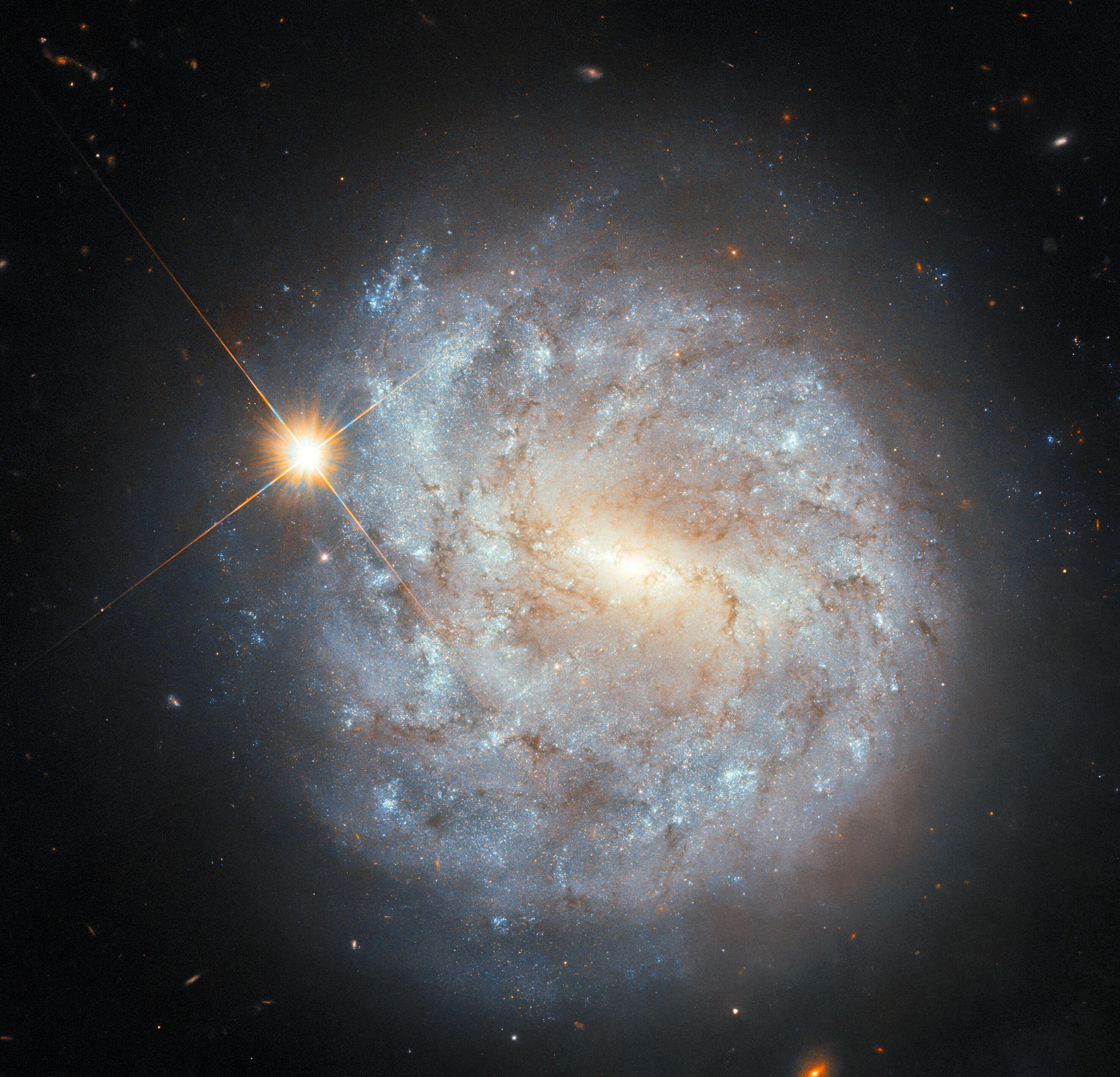
A stunning Hubble image showcases a spiral galaxy seemingly intertwined with a nearby star—but looks can be deceiving!
This new Hubble Space Telescope image showcases a dazzling spiral galaxy alongside a bright foreground star, both located in the constellation Virgo. Although they appear close together, almost overlapping, they are actually separated by an immense distance. The star, identified by its four long diffraction spikes, is within our own Milky Way galaxy, just 7,109 light-years from Earth. Meanwhile, the spiral galaxy, NGC 4900, is much farther away, located about 45 million light-years from Earth.
This striking image is a blend of data collected by two of Hubble’s instruments: the Advanced Camera for Surveys (ACS), installed in 2002 and still in use today, and the Wide Field and Planetary Camera 2 (WFC2), which was operational from 1993 to 2009. The data were gathered more than 20 years apart as part of two separate research programs, highlighting Hubble’s remarkable longevity in scientific discovery.
Both programs focused on understanding the death of massive stars. One study examined the locations of past supernovae, helping scientists estimate the original masses of the stars that exploded and explore how supernovae interact with their surroundings. NGC 4900 was chosen for observation because it hosted a supernova known as SN 1999br, providing valuable clues about the life cycle of stars.
In the other program, researchers laid the groundwork for studying future supernovae by collecting images of more than 150 nearby galaxies. After a supernova is detected in one of these galaxies, researchers can examine these images, searching for a star at the location of the supernova. Identifying a supernova progenitor star in pre-explosion images gives valuable information about how, when and why supernovae occur.
Never miss a breakthrough: Join the SciTechDaily newsletter.
Follow us on Google and Google News.