
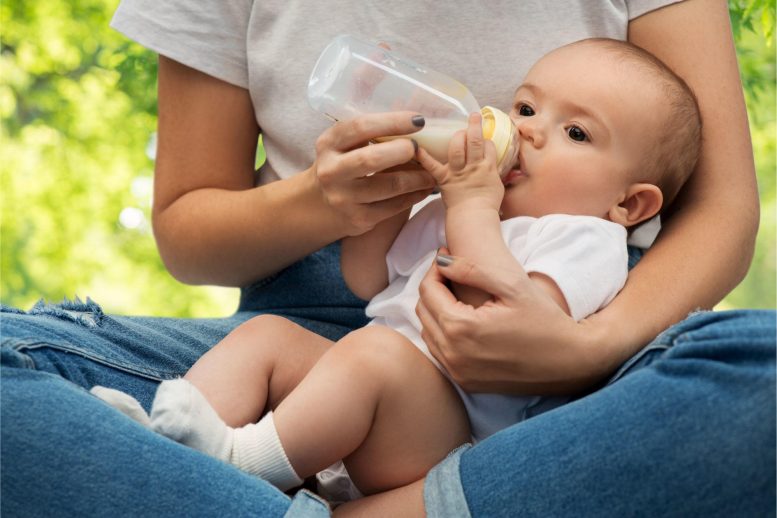
New Research Suggests That Not All Infant Formulas Are Equally Nutritious
Many baby formulas make grand promises. Numerous brands assert that they aid in brain development, enhance immunity, foster growth and development in children, and more.
Recently, a research team headed by Imperial College London has examined the validity of these claims. The findings have been published in The BMJ.
“Most of the claims about the health-giving and nutritional properties of breast milk substitutes seem to be based on little or no evidence,” the research group says.
Claims surrounding these replacement milk products are controversial. They can give the impression that infant formulas are just as good as breast milk, and perhaps even better, without any scientific basis for the claim.
Many Breastfeeding Mums in Norway
The researchers examined products from 15 countries with different social and economic conditions. Norwegian data are also included.
Norway has had a tradition of breastfeeding infants for a long time. Four out of five infants in Norway still receive breast milk when they are six months old, and only two percent never receive any breast milk (in Norwegian).
“Supportive social arrangements and long parental leave contribute to allowing many mothers in Norway to breastfeed,” says Melanie Rae Simpson, an associate professor at NTNU’s Department of Public Health and Nursing.
Simpson has contributed data to the new survey. She is happy about the social arrangements.
“Strict rules for marketing breast milk substitutes mean that advertising doesn’t influence how long women in Norway breastfeed,” says Simpson.
At the same time, some infant formulas make a lot of promises.
Norwegian Claims Maybe Not So Crazy, but Could Be Better
“A relatively high proportion of the products available in Norway include one or more claims about being beneficial for health,” says Simpson.
But that doesn’t necessarily mean that the situation in Norway is that bad.
“With so many women who breastfeed, we don’t have as many different types of infant formula in our grocery stores compared to some of the other countries in the study,” she says.
This means that a relatively high proportion of the products in Norway are sold in pharmacies.
“These are basically made for children with special needs,” Simpson points out.
The claims of these products are therefore often linked precisely to the special needs of children, but not always.
Norway has clear legislation to prevent undocumented claims from being used in connection with breast milk substitutes. Nevertheless, the documentation was characterized by the same challenges around transparency, independence from industry and scientific quality that the research group saw in the other countries.
608 out of 757 Made Claims
The research group examined the websites of the various companies that make infant formula. They also inspected the packaging of the products and checked all the health and nutrition claims against the documentation.
The research group found 41 different ingredients linked to these claims, but several companies also market their products without referring to specific ingredients.
The group tested a total of 757 products, and 608 of them included at least one of a total of 31 different claims about nutrition and health.
The Industry Runs Its Own Research
Only 161 of the 608 products referred to scientific research to support their claims. But only a small number, about 14 percent of the investigations, were clinical investigations carried out on humans.
Of these, the researchers found that 90 percent had a high risk of biased research. This was either because they had received money from the industry or the research was simply carried out by the industry itself.
Much of the so-called “research” consists of reviews, opinions, and other forms of research that do not meet high enough quality requirements, such as research on non-human species.
On average, the products included two claims. But the aggressiveness of the marketing varies greatly, from an average of one claim in Australia to as many as four claims in the USA.
Calls for Stricter Rules
The research group wants stricter rules, and quickly. This is to better protect users and to avoid aggressive marketing having unwanted consequences for children’s health.
The researchers are supported by Professor Nigel Rollins from the World Health Organization (WHO). He believes that self-regulation, where the industry itself largely runs the research on product effectiveness, is clearly not good enough. Regulatory authorities in the various countries should therefore consider whether they need to do something to improve conditions.
Reference: “Health and nutrition claims for infant formula: international cross sectional survey” by Ka Yan Cheung, Loukia Petrou, Bartosz Helfer, Erika Porubayeva, Elena Dolgikh, Sana Ali, Insaf Ali, Lindsay Archibald-Durham, Meredith (Merilee) Brockway, Polina Bugaeva, Rishma Chooniedass, Pasquale Comberiati, Erika Cortés-Macías, Sofia D’Elios, Gavriela Feketea, Peter Hsu, Musa Abubakar Kana, Tatiana Kriulina, Yuzuka Kunii, Comfort Madaki, Rihab Omer, Diego Peroni, Jana Prokofiev, Melanie Rae Simpson, Naoki Shimojo, Linda P Siziba, Jon Genuneit, Sohini Thakor, Marium Waris, Quan Yuan, Sadia Zaman, Bridget E Young, Brighid Bugos, Matthew Greenhawt, Michael E Levin, Jonathan Zheng, Robert J Boyle and Daniel Munblit, 15 February 2023, The BMJ.
DOI: 10.1136/bmj-2022-071075
Products from Norway, Australia, Canada, Germany, India, Italy, Japan, Nigeria, Pakistan, Russia, Saudi Arabia, South Africa, Spain, Great Britain and the USA were included in the study.
Never miss a breakthrough: Join the SciTechDaily newsletter.
Follow us on Google and Google News.