
Close Menu
    Facebook X (Twitter) Instagram
    SciTechDaily
    • Biology
    • Chemistry
    • Earth
    • Health
    • Physics
    • Science
    • Space
    • Technology
    Facebook X (Twitter) Pinterest YouTube RSS
    SciTechDaily
    Home»Earth»Intriguing Details of Giant Straight-Tusked Elephants Chronicled in New Study
    Earth

    Intriguing Details of Giant Straight-Tusked Elephants Chronicled in New Study

    By University of BristolJanuary 25, 2020No Comments4 Mins Read
    Facebook Twitter Pinterest Telegram LinkedIn WhatsApp Email Reddit
    Share
    Facebook Twitter LinkedIn Pinterest Telegram Email Reddit
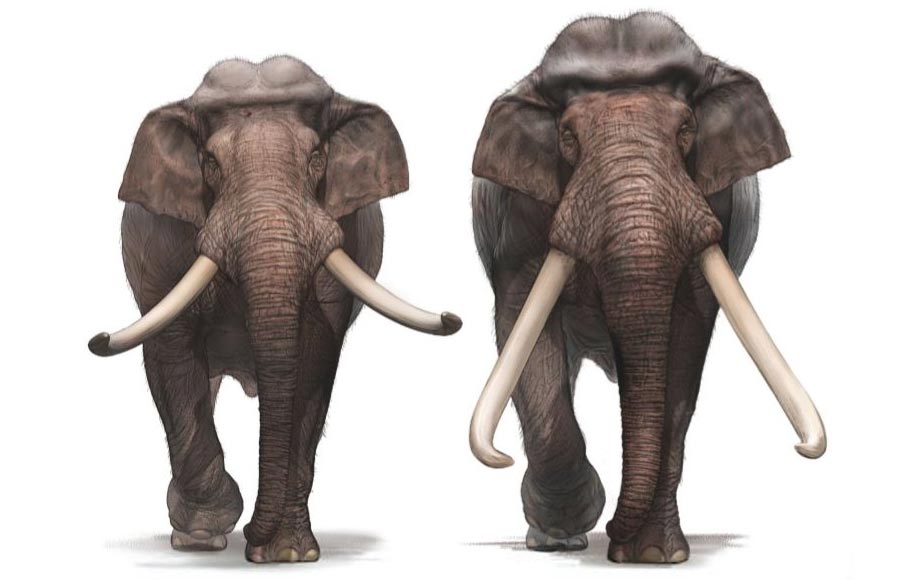
    European Straight Tusked Elephant Front
    Reconstructed life appearance of the extinct European straight-tusked elephant Palaeoloxodon antiquus in frontal view, based on remains uncovered from the Neumark-Nord 1 site in Saxony-Anhalt, Germany. Credit: Hsu Shu-yu

    About 800,000 years ago, the giant straight-tusked elephant Palaeoloxodon migrated out of Africa and became widespread across Europe and Asia.

    It divided into many species, with distinct types in Japan, Central Asia, and Europe — even some dwarf forms as large as a small donkey on some Mediterranean islands.

    In a new study by scientists in Spain, Italy, and the UK, including University of Bristol Ph.D. student Hanwen Zhang, published in the journal, Quaternary Science Reviews, some order has been brought into our understanding of all these species.

    The most intriguing feature of the straight-tusked elephant, apart from its absolutely enormous size, is the massive, headband-like crest on the skull roof which projects down the forehead. When the celebrated Victorian Scottish geologist Hugh Falconer studied the first fossil skull of Palaeoloxodon found in India, he remarked that the head seemed ‘so grotesquely constructed that it looks the caricature of an elephant’s head in a periwig.’
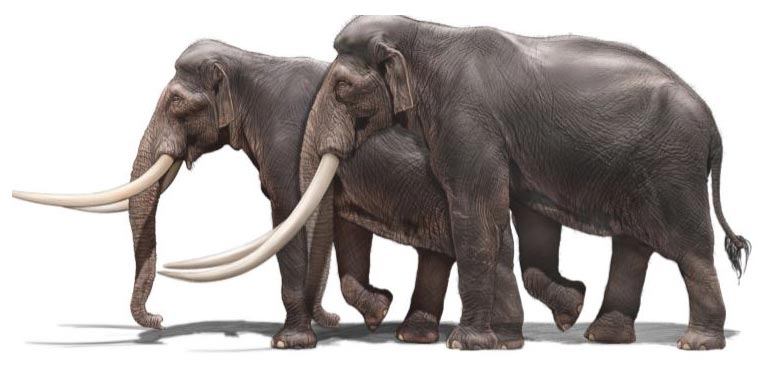
    European Straight Tusked Elephant
    Reconstructed life appearance of the extinct European straight-tusked elephant Palaeoloxodon antiquus in side view, based on remains uncovered from the Neumark-Nord 1 site in Saxony-Anhalt, Germany. Credit: Hsu Shu-yu

    For a long time, paleontologists thought that the European species, Palaeoloxodon antiquus, had a rather slenderly built skull roof crest; whereas the Indian species Palaeoloxodon namadicus, is characterized by an extremely robust skull crest that extends near to the base of the trunk from the top of the skull.

    But some Palaeoloxodon skulls, found in Italy and Germany, with almost the same exaggerated skull crest as the Indian form, led a few experts into suspecting these might all be single species.

    Hanwen Zhang, who is based in Bristol’s School of Earth Sciences, said: “Just like modern elephants, Palaeoloxodon went through six sets of teeth in their lifetimes. This means we can tell the age of any individual with confidence by looking at its fossilized teeth.

    “When we looked at a series of skulls from Italy, Germany, and India, we found a consistent pattern: the skull crest developed from being very small, not protruding beyond the forehead in juveniles to being larger and more protruding in young adults, eventually becoming very stout in aged adults.”

    The study’s lead author, Asier Larramendi, an independent researcher from Spain, added: “As I plotted various skull and limb bone measurements for these incredible prehistoric elephants, it became clear that the Indian Palaeoloxodon form a distinct group from the European ones; even in European skulls with quite pronounced crests, the skull roof never becomes as thickened as in the Indian specimens.

    “This tells us we once had two separate species of these enormous elephants in Europe and India.

    “Besides the funky skull roof crest, the head of the straight-tusked elephant is also remarkable for being huge, the largest of any elephant ever — some 4.5 feet (1.4 meters) from the top of the skull roof to the base of the tusk sheaths!

    “Therefore, the skull crest probably evolved to provide additional attachment areas for extra neck muscles, so the animal did not fall on its head.”

    Hanwen Zhang said: “Having gotten to the bottom of the antiquus/namadicus problem, it then became apparent that other fossil skull materials found in Asia and East Africa represent distinct, possibly more evolutionarily conservative species of Palaeoloxodon.

    “Even in fully mature adults with the last set of teeth in place, the skull roof crest remains comparatively unpronounced. This is the case with the earliest Palaeoloxodon from Africa, some Asian species retained this condition.”

    Reference: “The evolution of Palaeoloxodon skull structure: Disentangling phylogenetic, sexually dimorphic, ontogenetic, and allometric morphological signals” by Asier Larramendi, Hanwen Zhang, Maria Rita Palombo and Marco P. Ferretti, 17 December 2019, Quaternary Science Reviews.
    DOI: 10.1016/j.quascirev.2019.106090

    Never miss a breakthrough: Join the SciTechDaily newsletter.
    Follow us on Google and Google News.

    Elephants Evolution Paleontology University of Bristol
    Share. Facebook Twitter Pinterest LinkedIn Email Reddit

    Related Articles

    Global Climate Dynamics Drove the Decline of Mastodonts and Elephants, Not Overhunting by Early Humans

    Discovery of a New Mass Extinction – Carnian Pluvial Episode – 233 Million Years Ago

    Giant Armored Fish Fed Similar to Basking Sharks 380-Million-Years Ago

    What Came First, the Animal or the Embryo? New Research Has Answer

    It Seems There Were Too Many Meat-Eating Dinosaurs – This May Be the Explanation

    Gap in Fossil Record Filled by Find From School Class Hike – Ancient Rhinos Roamed the Yukon

    It Really Was the Asteroid That Ended the Dinosaurs – Here’s How It Went Down

    Ancient Crocodiles Were a Much More Diverse Species – Fascinating Research Describes What They Ate

    New Discovery Changes Perceptions of the Evolution of Earth’s Biosphere

    Leave A Reply Cancel Reply

    • Facebook
    • Twitter
    • Pinterest
    • YouTube

    Don't Miss a Discovery

    Subscribe for the Latest in Science & Tech!

    Trending News

    Mezcal “Worm” in a Bottle Mystery: DNA Testing Reveals a Surprise

    New Research Reveals That Your Morning Coffee Activates an Ancient Longevity Switch

    This Is What Makes You Irresistible to Mosquitoes

    Shockingly Powerful Giant Octopuses Ruled the Seas 100 Million Years Ago

    Scientists Stunned by New Organic Molecules Found on Mars

    Rewriting Dinosaur Evolution: Scientists Unearth Remarkable 150-Million-Year-Old Stegosaur Skull

    Omega-3 Supplements Linked to Cognitive Decline in Surprising New Study

    First-of-Its-Kind Discovery: Homer’s Iliad Found Embedded in a 1,600-Year-Old Egyptian Mummy

    Follow SciTechDaily
    • Facebook
    • Twitter
    • YouTube
    • Pinterest
    • Newsletter
    • RSS
    SciTech News
    • Biology News
    • Chemistry News
    • Earth News
    • Health News
    • Physics News
    • Science News
    • Space News
    • Technology News
    Recent Posts
    • Male Birth Control Breakthrough: Scientists Find Way To Turn Sperm Production Off and Back On
    • A Common Vitamin Could Hold the Key to Treating Fatty Liver Disease
    • New Research Shows Vitamin B12 May Hold the Key to Healthy Aging
    • Scientists Map Thousands of Brain Connections With RNA Barcodes
    • This Gene Tweak Turns Strawberries Into Healthier, Tastier Superfruit
    Copyright © 1998 - 2026 SciTechDaily. All Rights Reserved.
    • Science News
    • About
    • Contact
    • Editorial Board
    • Privacy Policy
    • Terms of Use

    Type above and press Enter to search. Press Esc to cancel.