
Recent research has turned previous assumptions about sea star evolution on their head by suggesting that the Asteriidae family originated much later than previously believed.
Utilizing extensive phylogenetic analysis of both fossil and modern species, this study introduces new Jurassic genera and suggests a more complex early diversity than once thought.
Reshaping Evolutionary Understanding in Marine Biology
A study published today (October 31) in PeerJ Life and Environment has transformed our understanding of sea star evolution, particularly within the family Asteriidae. Titled “Phylogenetic and Taxonomic Revisions of Jurassic Sea Stars Support a Delayed Evolutionary Origin of the Asteriidae,” the research presents findings that challenge established views on the timeline of these marine invertebrates.
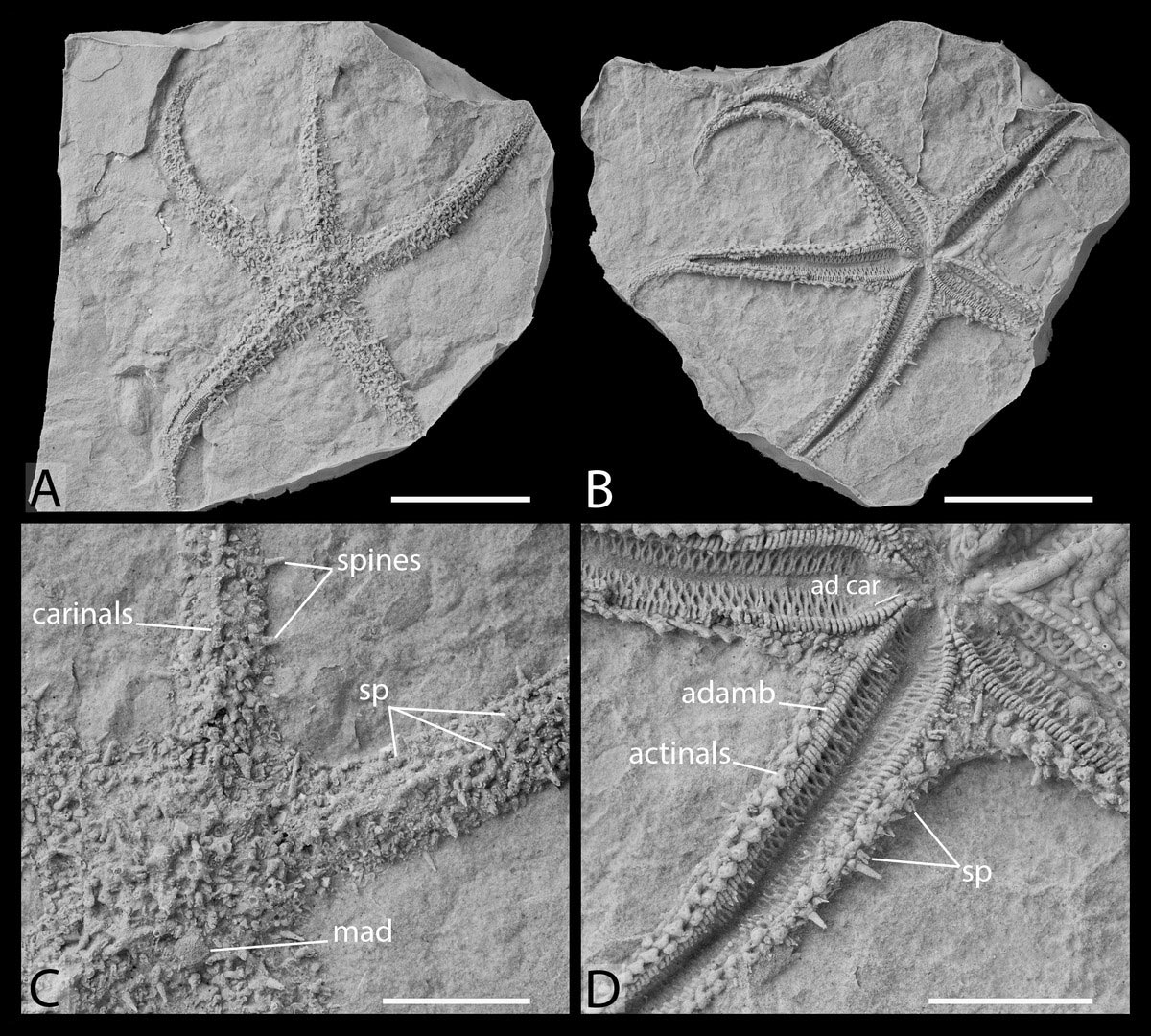
Sea stars in the superorder Forcipulatacea, which includes about 400 species, play a vital role in marine ecosystems. For over a century, scientists have debated the classifications within this group, resulting in various taxonomic perspectives. This new study revisits six well-preserved Jurassic sea star fossils and finds that none of them belong to modern families like Asteriidae. Instead, they represent stem-forcipulatids, suggesting that Asteriidae likely emerged later, in the Late Cretaceous, rather than during the Jurassic period as previously believed.
Key Findings:
- Comprehensive Phylogenetic Reassessment: The study employed cutting-edge phylogenetic methods to analyze 42 fossil and extant sea star species, creating the largest phylogenetic dataset for Forcipulatacea to date. This comprehensive matrix of 120 morphological traits provided a fresh perspective on the evolution of this group.
- Discovery of New Genera: Researchers described two new Jurassic sea star genera, Forbesasterias and Marbleaster, which contribute to our understanding of early sea star diversity and morphology.
- Delayed Origin of Asteriidae: The research concludes that Asteriidae, the largest family within Forcipulatacea, and the third largest family of sea stars, likely evolved during the Late Cretaceous, up to 100 million of years after the Jurassic species analyzed in this study. This contradicts previous assumptions that placed the origin of Asteriidae in the Triassic or Early Jurassic.
- Early Diversity of Forcipulatacea: The findings also suggest that Forcipulatacea was more diverse in its early evolutionary stages than previously believed, providing new insights into the adaptive radiation of these species.
Advanced Methodologies in Evolutionary Studies
The research utilized a Bayesian tip-dating analysis incorporating the fossilized birth-death process to estimate evolutionary relationships and timelines. This method enabled the time calibration of the phylogenetic tree, resulting in a more accurate representation of the evolutionary history of the group.
Lead author Dr. Marine Fau noted, “Our study reshapes how we think about the evolutionary trajectory of one of the most significant clades of sea stars. The delayed origin of Asteriidae has major implications for understanding the diversification of marine species in the Mesozoic era.”
Implications on Modern Marine Research
The findings from this research have wide-ranging implications for the field of marine biology, especially for paleontologists and evolutionary biologists. By identifying these Jurassic sea stars as stem-forcipulatids, the study pushes back the timeline for the evolution of modern sea star families and opens new avenues for future research into how these ancient species adapted to their environments.
Reference: “Phylogenetic and taxonomic revisions of Jurassic sea stars support a delayed evolutionary origin of the Asteriidae” by Marine Fau, David F. Wright, Timothy A.M. Ewin, Andrew S. Gale and Loïc Villier, 31 October 2024, PeerJ.
DOI: 10.7717/peerj.18169
Never miss a breakthrough: Join the SciTechDaily newsletter.
Follow us on Google and Google News.
1 Comment
No such things as evolutionary time lines.