
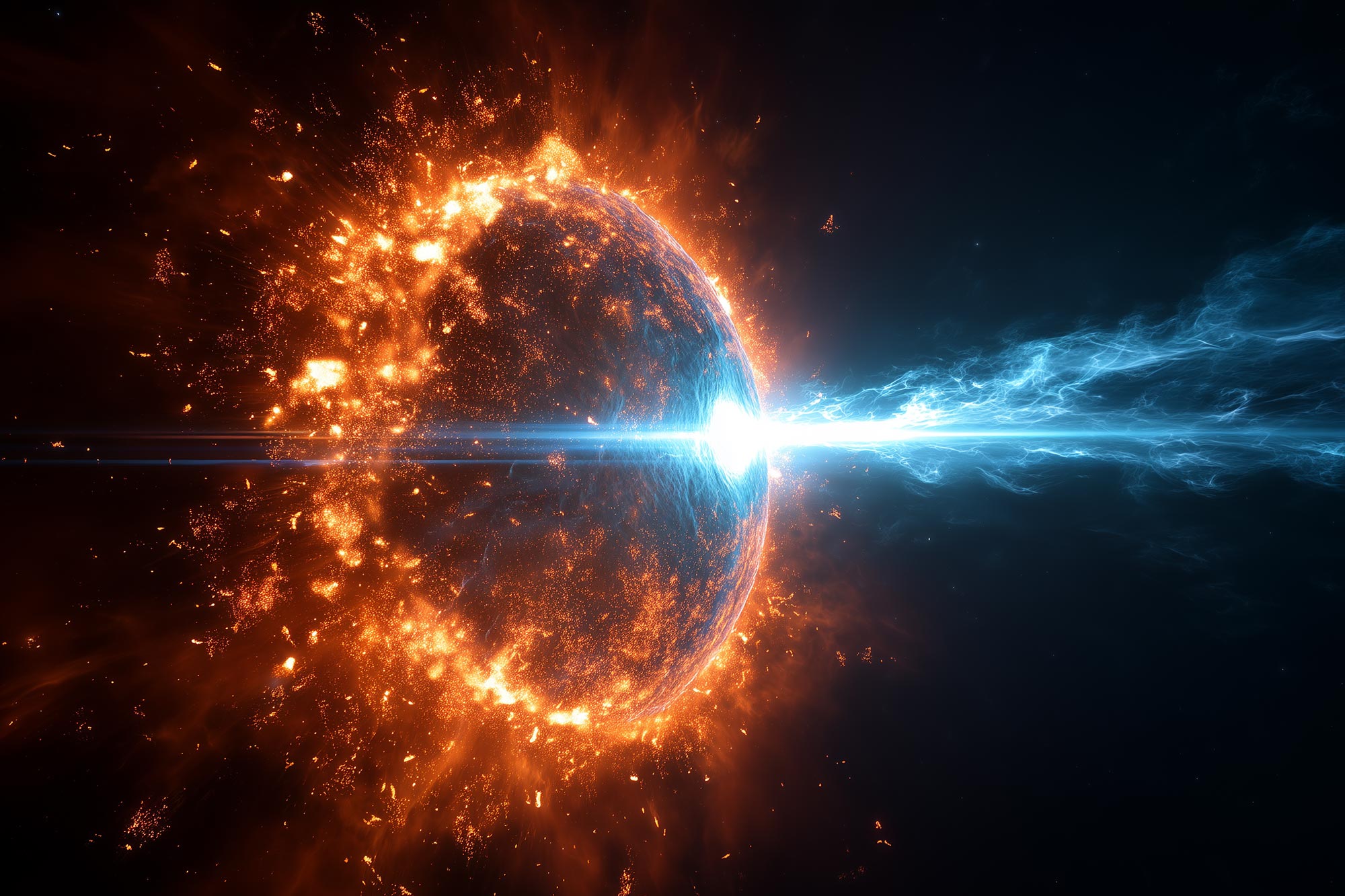
Using the James Webb Space Telescope, an international team of researchers has discovered chemical fingerprints from enormous primordial stars that were among the first to form after the Big Bang.
For more than twenty years, astronomers have struggled to explain a major puzzle about the early universe. Observations show that supermassive black holes already existed less than a billion years after the Big Bang, even though conventional stellar evolution cannot produce such enormous objects that quickly. Ordinary stars simply do not grow large enough or evolve fast enough to create black holes of that scale in such a short cosmic timeframe.
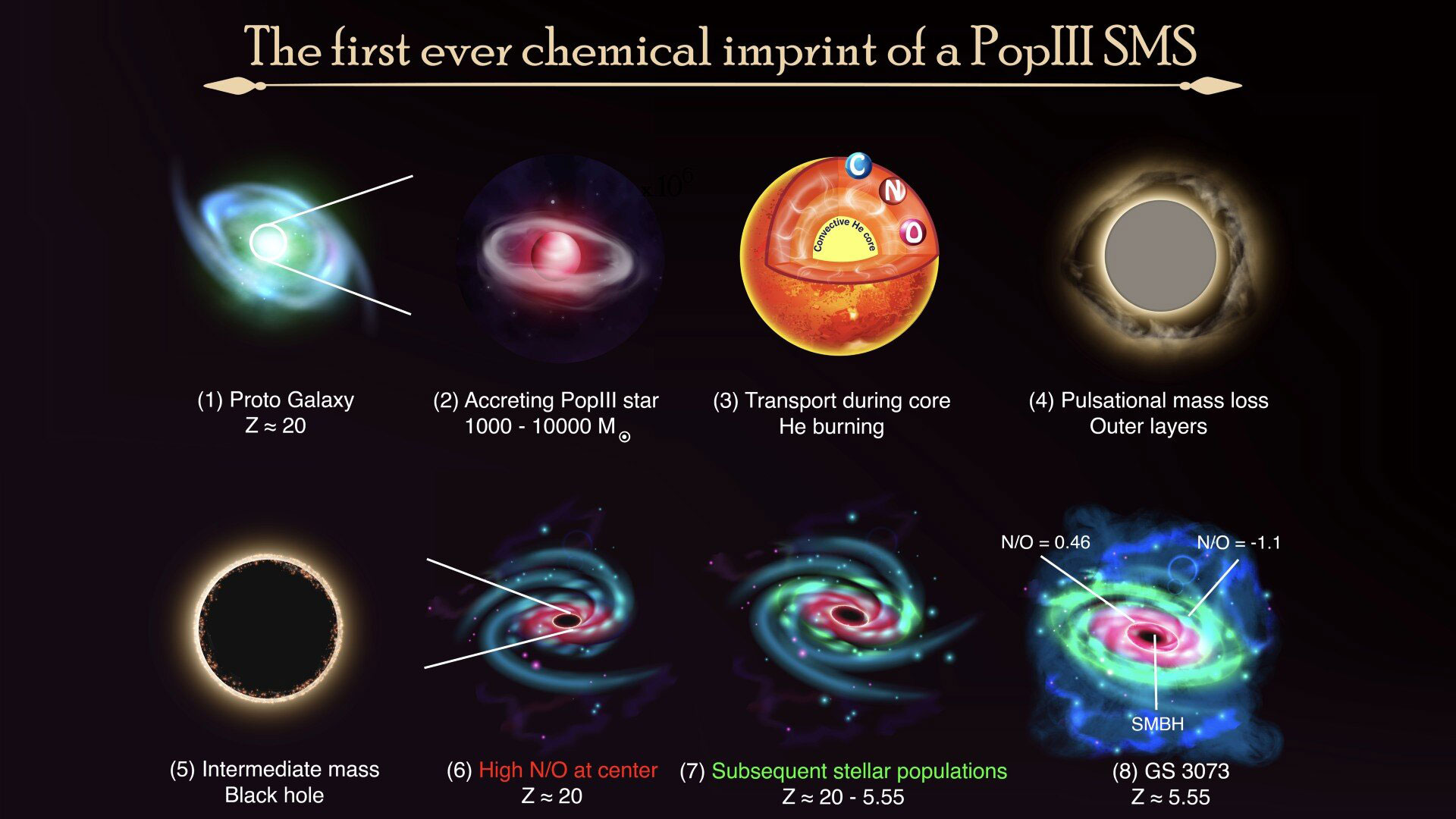
New observations from the James Webb Space Telescope (JWST) are now providing a possible answer. An international team of researchers reports the first strong evidence that extremely massive primordial stars once existed in the young universe. These so-called “monster stars” are thought to have reached between 1,000 and 10,000 times the mass of our Sun, making them far larger than any stars seen today.
Chemical evidence for primordial giants
The discovery centers on a distant galaxy known as GS 3073. By studying the galaxy’s chemical composition, scientists uncovered a striking clue about what kinds of stars once lived there. The research, led by the University of Portsmouth in England together with the Center for Astrophysics (CfA), Harvard and Smithsonian in the United States, identified an unusually large imbalance between nitrogen and oxygen. No known category of ordinary star can generate this chemical pattern.
The finding also supports a theoretical prediction proposed in 2022. In that earlier study published in Nature, researchers suggested that supermassive stars could naturally emerge in the early universe within dense, turbulent streams of cold gas. Such extreme stars could rapidly collapse into massive black holes, offering a mechanism for the appearance of quasars (extraordinarily bright black holes) less than a billion years after the Big Bang.
“Our latest discovery helps solve a 20-year cosmic mystery,” said Dr. Daniel Whalen from the University of Portsmouth’s Institute of Cosmology and Gravitation. “With GS 3073, we have the first observational evidence that these monster stars existed.
“These cosmic giants would have burned brilliantly for a brief time before collapsing into massive black holes, leaving behind the chemical signatures we can detect billions of years later. A bit like dinosaurs on Earth – they were enormous and primitive. And they had short lives, living for just a quarter of a million years – a cosmic blink of an eye.”
Nitrogen signature reveals stellar origin
The decisive clue came from analyzing the chemical ratio between nitrogen and oxygen inside GS 3073. Measurements show a nitrogen to oxygen ratio of 0.46, a level far beyond what astronomers would expect from any known type of star or stellar explosion.
Devesh Nandal from the CfA’s Institute for Theory and Computation explained: “Chemical abundances act like a cosmic fingerprint, and the pattern in GS3073 is unlike anything ordinary stars can produce. Its extreme nitrogen matches only one kind of source we know of – primordial stars thousands of times more massive than our sun. This tells us the first generation of stars included truly supermassive objects that helped shape the early galaxies and may have seeded today’s supermassive black holes.”
Models explain nitrogen enrichment
Researchers simulated how stars with masses between 1,000 and 10,000 times that of the Sun would develop and what chemical elements they would generate during their lifetimes. Their models revealed a process capable of producing unusually large amounts of nitrogen:
- Inside these enormous stars, helium fusion in the core produces carbon.
- Some of this carbon moves outward into a surrounding region where hydrogen fusion is taking place.
- In that layer, carbon reacts with hydrogen to form nitrogen through the carbon/nitrogen/oxygen (CNO) cycle.
- Powerful convection inside the star spreads the newly formed nitrogen throughout its interior.
- Over time, this nitrogen-rich material is expelled into space, enriching the gas around the star.
This sequence continues for millions of years during the helium-burning stage of the star’s life. The process steadily builds the unusually high nitrogen levels now observed in GS 3073.
Collapse of supermassive stellar remnants
The models, published in Astrophysical Journal Letters, also describe the fate of these extreme stars once their fuel is exhausted. Instead of ending their lives in violent supernova explosions, the simulations suggest that they collapse directly inward, forming massive black holes that can contain thousands of solar masses.
Observations of GS 3073 add another intriguing piece to the puzzle. The galaxy hosts an actively feeding black hole at its centre – potentially the surviving remnant of one of these early supermassive stars. If future observations confirm this connection, it would help explain both the unusual nitrogen signature and the origin of the galaxy’s central black hole.
The study also indicates that this chemical pattern appears only within a narrow range of stellar masses. Stars smaller than 1,000 solar masses or larger than 10,000 solar masses do not produce the same nitrogen rich signature. This suggests that only stars within this specific mass window create the conditions required for this type of chemical enrichment.
A new window on cosmic dawn
Together, these results offer new insight into one of the earliest chapters of cosmic history. The first few hundred million years after the Big Bang are often called the “cosmic Dark Ages”, a time when the first stars began to form and started transforming the simple elements of the young universe into the complex chemical mixture seen today.
Scientists expect that the James Webb Space Telescope will identify more galaxies that show similar nitrogen excesses as it continues to observe the distant universe. Each additional detection would provide stronger evidence that extremely massive first-generation stars once played a major role in shaping early galaxies and seeding the supermassive black holes seen today.
Reference: “1000–10,000 M⊙ Primordial Stars Created the Nitrogen Excess in GS 3073 at z = 5.55” by Devesh Nandal, Daniel J. Whalen, Muhammad A. Latif and Alexander Heger, 12 November 2025, The Astrophysical Journal Letters.
DOI: 10.3847/2041-8213/ae1a63
Never miss a breakthrough: Join the SciTechDaily newsletter.
Follow us on Google and Google News.
1 Comment
This paper was published in November 2025!