
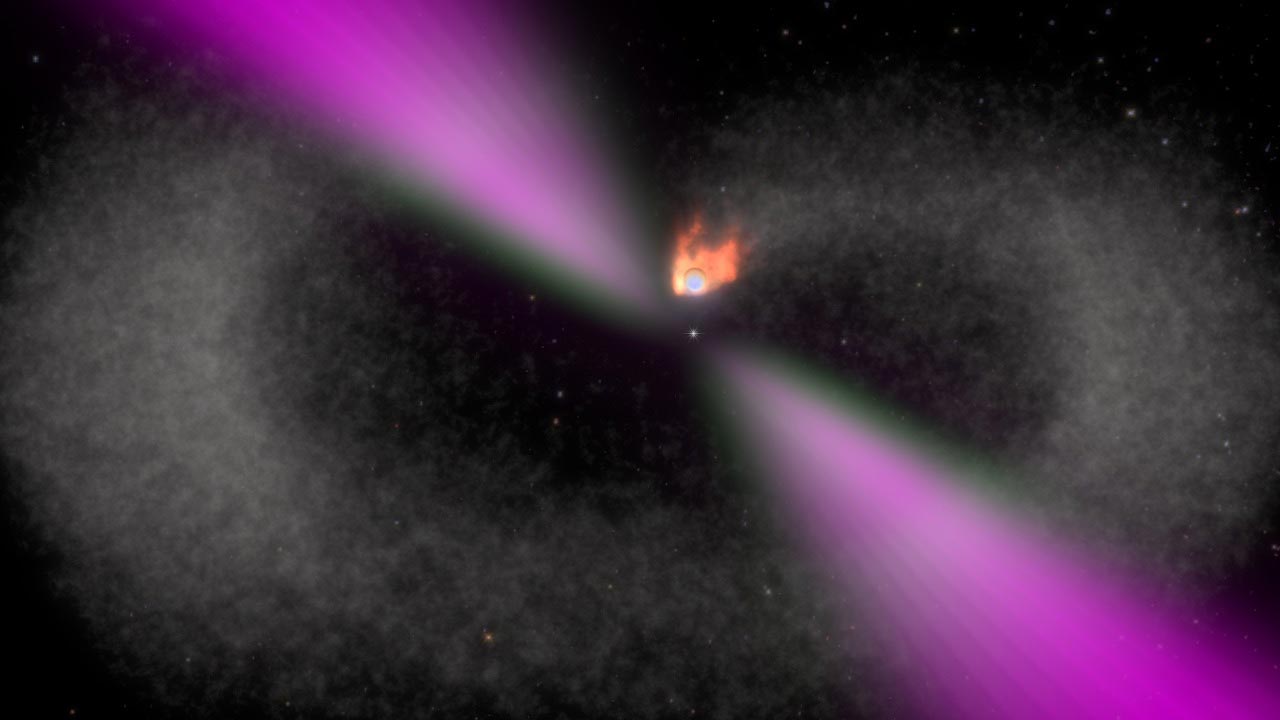
JWST found a carbon-atmosphere planet orbiting a pulsar, challenging current models of how planets form.
Scientific progress often comes from data that don’t fit our current understanding. This idea, first proposed by Thomas Kuhn in The Structure of Scientific Revolutions, suggests that paradigm shifts occur when evidence cannot be explained by current models.
Following that logic, scientists tend to embrace unexpected findings, especially those that force a rethink of how the universe works. A new preprint study on arXiv, using observations from the James Webb Space Telescope (JWST), may represent one of those moments. Researchers examined an exoplanet orbiting a millisecond pulsar and discovered that its atmosphere is composed almost entirely of pure carbon.
The “black widow” pulsar system
The pulsar, PSR J2322-2650, belongs to a rare class known as “black widow” systems. These systems generate intense energy by siphoning material from a nearby companion star. Over time, the pulsar’s powerful gravity and radiation strip away the companion’s outer layers, leaving behind a dense, Jupiter-sized remnant.
In this case, the companion has likely been reduced to a “hot Jupiter” that completes an orbit around the neutron star every 7.8 hours. Typically, this two-stage process begins with the neutron star (which also functions as a pulsar) accreting material and ends when it bombards its companion with high-energy gamma radiation, vaporizing most of its mass and producing a helium-rich planet.
Discovery of a carbon-rich atmosphere
The companion planet, PSR J2322-2650b, appears consistent in size and density with other Jupiter-like remnants formed in black widow systems, suggesting a helium-based composition. However, JWST’s spectral data revealed something entirely unexpected: the planet’s atmosphere consists primarily of elemental carbon. This carbon exists in molecular forms such as tricarbon (C3) and dicarbon (C2), making it unlike any other known black widow companion observed to date.
Usually, those types of elements are found in the tails of comets, or in actual flames here on Earth. Their presence in a planet’s atmosphere, especially in such abundant quantities, is new to science.
Another interesting thing about the planet’s atmosphere is the difference between the day and night sides. On the dayside, which is always facing the pulsar since the planet is tidally locked, temperatures can reach above 2000 ℃ and there are very clear chemical signatures. However, on the night side, there were almost no features at all, suggesting that side of the planet is covered in soot or something similar that doesn’t have any distinct features.
To further prove how strange this planet’s atmosphere is, the researchers calculated the ratios between carbon and oxygen as well as carbon and nitrogen. The C/O ratio was over 100, while the C/N ratio was over 10,000. In comparison, the Earth has a C/O ratio of .01 and a C/N ratio of 40. Obviously, there’s a lot of carbon on this planet.
A puzzle for planetary formation theory
And that doesn’t fit well with models of how scientists thought the planet should form. As part of the “black widow” process, the outer layers of the planet should have been either siphoned up by the companion star or burned away by that star’s radiation. The fact that such a rich carbon atmosphere still exists remains a mystery. There are processes that can create such an atmosphere, such as a white-dwarf merger between two “carbon stars,” but even that falls short of explaining how the planet’s C/O ratio got so high.
Other aspects of the planet align with general theory, though. Circulation models predict that rapidly rotating planets, like PSR J2322-2650b, would have strong westerly winds, which is different from the typical easterly winds on other tidally locked hot Jupiters. The JWST data show that the hottest part of the planet is about 12 degrees west of center, providing the first-ever observational evidence of this western wind phenomenon.
In other words, PSR J2322-2650b is contradictory. It’s the right size and shape for a typical black widow pulsar system. Its window circulation also fits well with our best models. But its atmosphere is something else entirely, and scientists will have to go back to the theory to try to find a way to make it make sense with the new data. While they’re busy doing that, JWST will continue scanning the sky for more anomalies that could drive the next scientific revolution.
Reference: “A Carbon-rich atmosphere on a windy pulsar planet” by Michael Zhang, Maya Beleznay, Timothy D. Brandt, Roger W. Romani, Peter Gao, Hayley Beltz, Matthew Bailes, Matthew C. Nixon, Jacob L. Bean, Thaddeus D. Komacek, Brandon P. Coy, Guangwei Fu, Rafael Luque, Daniel J. Reardon, Emma Carli, Ryan M. Shannon, Jonathan J. Fortney, Anjali A.A. Piette, M. Coleman Miller and Jean-Michel Desert. 11 September 2025, arXiv.
DOI:10.48550/arXiv.2509.04558
Adapted from an article originally published on Universe Today.
Never miss a breakthrough: Join the SciTechDaily newsletter.
Follow us on Google and Google News.
5 Comments
If that planet shouldn’t exist, then the JWST shouldn’t have discovered it.
It doesn’t matter anyway. SciTech is lying again. The original story in Universe Today had the title:
“JWST Finds An Exoplanet Around A Pulsar Whose A t m o s p h e r e Is All Carbon” (emph. added)
and the article is over a month old. It isn’t “daily”. It isn’t “news”.
Indeed. I’m only here to make quippy comments anyway.
Charcoal briquette? Surrounded by cloud of dust as usual.
With these water worlds it makes the octopus theory even more plausible that they are extraterrestrial came to earth frozen in a comet.