
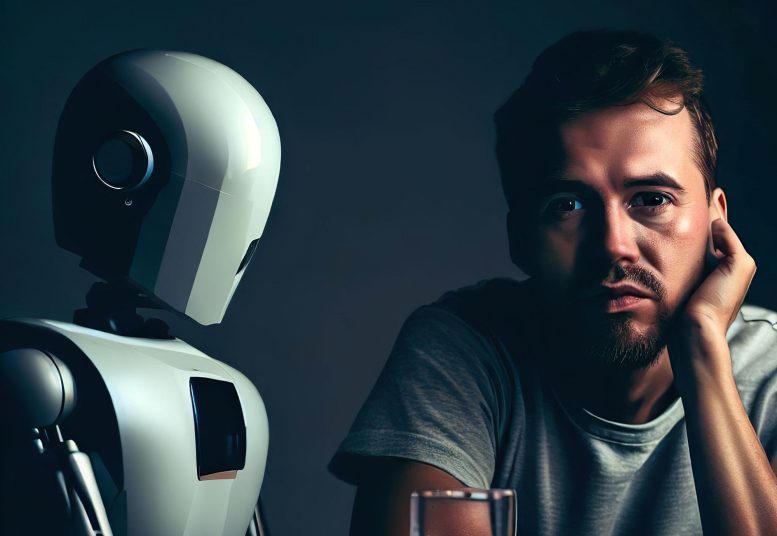
Frequent AI use at work increases loneliness and insomnia but also encourages helping behaviors. Solutions include adding human-like features to AI and fostering socialization at work.
Employees who frequently interact with artificial intelligence systems are more likely to experience loneliness that can lead to insomnia and increased after-work drinking, according to research published by the American Psychological Association.
Researchers conducted four experiments in the U.S., Taiwan, Indonesia, and Malaysia. Findings were consistent across cultures. The research will be published online today (June 12) in the Journal of Applied Psychology.
In a prior career, lead researcher Pok Man Tang, PhD, worked in an investment bank where he used AI systems, which led to his interest in researching the timely issue.
“The rapid advancement in AI systems is sparking a new industrial revolution that is reshaping the workplace with many benefits but also some uncharted dangers, including potentially damaging mental and physical impacts for employees,” said Tang, an assistant professor of management at the University of Georgia. “Humans are social animals, and isolating work with AI systems may have damaging spillover effects into employees’ personal lives.”
At the same time, working with AI systems may have some benefits. The researchers found that employees who frequently used AI systems were more likely to offer help to fellow employees, but that response may have been triggered by their loneliness and need for social contact.
Furthermore, the studies found that participants with higher levels of attachment anxiety – the tendency to feel insecure and worried about social connections – responded more strongly to working on AI systems with both positive reactions, such as helping others, and negative ones, such as loneliness and insomnia.
Cultural and Experimental Insights on AI Effects
In one experiment, 166 engineers at a Taiwanese biomedical company who worked with AI systems were surveyed over three weeks about their feelings of loneliness, attachment anxiety and sense of belonging. Coworkers rated individual participants on their helpful behaviors, and family members reported on participants’ insomnia and after-work alcohol consumption. Employees who interacted more frequently with AI systems were more likely to experience loneliness, insomnia and increased after-work alcohol consumption, but also showed some helping behaviors toward fellow employees.
In another experiment with 126 real estate consultants in an Indonesian property management company, half were instructed not to use AI systems for three consecutive days while the other half were told to work with AI systems as much as possible. The findings for the latter group were similar to the previous experiment, except there was no association between the frequency of AI use and after-work alcohol consumption.
There were similar findings from an online experiment with 214 full-time working adults in the U.S. and another with 294 employees at a Malaysian tech company.
The research findings are correlational and don’t prove that work with AI systems causes loneliness or the other responses, just that there is an association among them.
Tang said that moving forward, developers of AI technology should consider equipping AI systems with social features, such as a human voice, to emulate human-like interactions. Employers also could limit the frequency of work with AI systems and offer opportunities for employees to socialize.
Team decision-making and other tasks where social connections are important could be done by people, while AI systems could focus more on tedious and repetitive tasks, Tang added.
“Mindfulness programs and other positive interventions also might help relieve loneliness,” Tang said. “AI will keep expanding so we need to act now to lessen the potentially damaging effects for people who work with these systems.”
Reference: “No Person Is an Island: Unpacking the Work and After-Work Consequences of Interacting With Artificial Intelligence” by Pok Man Tang, Joel Koopman, Ke Michael Mai, David De Cremer, Jack H. Zhang, Philipp Reynders, Chin Tung Stewart Ng and I-Heng Chen, 12 June 2023, Journal of Applied Psychology.
DOI: 10.1037/apl0001103
Authors: Pok Man Tang, PhD, University of Georgia; Joel Koopman, PhD, Texas A&M University; Ke Michael Mai, PhD, and David De Cremer, PhD, National University of Singapore; Jack H. Zhang, PhD, Nanyang Business School; Philipp Reynders, PhD, Cardiff University; Chin Tung Stewart Ng, MSc, and I-Heng Chen, PhD, National Sun Yat-sen University.
Never miss a breakthrough: Join the SciTechDaily newsletter.
Follow us on Google and Google News.
1 Comment
That’s because they aren’t complete in themselves. They are seeking external whatever for completion and fulfillment. This is a failing of their own psychological awareness, not any issue with their job.