
Close Menu
    Facebook X (Twitter) Instagram
    SciTechDaily
    • Biology
    • Chemistry
    • Earth
    • Health
    • Physics
    • Science
    • Space
    • Technology
    Facebook X (Twitter) Pinterest YouTube RSS
    SciTechDaily
    Home»Physics»Mapping Out a Transient Atom: First User Experiment Carried Out at European XFEL’s Small Quantum System
    Physics

    Mapping Out a Transient Atom: First User Experiment Carried Out at European XFEL’s Small Quantum System

    By European XFELDecember 22, 2020No Comments3 Mins Read
    Facebook Twitter Pinterest Telegram LinkedIn WhatsApp Email Reddit
    Share
    Facebook Twitter LinkedIn Pinterest Telegram Email Reddit
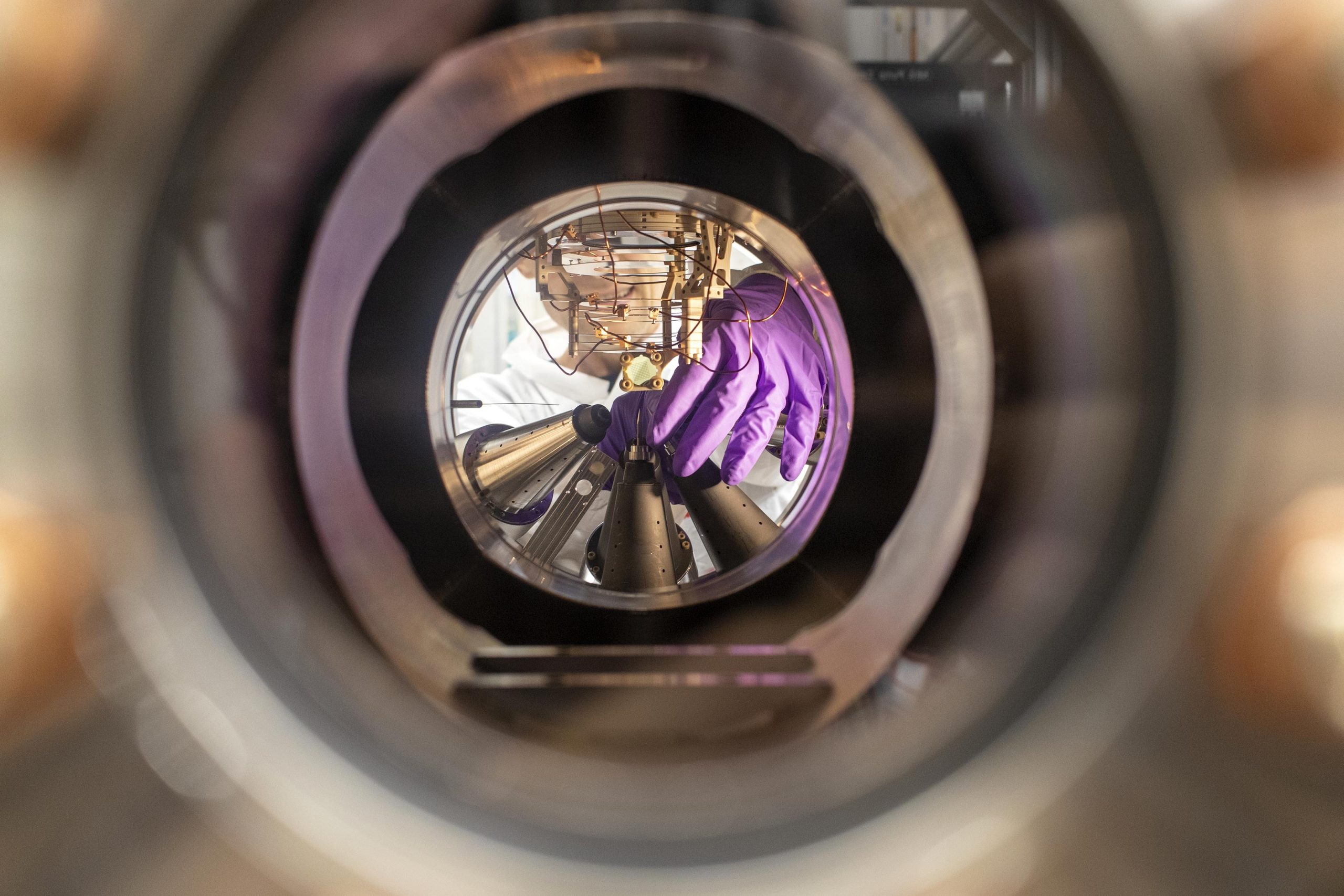
    SQS Instrument at European XFEL
    A view into the atomic-like quantum systems (AQS) experiment station. The experiment is carried out at the SQS scientific instrument of the European XFEL, using the AQS experimental station. Credit: European XFEL

    A new experiment provides better understanding of fundamental photo-induced processes with special importance for photocatalysis, photosynthesis and radiation damage.

    An international team from Germany, Sweden, Russia, and the USA, led by scientists from European XFEL, has published the results of an experiment that could provide a blueprint for the analysis of transition states in atoms and molecules. This would open up new opportunities to gain insights into important processes such as photocatalysis, elementary steps in photosynthesis, and radiation damage.

    It was the very first user experiment carried out at European XFEL’s Small Quantum System (SQS) instrument. The scientists used high-resolution electron spectroscopy to capture a snapshot of the short-lived transient state produced when X-rays punch a hole in the very core of the atomic electron cloud. The results of the study, which was carried out on neon atoms, are the starting point for the analysis of transient states and have been published in Physical Review X.

    The extremely short-lived transient state of core-exited neon lasts for just 2.4 femtoseconds. To put a femtosecond in context: a femtosecond is to a second as a second is to about 31.71 million years. “The European XFEL allows us to use a high number of laser pulses per second and high pulse energy. This means we can bring a very high number of photons to the sample, which is crucial to probe such transient atomic states,” explains Tommaso Mazza, the lead author of the paper.

    “We used intense X-ray pulses to first remove the electrons from the inner shell, or core, of a neon atom and then used a second photon from the same X-ray pulse to map out the ‘hollow’ atom,” says Mazza. “This is the first time scientists are able to obtain information of the electronic structure of this core-hole transient state by X-ray induced electron spectroscopy, and, more precisely, by measuring the energy of the electrons emitted after the excitation by the second photon while smoothly changing the wavelength of the X-ray pulses,” he adds.

    Leading Scientist at SQS Michael Meyer underlines that the results of this paper along with a paper recently published in Science show the outstanding possibility to efficiently control and probe excitations of specific electronic subshells at the SQS instrument. “We can enable atomic or element-specific excitations in molecular targets and independently investigate for each atom the influence on the photon-induced molecular dynamics,” he says. Targeting a specific atom in a molecule allows scientists to gain a deeper understanding of the behavior of individual building blocks in the molecular assembly under intense irradiation.

    Reference: “Mapping Resonance Structures in Transient Core-Ionized Atoms” by T. Mazza et al., 18 December 2020, Physical Review X.
    DOI: 10.1103/PhysRevX.10.041056

    Never miss a breakthrough: Join the SciTechDaily newsletter.
    Follow us on Google and Google News.

    Particle Physics
    Share. Facebook Twitter Pinterest LinkedIn Email Reddit

    Related Articles

    ICARUS Experiment Claims Neutrinos Aren’t Faster Than Light

    New Type of Neutrino Oscillation Discovered at Daya Bay

    More Data of Elusive Higgs Boson from Defunct US Tevatron Collider

    Dynamics of a System of Ultracold Potassium Atoms

    Evidence of Elusive Majorana Fermions Raises Possibilities for Quantum Computing

    Possible Mistakes Found in Faster Than Light Neutrino Measurement

    Quantum Entanglement of 8 Photons Successfully Accomplished by Physicists

    Higgs Boson Signals Gain Strength at Large Hadron Collider

    Quantum Physicists Take a Step Forward in Understanding Quantum Inseparability

    Leave A Reply Cancel Reply

    • Facebook
    • Twitter
    • Pinterest
    • YouTube

    Don't Miss a Discovery

    Subscribe for the Latest in Science & Tech!

    Trending News

    Bone-Strengthening Discovery Could Reverse Osteoporosis

    Scientists Uncover Hidden Trigger Behind Stem Cell Aging

    Scientists Find Way to Reverse Fatty Liver Disease Without Changing Diet

    Could Humans Regrow Limbs? New Study Reveals Promising Genetic Pathway

    Scientists Reveal Eating Fruits and Vegetables May Increase Your Risk of Lung Cancer

    Scientists Reverse Brain Aging With Simple Nasal Spray

    Scientists Uncover Potential Brain Risks of Popular Fish Oil Supplements

    Scientists Discover a Surprising Way To Make Bread Healthier and More Nutritious

    Follow SciTechDaily
    • Facebook
    • Twitter
    • YouTube
    • Pinterest
    • Newsletter
    • RSS
    SciTech News
    • Biology News
    • Chemistry News
    • Earth News
    • Health News
    • Physics News
    • Science News
    • Space News
    • Technology News
    Recent Posts
    • This Student Recreated the Universe in a Bottle. What She Discovered Could Help Reveal How Life Started on Earth
    • Alzheimer’s Symptoms May Start Outside the Brain, Study Finds
    • Cancer’s Secret Weapon? Scientists Reveal How Tumors “Learn” To Survive Treatment
    • Millions Take This Popular Supplement – Scientists Discover a Concerning Link to Heart Failure
    • What Makes Rubber So Strong? Scientists Finally Solve 100-Year-Old Mystery
    Copyright © 1998 - 2026 SciTechDaily. All Rights Reserved.
    • Science News
    • About
    • Contact
    • Editorial Board
    • Privacy Policy
    • Terms of Use

    Type above and press Enter to search. Press Esc to cancel.