
Close Menu
    Facebook X (Twitter) Instagram
    SciTechDaily
    • Biology
    • Chemistry
    • Earth
    • Health
    • Physics
    • Science
    • Space
    • Technology
    Facebook X (Twitter) Pinterest YouTube RSS
    SciTechDaily
    Home»Physics»CMS Detector at the Large Hadron Collider Sets New Bounds on the Mass of Leptoquarks
    Physics

    CMS Detector at the Large Hadron Collider Sets New Bounds on the Mass of Leptoquarks

    By CERNDecember 22, 20202 Comments2 Mins Read
    Facebook Twitter Pinterest Telegram LinkedIn WhatsApp Email Reddit
    Share
    Facebook Twitter LinkedIn Pinterest Telegram Email Reddit
    LHC CMS Detector
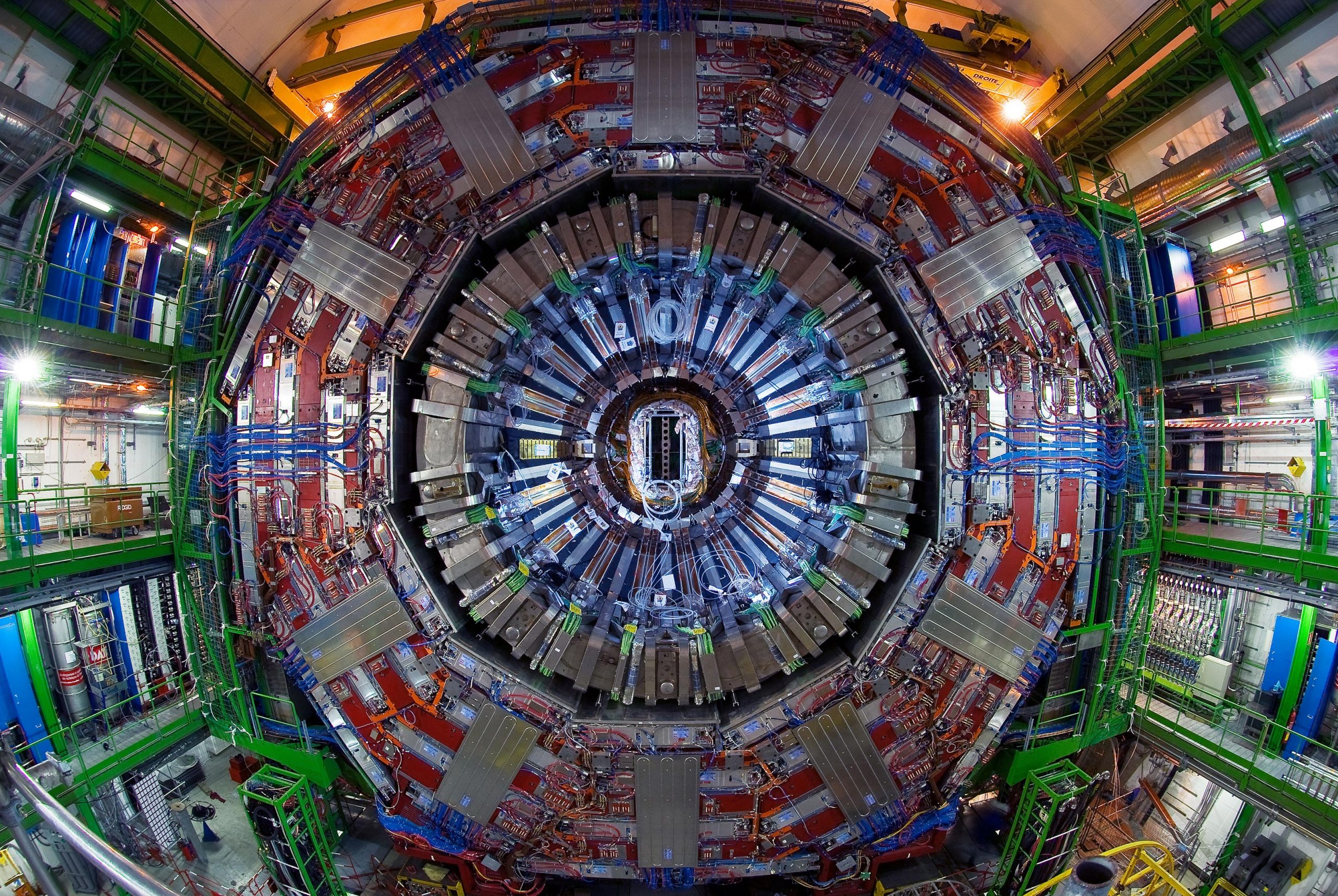
    The Compact Muon Solenoid (CMS) is a general-purpose detector at the Large Hadron Collider (LHC). Credit: CERN

    The bounds are some of the tightest yet on the existence of third-generation leptoquarks.

    At the most fundamental level, matter is made up of two types of particles: leptons, such as the electron, and quarks, which combine to form protons, neutrons and other composite particles. Under the Standard Model of particle physics, both leptons and quarks fall into three generations of increasing mass. Otherwise, the two kinds of particles are distinct. However, some theories that extend the Standard Model predict the existence of new particles called leptoquarks that would unify quarks and leptons by interacting with both.

    In a new paper, the CMS collaboration reports the results of its latest search for leptoquarks that would interact with third-generation quarks and leptons (the top and bottom quarks, the tau lepton and the tau neutrino). Such third-generation leptoquarks are a possible explanation for an array of tensions with the Standard Model (or “anomalies”), which have been seen in certain transformations of particles called B mesons but have yet to be confirmed. There is therefore an additional reason for hunting down these hypothetical particles.

    The CMS team looked for third-generation leptoquarks in a data sample of proton–proton collisions that were produced by the Large Hadron Collider (LHC) at an energy of 13 TeV and were recorded by the CMS experiment between 2016 and 2018. Specifically, the team looked for pairs of leptoquarks that transform into a top or bottom quark and a tau lepton or tau neutrino, as well as for single leptoquarks that are produced together with a tau neutrino and transform into a top quark and a tau lepton.

    The CMS researchers didn’t find any indication that such leptoquarks were produced in the collisions. However, they were able to set lower bounds on their mass: they found that such leptoquarks would need to be at least 0.98–1.73 TeV in mass, depending on their intrinsic spin and the strength of their interaction with a quark and a lepton. These bounds are some of the tightest yet on third-generation leptoquarks, and they allow part of the leptoquark-mass range that could explain the B-meson anomalies to be excluded.

    The search for leptoquarks continues.

    Never miss a breakthrough: Join the SciTechDaily newsletter.
    Follow us on Google and Google News.

    CERN Large Hadron Collider Particle Physics
    Share. Facebook Twitter Pinterest LinkedIn Email Reddit

    Related Articles

    New CERN Study Suggests Subatomic Particles Could Defy the Standard Model

    CERN Reports Observation of Pentaquark Particles

    Physicists Confirm Discovery of Four-Quark Hadron

    New Results Indicate That Particle Discovered at LHC Is a Higgs Boson

    The Large Hadron Collider Prepares for Shutdown

    CERN to Announce the Latest Results from ATLAS and CMS

    Discussing the Search for the Higgs Particle

    More Data of Elusive Higgs Boson from Defunct US Tevatron Collider

    Higgs Boson Signals Gain Strength at Large Hadron Collider

    2 Comments

    1. Hashim on December 23, 2020 12:27 am

      I really love to study on the cern and know more about LHC and it’s function that is defenitely wonderful and more enjoyable for me thanks

      Reply
    2. Who cares on December 26, 2020 10:15 am

      As soon as they turn it on again we see the UK battered by floods, storms, and sinkholes

      Reply
    Leave A Reply Cancel Reply

    • Facebook
    • Twitter
    • Pinterest
    • YouTube

    Don't Miss a Discovery

    Subscribe for the Latest in Science & Tech!

    Trending News

    Your Blood Pressure Reading Could Be Wrong Because of One Simple Mistake

    Astronomers Stunned by Ancient Galaxy With No Spin

    Physicists May Be on the Verge of Discovering “New Physics” at CERN

    Scientists Solve 320-Million-Year Mystery of Reptile Skin Armor

    Scientists Say This Daily Walking Habit May Be the Secret to Keeping Weight Off After Dieting

    New Therapy Rewires the Brain To Restore Joy in Depression Patients

    Giant Squid Detected off Western Australia in Stunning Deep-Sea Discovery

    Popular Sugar-Free Sweetener Linked to Liver Disease, Study Warns

    Follow SciTechDaily
    • Facebook
    • Twitter
    • YouTube
    • Pinterest
    • Newsletter
    • RSS
    SciTech News
    • Biology News
    • Chemistry News
    • Earth News
    • Health News
    • Physics News
    • Science News
    • Space News
    • Technology News
    Recent Posts
    • Hidden Warm Water Beneath Antarctica Could Rapidly Raise Global Sea Levels
    • Scientists Revive Ancient Chemistry Trick To Engineer Next-Generation Glass
    • Scientists Use AI To Supercharge Ultrafast Laser Simulations by More Than 250x
    • Scientists Just Found a Surprising Way To Destroy “Forever Chemicals”
    • Popular Supplement Ingredient Linked to Shorter Lifespan in Men
    Copyright © 1998 - 2026 SciTechDaily. All Rights Reserved.
    • Science News
    • About
    • Contact
    • Editorial Board
    • Privacy Policy
    • Terms of Use

    Type above and press Enter to search. Press Esc to cancel.