
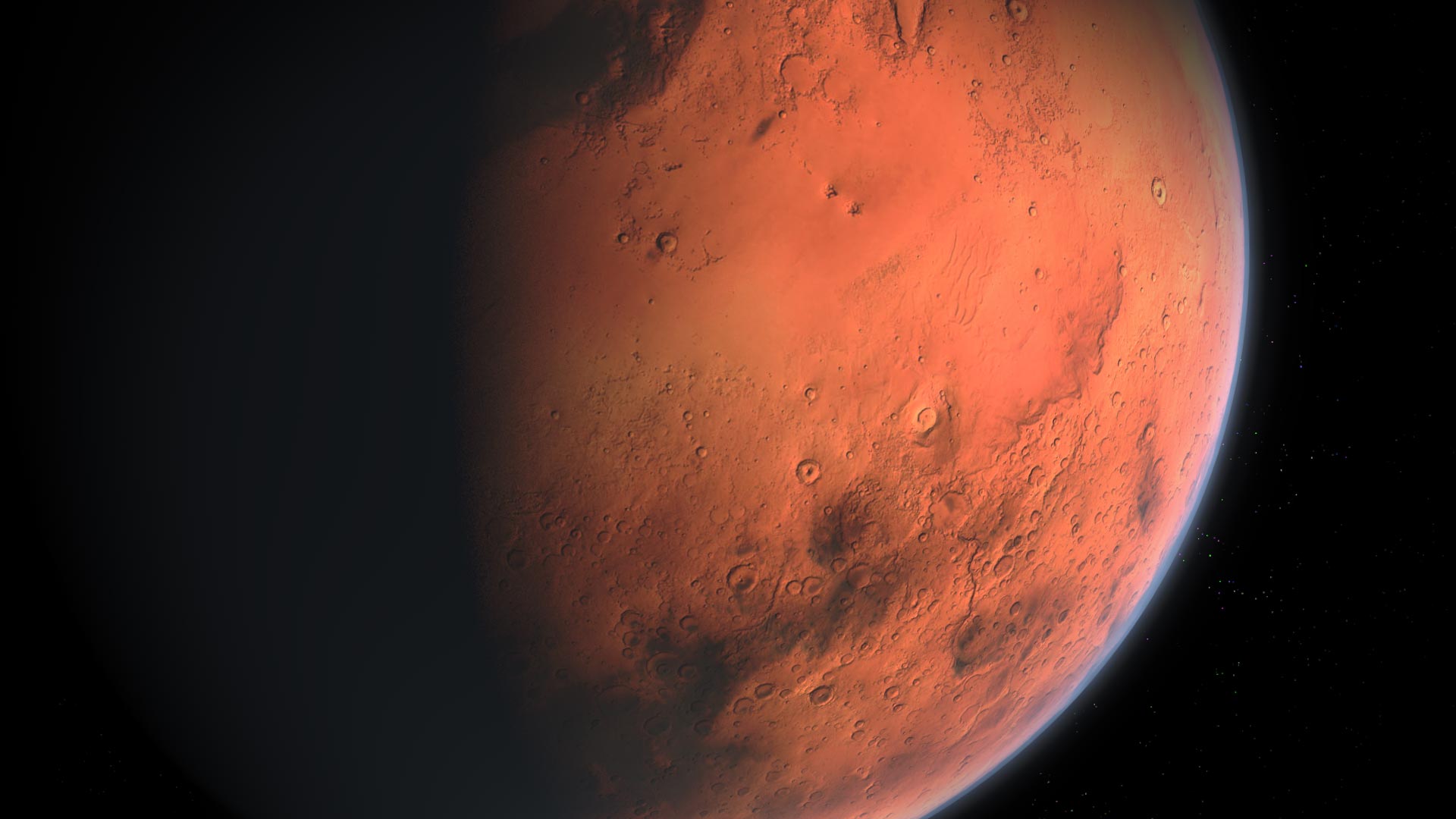
Cornell researchers explain Mars’ bright radar reflections with ice layer interference, challenging the idea of liquid water beneath the pole.
Cornell University researchers have provided a simple and comprehensive – if less dramatic – explanation for the bright radar reflections initially thought to be liquid water under the ice cap at Mars’ south pole.
Their simulations show that small variations in layers of water ice – too subtle for ground-penetrating radar instruments to resolve – can cause constructive interference between radar waves. Such interference can produce reflections whose intensity and variability match observations to date – not only in the area proposed to be liquid water, but across the so-called south polar layered deposits.
“I can’t say it’s impossible that there’s liquid water down there, but we’re showing that there are much simpler ways to get the same observation without having to stretch that far, using mechanisms and materials that we already know exist there,” said Daniel Lalich, research associate in the Cornell Center for Astrophysics and Planetary Science. “Just through random chance, you can create the same observed signal in the radar.”
Lalich is the first author of a recent study published in Science Advances.
Robotic explorers have provided extensive evidence that water flowed on the surface of ancient Mars, including at a former river delta now under investigation by NASA’s Perseverance rover. Relying on a radar instrument that can probe below the surface to detect water ice and potentially hidden aquifers, members of the European Space Agency-led Mars Express orbiter’s science team in 2018 announced they’d discovered a lake buried below the south polar cap.
The implications were enormous: Where there is liquid water, there could be microbial life.
Reinterpreting Radar Observations
But while the same bright radar reflections would likely indicate a subglacial lake on Earth, Lalich said, the temperature and pressure conditions on Mars are very different.
Using simpler models, Lalich previously showed that the bright radar signals could be created in the absence of liquid water, but he said assumptions about layers of frozen carbon dioxide below the ice cap likely were incorrect.
The new research tells a more complete story, he said, closing gaps in the radar interference hypothesis with more realistic modeling. The thousands of randomly generated layering scenarios were based only on conditions known to exist at the Martian poles, and varied the ice layers’ composition and spacing in ways that would be expected over tens or hundreds of miles.
Those slight adjustments sometimes produced bright subsurface signals consistent with observations in each of the three frequencies used by the Mars Express orbiter’s MARSIS radar instrument, a partnership between NASA and the Italian Space Agency. Likely for a simple reason, Lalich argues: Radar waves bouncing off layers spaced too closely for the instrument to resolve may be combined, amplifying their peaks and troughs.
“This is the first time we have a hypothesis that explains the entire population of observations below the ice cap, without having to introduce anything unique or odd,” Lalich said. “This result where we get bright reflections scattered all over the place is exactly what you would expect from thin-layer interference in the radar.”
Conclusion: The Likelihood of Liquid Water
While not ruling out the potential for some future detection by more capable instruments, Lalich said he suspects the story of liquid water and potential life on the red planet ended long ago.
“The idea that there would be liquid water even somewhat near the surface would have been really exciting,” Lalich said. “I just don’t think it’s there.”
Reference: “Small variations in ice composition and layer thickness explain bright reflections below martian polar cap without liquid water” by Daniel E. Lalich, Alexander G. Hayes and Valerio Poggiali, 7 June 2024, Science Advances.
DOI: 10.1126/sciadv.adj9546
The research was supported by NASA.
Never miss a breakthrough: Join the SciTechDaily newsletter.
Follow us on Google and Google News.
1 Comment
Oh, no. This will make Elon musk cry.