
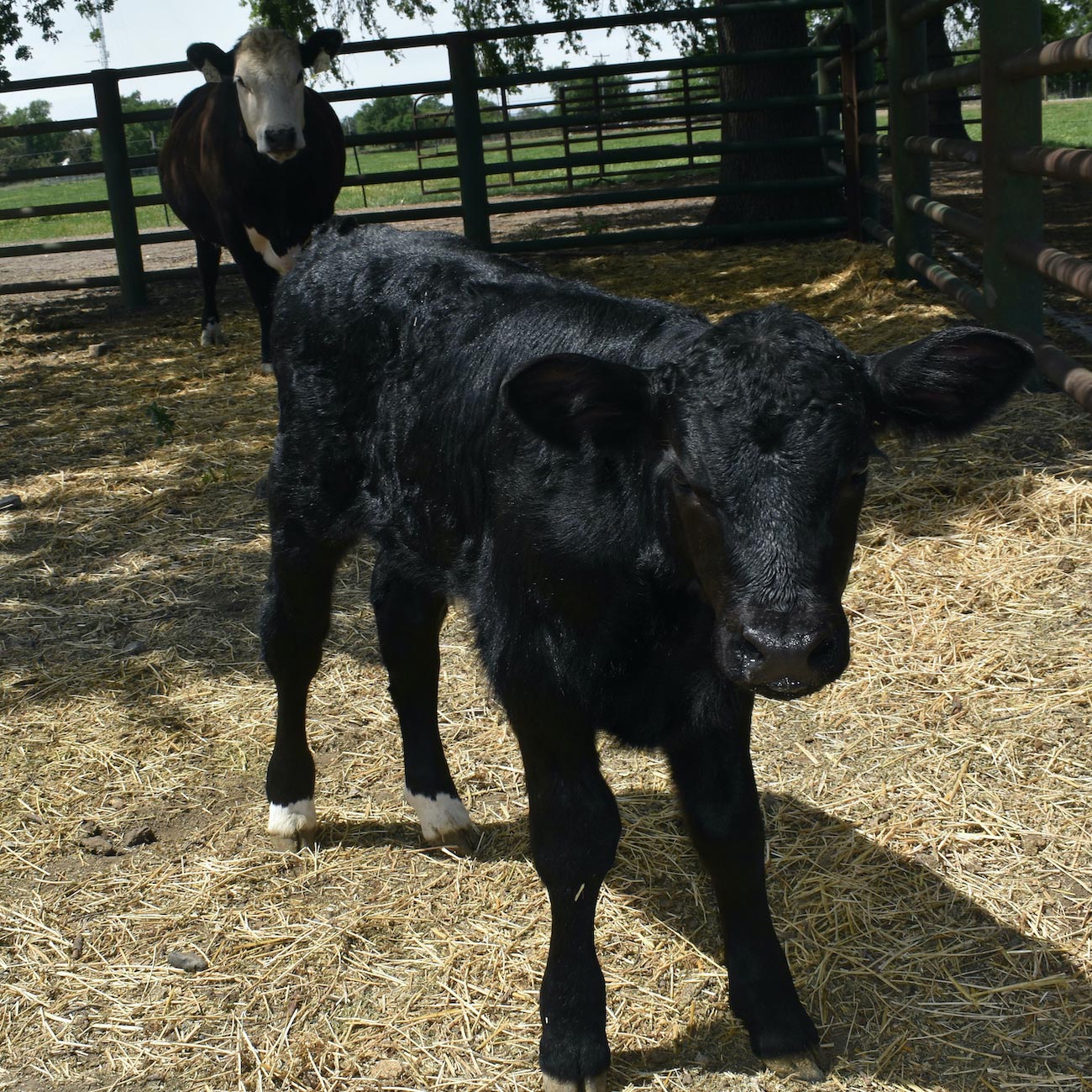
Scientists Use CRISPR Technology to Insert Sex-Determining Gene.
Scientists at the University of California, Davis, have successfully produced a bull calf, named Cosmo, who was genome-edited as an embryo so that he’ll produce more male offspring. The research was presented in a poster yesterday, (July 23, 2020) at the American Society of Animal Science meeting.
Using the genome-editing technology CRISPR, researchers can make targeted cuts to the genome or insert useful genes, which is called a gene knock-in. In this case, scientists successfully inserted or knocked-in the cattle SRY gene, the gene that is responsible for initiating male development, into a bovine embryo. It’s the first demonstration of a targeted gene knock-in for large sequences of DNA via embryo-mediated genome editing in cattle.
“We anticipate Cosmo’s offspring that inherit this SRY gene will grow and look like males, regardless of whether they inherit a Y chromosome,” said Alison Van Eenennaam, animal geneticist with the UC Davis Department of Animal Science.
More males, more beef
Van Eenennaam says part of the motivation to produce more male cattle is that male cattle are about 15 percent more efficient at converting feed into weight gain. They are more fuel-efficient than females. Additionally, they tend to be processed at a heavier weight.
It could also be a win for the environment, with fewer cattle needed to produce the same amount of beef. “Ranchers could produce some females as replacements and direct a higher proportion of male cattle for market,” said Joey Owen, a postdoctoral researcher in animal science who is leading the project with Van Eenennaam.
An arduous journey
The SRY gene was inserted into bovine chromosome 17, which is a genomic safe harbor site. That ensures the genetic elements function predictably and don’t disrupt the expression or regulation of adjacent genes. Chromosome 17 was chosen after unsuccessful attempts to knock-in the gene on the X chromosome, which would have resulted in a bull that produced only male offspring. Cosmo is expected to produce 75 percent male offspring — the normal 50 percent XY animals, and another 25 percent XX animals that inherit the SRY gene.
“It took two and a half years to develop the method to insert a gene into the developing embryo and another two years to successfully establish a pregnancy,” said Owen. But in April 2020, a healthy 110-pound male calf was born.
“This has been a real labor of love,” said Van Eenennaam.
She said this is just the beginning of the research. Cosmo will reach sexual maturity in a year, and he will be bred to study if inheriting the SRY gene on chromosome 17 is sufficient to trigger the male developmental pathway in XX embryos, and result in offspring that will grow and look like males. As the Food and Drug Administration regulates gene-editing of animals as if they were drugs, Cosmo and his offspring will not enter the food supply.
Other researchers on the team include James Murray, Pablo Ross, Sadie Hennig, and Jason Lin with the UC Davis Department of Animal Science, and Bret McNabb and Tamer Mansour of the UC Davis School of Veterinary Medicine.
This project was supported by Biotechnology Risk Assessment Grant Program from the U.S. Department of Agriculture, the California Agricultural Experiment Station at UC Davis and the USDA NIFA National Needs Graduate and Postgraduate Fellowship.
Never miss a breakthrough: Join the SciTechDaily newsletter.
Follow us on Google and Google News.
4 Comments
Why do all that work when all you would have to do is cut the left nut.
Well the new way of changing DNA still does not reverse the past 30 years where all Genetic Engineering has solely been done using Agro Bacteria Tumefaciens, which is responsible for creating Tumors in Plants by adding here own DNA into the Plant. The Disease is well known as crown Gall.
It has been used to alter Plants, Animals, Insects, Fungus and everything Between.It has been proven over and over that after the Gene transfer the Bacterium ( a Gram negative Soil Bacteria ) continued to alter the DNA of the new Host because Science failed to completely kill all active Bacteria via Antibiotic after the new Genes
Where added.
Pandora’s Box is wide open and not reverse able. Less then a Year ago thanks to the effort of an FDA Inspector who put some extra Hours in the discovered that a new breed of Holstein Cow that was just about to be released was composed out of 2 Types of DNA. Plant and Animal.
WHAT THAT MEANS, is that this new Breed was Part Animal and part Plant or a Hybrid Lifeform out of Frankensteins Lab.
During the entire existence of Planet Earth, Mother Nature has never let that happen that DNA change Kingdom from one Species into another Species Chromosomal DNA.
That was definitely not an exception than rather the Rule.
Now we are wondering about the Resistance from a increasing number of Micro Organisms that show no affect on Antibiotics anymore and are able to change there behavior and form in such a fast pace that it definitely has nothing to do with Evolution. COVID 19, Morgellons Disease, Cancer:etc. . Ever wondered why all in the sudden every large Corporation pumps Millions into the Space Program and everyone seems to be in a Hurry to get the Hell out of Dodge City..
There are Research Paper online since 2005 that proof that this Horror Scenario is all to real.
Just check out Prof. Dr. Vitally Citovsky’s research Studys, who is one of the World leading Authorities in his Field or Google Dr. Mae Wan or Prof. Joe Cummins.
The Time to worry about GMOs and our Environment has has passed a long Time ago to a point of no return and solely fueled by Human Greed.
Thanks for reading
Michael de Beyer
apply this technology to humans. should sell well in India and China where male offspring are way more desirable than females. where emotions trump logic and science.
I wouldn’t touch it, much less eat it. The only reason for this is Greed, not care for the species that has fed us safely and reliably for over 100 years.