
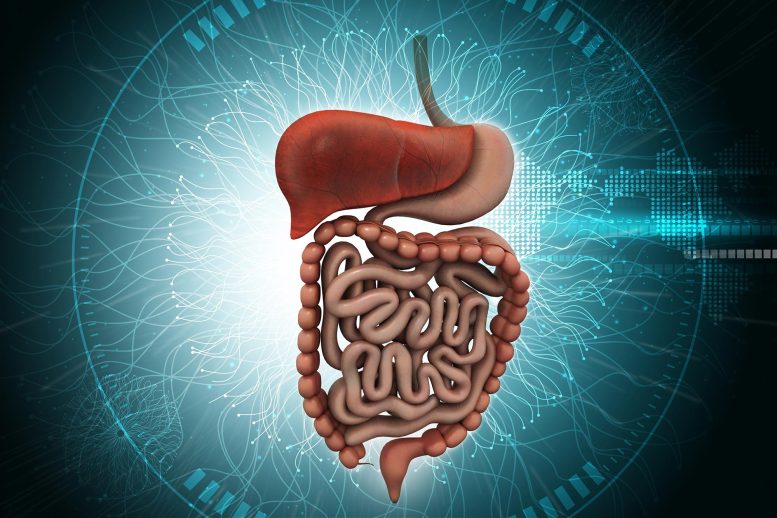
New hypothesis unifies several contrasting theories that may help explain the underlying cause of IBS.
According to a new theory from researchers out of Cedars-Sinai Medical Center, gravity may be the cause of irritable bowel syndrome (IBS), the most common gastrointestinal disorder.
Brennan Spiegel, MD, MSHS, director of Health Services Research at Cedars-Sinai and author of the hypothesis, explains that IBS—and many other conditions—could result from the body’s inability to manage gravity.
“As long as there’s been life on Earth, from the earliest organisms to Homo sapiens, gravity has relentlessly shaped everything on the planet,” said Spiegel, who is also a professor of Medicine. “Our bodies are affected by gravity from the moment we’re born to the day we die. It’s a force so fundamental that we rarely note its constant influence on our health.”
The hypothesis, published in the American Journal of Gastroenterology, describes how the intestines, spine, heart, nerves, and brain evolved to manage gravity.
Irritable bowel syndrome (IBS) is a collection of symptoms that occur together, including repeated pain in your abdomen and changes in your bowel movements, which may be diarrhea, constipation, or both. With IBS, you have these symptoms without any visible signs of damage or disease in your digestive tract.
Gravity in Digestive Health
“Our body systems are constantly pulled downward,” Spiegel noted. “If these systems cannot manage the drag of gravity, then it can cause issues like pain, cramping, lightheadedness, sweating, rapid heartbeat and back issues—all symptoms seen with IBS. It can even contribute to bacterial overgrowth in the gut, a problem also linked to IBS.”
The underlying mechanism of IBS has been puzzling researchers since it was first described over a century ago. While the disorder affects up to 10% of the world’s population, experts still aren’t sure exactly how or why it develops.
There are, however, several contrasting theories that explain its clinical features. One is that IBS is a gut-brain interaction disorder; evidence shows that neuromodulators and behavioral therapies are effective. Another theory holds that IBS is driven by abnormalities in the gut microbiome, which can be managed with antibiotics or low fermentable diets.
Other theories suggest that abnormalities in motility, gut hypersensitivity, abnormal serotonin levels, or a dysregulated autonomic nervous system cause IBS.
Unifying Gravity Hypothesis for IBS Symptoms
“There’s such a variety of explanations that I wondered if they could all be simultaneously true,” said Spiegel. “As I thought about each theory, from those involving motility, to bacteria, to the neuropsychology of IBS, I realized they might all point back to gravity as a unifying factor. It seemed pretty strange at first, no doubt, but as I developed the idea and ran it by colleagues, it started to make sense.”
The most common symptoms of IBS are pain in your abdomen, often related to your bowel movements, and changes in your bowel movements. These changes may be diarrhea, constipation, or both, depending on what type of IBS you have.
Gravity can compress the spine and decrease one’s flexibility. It can also cause organs to shift downward, moving from their proper position. The abdominal contents are heavy, like a sack of potatoes that we’re destined to carry our entire lives, Spiegel explained.
“The body evolved to hoist this load with a set of support structures. If these systems fail, then IBS symptoms can occur along with musculoskeletal problems,” Spiegel said.
Some people have bodies that are more capable of carrying the load than others. For example, some have “stretchy” suspension systems that cause the intestines to droop down. Others have spinal issues that cause the diaphragm to sag or the belly to protrude, leading to a compressed abdomen.
These factors might trigger motility problems or bacterial overgrowth in the gut. This may also help explain why physical therapy and exercise is effective for IBS because these interventions strengthen the support systems.
The gravity hypothesis, however, also goes beyond the intestines.
“This hypothesis is very provocative, but the best thing about is that it is testable. If proved correct, it is a major paradigm shift in the way we think about IBS and possibly treatment as well.” Shelly Lu, MD
“Our nervous system also evolved in a world of gravity, and that might explain why many people feel abdominal ‘butterflies’ when anxious,” said Spiegel. “It’s curious that these ‘gut feelings’ also occur when falling toward Earth, like when dropping on a roller coaster or in a turbulent airplane. The nerves in the gut are like an ancient G-force detector that warns us when we’re experiencing—or about to experience—a dangerous fall. It’s just a hypothesis, but people with IBS might be prone to over-predicting G-force threats that never occur.”
Some people are more resilient to G-forces than others. For example, one person may raise their hands and grin while dropping on a roller coaster while another grits their teeth and groans. The first person is amused while the second feels threatened, revealing a spectrum of what Spiegel calls “G-force vigilance.”
Serotonin and Gravity Intolerance
Another contributor that may play a role is serotonin, a neurotransmitter that may have evolved in part to manage gravity across body systems. Serotonin is necessary for mood elevation, both metaphorically and literally, noted Spiegel. Without it, people also would not be able to stand up, maintain balance, circulate blood, or pump intestinal contents against gravity.
“Dysregulated serotonin may be a form of gravity failure,” Spiegel said. “When serotonin biology is abnormal, people can develop IBS, anxiety, depression, fibromyalgia, and chronic fatigue. These may be forms of gravity intolerance.”
Further research is needed to test this approach and the possible treatments.
“This hypothesis is very provocative, but the best thing about is that it is testable,” said Shelly Lu, MD, the Women’s Guild Chair in Gastroenterology and director of the Division of Digestive and Liver Diseases at Cedars-Sinai. “If proved correct, it is a major paradigm shift in the way we think about IBS and possibly treatment as well.”
Reference: “Gravity and the Gut: A Hypothesis of Irritable Bowel Syndrome by Spiegel, Brennan MD, MSHS, FACG, 1 December 2022, The American Journal of Gastroenterology.
DOI: 10.14309/ajg.0000000000002066
Never miss a breakthrough: Join the SciTechDaily newsletter.
Follow us on Google and Google News.
3 Comments
Unless you’re positioned upside down (or, to a much lesser extent, laying down) the GI tract is not pumping anything against gravity. In the vertical, right-side up position, everything is following gravity, even when it’s traveling upward, thanks to downward pressure/vacuum of the adjacent contents. This is how siphons work, no pumping required as long as the exit is below the entrance. Intestinal pumping is mainly to overcome internal friction and pressures such as those generated by gut bacteria producing gaseous waste, the force of gravity being negligible in comparison.
Now if we were twice as tall and the flow of digestion occurred in the opposite direction, gravity would definitely present a problem.
Regardless, the “g-force signaling” interpretation seems rather tortured, while at the same time lacking any clear causal explanation or identifiable hypothesis, at least in this write up. Suffering from diarrhea or constipation is not, to my knowledge, a commonly cited effect of riding a roller coaster, no matter how poorly tolerated the experience may be.
L
It sounds to me like they are confusing long-term chronic subclinical non-IgE-mediated allergy reactions (Dr. Arthur F. Coca), individually bad diet and related medical errors (which together can weaken bones and muscles, minimally), with the force of gravity. One type of relevant medical error I’m personally familiar with is medically undiagnosed calcium deficiency, caused in part by standard blood serum testing for calcium being unreliable, probably a lot more common (especially in mothers) than generally thought.
I’m sorry but isn’t that the same as saying breathing air is the cause of catching the common cold?