
Close Menu
    Facebook X (Twitter) Instagram
    SciTechDaily
    • Biology
    • Chemistry
    • Earth
    • Health
    • Physics
    • Science
    • Space
    • Technology
    Facebook X (Twitter) Pinterest YouTube RSS
    SciTechDaily
    Home»Biology»Mito Warriors: New Footage Shows T Cell Assassins Hunting Down and Destroying Cancer Cells
    Biology

    Mito Warriors: New Footage Shows T Cell Assassins Hunting Down and Destroying Cancer Cells

    By University of CambridgeOctober 14, 2021No Comments3 Mins Read
    Facebook Twitter Pinterest Telegram LinkedIn WhatsApp Email Reddit
    Share
    Facebook Twitter LinkedIn Pinterest Telegram Email Reddit
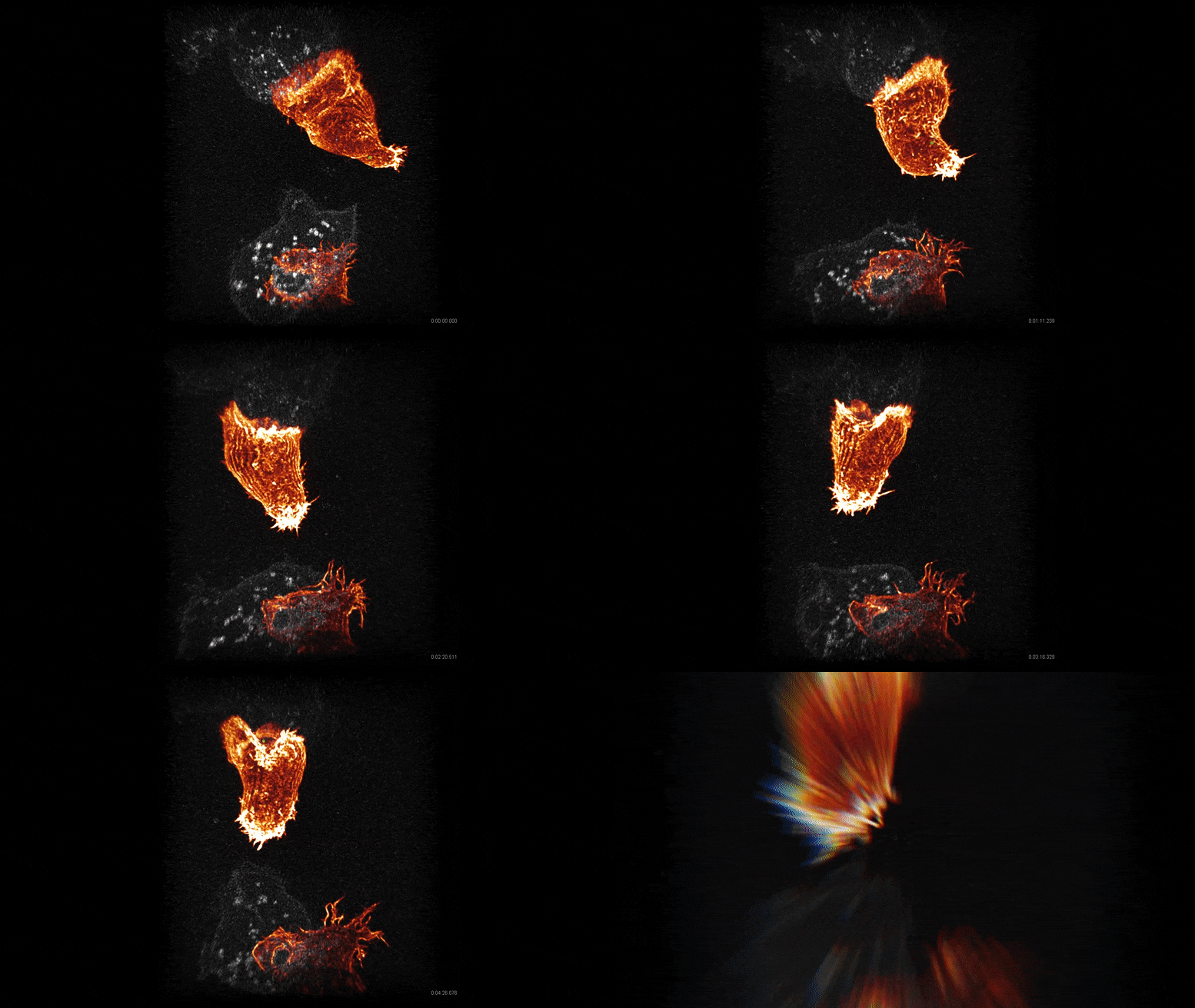
    T Cell Assassins
    Scientists have discovered that the refueling of T cells’ toxic weapons is regulated by mitochondria. This allows T cells to kill and kill again. Credit: University of Cambridge

    Scientists discover how T cell assassins reload their weapons to kill and kill again.

    Cambridge researchers have discovered how T cells – an important component of our immune system – are able to keep on killing as they hunt down and kill cancer cells, repeatedly reloading their toxic weapons.

    Cytotoxic T cells are specialist white blood cells that are trained by our immune system to recognize and eliminate threats – including tumor cells and cells infected with invading viruses, such as SARS-CoV-2, which causes COVID-19. They are also at the heart of new immunotherapies that promise to transform cancer treatment. 

    Professor Gillian Griffiths from the Cambridge Institute for Medical Research, who led the research, said: “T cells are trained assassins that are sent on their deadly missions by the immune system. There are billions of them in our blood, each engaged in a ferocious and unrelenting battle to keep us healthy.

    “Once a T cell has found its target, it binds to it and releases its toxic cargo. But what is particularly remarkable is that they are then able to go on to kill and kill again. Only now, thanks to state-of-the-art technologies, have we been able to find out how they reload their weapons.”

    Today, in a study published in Science, the team have shown that the refueling of T cells’ toxic weapons is regulated by mitochondria. Mitochondria are often referred to as a cell’s batteries as they provide the energy that power their function. However, in this case the mitochondria use an entirely different mechanism to ensure the killer T cells have sufficient ‘ammunition’ to destroy their targets.

    Balancing Health and Lethality in T Cells

    Professor Griffiths added: “These assassins need to replenish their toxic payload so that they can keep on killing without damaging the T cells themselves. This careful balancing act turns out to be regulated by the mitochondria in T cells, which set the pace of killing according to how quickly they themselves can manufacture proteins. This enables killer T cells to stay healthy and keep on killing under challenging conditions when a prolonged response is required.”

    To accompany the study, Professor Griffiths and colleagues have released footage showing killer T cells as they hunt down and eliminate cancer cells.

    One teaspoon full of blood alone is believed to have around 5 million T cells, each measuring around 10 micrometers in length, about a tenth the width of a human hair. The cells, seen in the video as red or green amorphous ‘blobs’, move around rapidly, investigating their environment as they travel.

    When a T cell finds an infected cell or, in the case of the film, a cancer cell, membrane protrusions rapidly explore the surface of the cell, checking for tell-tale signs that this is an uninvited guest. The T cell binds to the cancer cell and injects poisonous ‘cytotoxin’ proteins down special pathways called microtubules to the interface between the T cell and the cancer cell, before puncturing the surface of the cancer cell and delivering its deadly cargo.

    Reference: “Mitochondrial translation is required for sustained killing by cytotoxic T cells” by Miriam Lisci, Philippa R. Barton, Lyra O. Randzavola, Claire Y. Ma, Julia M. Marchingo, Doreen A. Cantrell, Vincent Paupe, Julien Prudent, Jane C. Stinchcombe and Gillian M. Griffiths, 15 October 2021, Science.
    DOI: 10.1126/science.abe9977

    The research was funded by Wellcome.

    Never miss a breakthrough: Join the SciTechDaily newsletter.
    Follow us on Google and Google News.

    Cancer Cell Biology Immunology University of Cambridge
    Share. Facebook Twitter Pinterest LinkedIn Email Reddit

    Related Articles

    Scientists Finally Reveal How Cancer-Fighting T Cells Switch On

    Brains Not Required: Cells Exhibit Surprising Learning Abilities

    How High-Fat Diets Allow Cancer Cells To Go Unnoticed by the Immune System

    Fat “Shield” Protects Natural Killer Immune Cells – and Some Cancers – From Destruction by Their Deadly Biological Weapons

    New Technology Makes Cancer Tumors Eliminate Themselves

    New “Time Machine” Technique Unveiled to Measure Cells

    Daily Rhythms May Impact Our Ability to Fight Disease – Immune System Killer Cells Controlled by Circadian Rhythms

    Scientists Sequence the Genome of the World’s Oldest Continuously Surviving Cancer

    Two-Drug Combination Could Be the Key to Curing Cancer

    Leave A Reply Cancel Reply

    • Facebook
    • Twitter
    • Pinterest
    • YouTube

    Don't Miss a Discovery

    Subscribe for the Latest in Science & Tech!

    Trending News

    FDA-Approved Drug Shows Promise for Reversing Osteoarthritis Damage

    11,000-Year-Old Grains Reveal a Surprise About the Origins of Agriculture

    This Common Type of Medication Is Linked to Slower Cognitive Decline

    Quantum Computer Solves a Problem in 15 Minutes That Classical Methods Can’t Practically Compute

    Taking the Stairs Could Cut Your Risk of Heart-Related Death by 39%

    Scientists Uncover a Surprising New Route for Stonehenge’s Most Mysterious Stone

    A Star Near the Milky Way’s Black Hole Is Losing Mass at an Astonishing Rate

    Scientists Solve a Vitamin B12 Mystery With an Unexpected Culprit

    Follow SciTechDaily
    • Facebook
    • Twitter
    • YouTube
    • Pinterest
    • Newsletter
    • RSS
    SciTech News
    • Biology News
    • Chemistry News
    • Earth News
    • Health News
    • Physics News
    • Science News
    • Space News
    • Technology News
    Recent Posts
    • Scientists Turn an Overlooked Chip Layer Into a Powerful New Light Source
    • New Technique Could Slash AI’s Memory Energy Use by Thousands of Times
    • Scientists Find a Hidden Biological Link Across Different Forms of Autism
    • Scientists Discover a 3.7-Billion-Year-Old Secret of Early Life
    • Scientists Revisited a Forest Experiment That Was Forgotten for 30 Years. What They Found Was Astounding
    Copyright © 1998 - 2026 SciTechDaily. All Rights Reserved.
    • Science News
    • About
    • Contact
    • Editorial Board
    • Privacy Policy
    • Terms of Use

    Type above and press Enter to search. Press Esc to cancel.