
Close Menu
    Facebook X (Twitter) Instagram
    SciTechDaily
    • Biology
    • Chemistry
    • Earth
    • Health
    • Physics
    • Science
    • Space
    • Technology
    Facebook X (Twitter) Pinterest YouTube RSS
    SciTechDaily
    Home»Earth»Moon-Sized Impacts: The Secret Behind Gold & Platinum in Earth’s Mantle?
    Earth

    Moon-Sized Impacts: The Secret Behind Gold & Platinum in Earth’s Mantle?

    By Southwest Research InstituteOctober 12, 20232 Comments4 Mins Read
    Facebook Twitter Pinterest Telegram LinkedIn WhatsApp Email Reddit
    Share
    Facebook Twitter LinkedIn Pinterest Telegram Email Reddit
    Earth Impact Mantle Materials
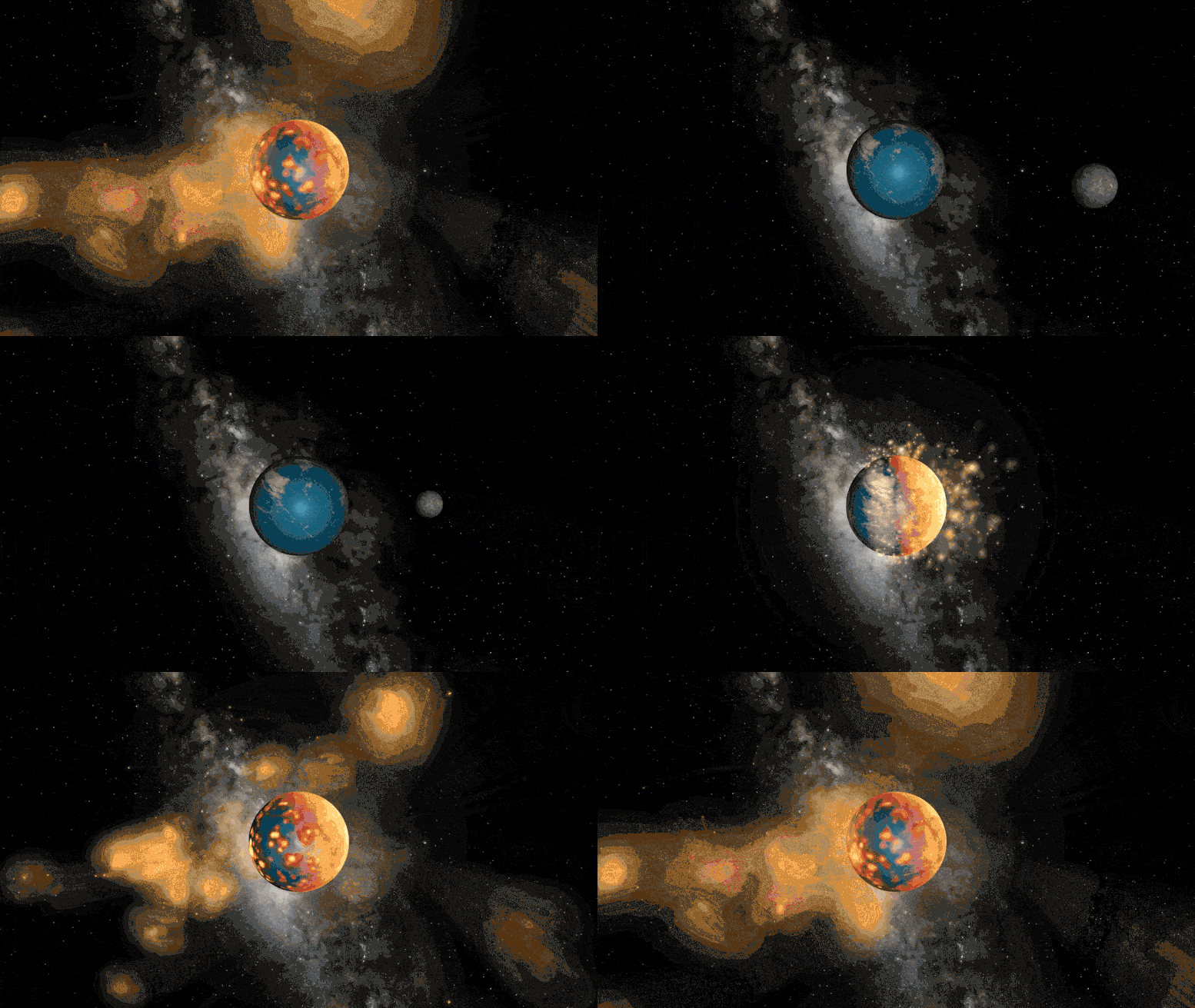
    Southwest Research Institute’s Dr. Simone Marchi collaborated on a new study finding the first geophysically plausible scenario to explain the abundance of certain precious metals — including gold and platinum — in the Earth’s mantle. Based on these simulations, scientists found an impact-driven mixing of mantle materials scenarios that could prevent the metals from completely sinking into the Earth’s core. Credit: Southwest Research Institute

    A new study suggests impact-driven mixing of mantle materials could create current mantle composition.

    Southwest Research Institute’s Dr. Simone Marchi collaborated on a new study finding the first geophysically plausible scenario to explain the abundance of certain precious metals — including gold and platinum — in the Earth’s mantle. Based on the simulations, or model, scientists found that impact-driven mixing of mantle materials scenario that could prevent the metals from completely sinking into the Earth’s core.

    The Earth’s Early History

    Early in its evolution, about 4.5 billion years ago, Earth sustained an impact with a Mars-sized planet, and the Moon formed from the resulting debris ejected into an Earth-orbiting disk. A long period of bombardment followed, the so-called “late accretion,” when planetesimals as large as our Moon impacted the Earth delivering materials including highly “siderophile” elements (HSEs) — metals with a strong affinity for iron — that were integrated into the young Earth.

    Previous Understanding vs. New Insights

    “Previous simulations of impacts penetrating Earth’s mantle showed that only small fractions of a metallic core of planetesimals are available to be assimilated by Earth’s mantle, while most of these metals — including HSEs — quickly drain down to the Earth’s core,” said Marchi, who coauthored a Proceedings of the National Academy of Sciences (PNAS) paper outlining the new findings. “This brings us to the question: How did Earth get some of its precious metals? We developed new simulations to try to explain the metal and rock mix of materials in the present-day mantle.”

    Metal-Mantle Redraw
    This schematic illustrates the most geophysically plausible explanation for the abundance of HSE metals present in the Earth’s mantle. During the long period of bombardment, impactors would strike the Earth and deliver materials. (a) Liquid metals would sink in the locally produced impact-generated magma ocean before percolating through the partially molten zone beneath. (b) Compression causes the metals in the molten zone to solidify and sink. (c) Then thermal convection mixes and redistributes the metal-impregnated mantle components over long geologic time frames. Credit: Southwest Research Institute

    How HSEs Remained in the Mantle

    The relative abundance of HSEs in the mantle points to delivery via impact after Earth’s core had formed; however, retaining those elements in the mantle proved difficult to model — until now. The new simulation considered how a partially molten zone under a localized impact-generated magma ocean could have stalled the descent of planetesimal metals into Earth’s core.

    “To achieve this, we modeled mixing an impacting planetesimal with the mantle materials in three flowing phases: solid silicate minerals, molten silicate magma, and liquid metal,” said Dr. Jun Korenaga, the paper’s lead author from Yale University. “The rapid dynamics of such a three-phase system, combined with the long-term mixing provided by convection in the mantle, allows HSEs from planetesimals to be retained in the mantle.”

    Understanding Mantle Dynamics

    In this scenario, an impactor would crash into the Earth, creating a localized liquid magma ocean where heavy metals sink to the bottom. When metals reach the partially molten region beneath, the metal would quickly percolate through the melt and, after that, slowly sink toward the bottom of the mantle. During this process the molten mantle solidifies, trapping the metal. That’s when convection takes over, as heat from the Earth’s core causes a very slow creeping motion of materials in the solid mantle and the ensuing currents carry heat from the interior to the planet’s surface.

    “Mantle convection refers to the process of rising hot mantle material and sinking colder material,” Korenaga said. “The mantle is almost entirely solid although, over long geologic time spans, it behaves as a ductile and highly viscous fluid, mixing and redistributing mantle materials, including HSEs accumulated from large collisions that took place billions of years ago.”

    Reference: “Vestiges of impact-driven three-phase mixing in the chemistry and structure of Earth’s mantle” by Jun Korenaga and Simone Marchi, 9 October 2023, Proceedings of the National Academy of Sciences.
    DOI: 10.1073/pnas.2309181120

    Never miss a breakthrough: Join the SciTechDaily newsletter.
    Follow us on Google and Google News.

    Planets Popular Southwest Research Institute
    Share. Facebook Twitter Pinterest LinkedIn Email Reddit

    Related Articles

    New Clues to Earth’s Formation From Ancient Helium Leaking From the Planet’s Core

    Confessions of a Former Fireball: How Earth Transformed Itself From a Fiery Ball to a Habitable Planet

    Scientists Reveal Superionic Secrets of Earth’s Inner Core

    Geological “Goldilocks Zone” for Metal Deposits Discovered at the Base of Earth’s Crust

    Scientists Use Occultation Event To Confirm Decrease in Pluto’s Atmospheric Density

    Strange New Auroral Feature Discovered on Jupiter

    Researchers Tackle the Enigmatic “Spiders” From Mars

    When Volcanoes Go Metal: What Lava Flows Look Like on a Planet Made of Metal

    Luck Played a Major Role in Keeping Earth Fit for Life

    2 Comments

    1. Clyde Spencer on October 12, 2023 6:26 pm

      Why only silicates and metals? Why no mention of sulfides?

      Reply
    2. Torbjörn Larsson on October 18, 2023 1:19 am

      Unfortunately a paywalled paper. But the abstract is tantalizing, proposing a new hypotheses for mysterious large low-shear-velocity provinces:

      “In addition, large low-shear-velocity provinces in the lower mantle may originate from compositional heterogeneities resulting from the proposed three-phase flow during high-energy collisions.”

      Reply
    Leave A Reply Cancel Reply

    • Facebook
    • Twitter
    • Pinterest
    • YouTube

    Don't Miss a Discovery

    Subscribe for the Latest in Science & Tech!

    Trending News

    Mezcal “Worm” in a Bottle Mystery: DNA Testing Reveals a Surprise

    New Research Reveals That Your Morning Coffee Activates an Ancient Longevity Switch

    This Is What Makes You Irresistible to Mosquitoes

    Shockingly Powerful Giant Octopuses Ruled the Seas 100 Million Years Ago

    Scientists Stunned by New Organic Molecules Found on Mars

    Rewriting Dinosaur Evolution: Scientists Unearth Remarkable 150-Million-Year-Old Stegosaur Skull

    Omega-3 Supplements Linked to Cognitive Decline in Surprising New Study

    First-of-Its-Kind Discovery: Homer’s Iliad Found Embedded in a 1,600-Year-Old Egyptian Mummy

    Follow SciTechDaily
    • Facebook
    • Twitter
    • YouTube
    • Pinterest
    • Newsletter
    • RSS
    SciTech News
    • Biology News
    • Chemistry News
    • Earth News
    • Health News
    • Physics News
    • Science News
    • Space News
    • Technology News
    Recent Posts
    • New Research Challenges Long-Held Beliefs About How the Brain Makes Decisions
    • Breakthrough Technology Reveals New Treatment Targets for Cancer
    • Scientists Discover New Way To Make Drug-Resistant Cancer Treatable Again
    • This Simple Exercise Trick Builds Muscle With Less Effort, Study Finds
    • Middle Age Is Becoming a Breaking Point in America, Study Reveals
    Copyright © 1998 - 2026 SciTechDaily. All Rights Reserved.
    • Science News
    • About
    • Contact
    • Editorial Board
    • Privacy Policy
    • Terms of Use

    Type above and press Enter to search. Press Esc to cancel.