

For the first time in history, scientists have analyzed actual samples from the lunar farside—thanks to China’s Chang’e-6 mission—and discovered that the surface there weathers differently than the Moon’s near side.
Using cutting-edge microscopy, researchers found that solar wind, more than micrometeorites, dominates the transformation of minerals on the farside. These findings challenge long-held assumptions and shed light on how the Moon’s hidden face evolves under space conditions.
First Lunar Farside Samples Return
On June 25, 2024, China’s Chang’e-6 mission made history by completing the first-ever sample return from the lunar farside. The spacecraft successfully collected and brought back material from this unexplored region of the Moon. A new study, “Differences in space weathering between the near and far side of the Moon: Evidence from Chang’e-6 samples,” has been published in National Science Review. It was led by Dr. Haiyang Xian and Dr. Jianxi Zhu of the Guangzhou Institute of Geochemistry, part of the Chinese Academy of Sciences.
In recognition of his previous work analyzing Chang’e-5 samples, Dr. Xian was among the first researchers to receive a batch of Chang’e-6 material in August 2024. This milestone represents the first time in human history that physical samples have been directly collected from the Moon’s farside. The research team aims to study how space weathering, the process by which the lunar surface is altered by solar wind and micrometeoroid impacts, differs on the farside. These samples offer a unique opportunity to better understand the space environment conditions in this previously unstudied region.
Analyzing the Dust: SEM & Sample Selection
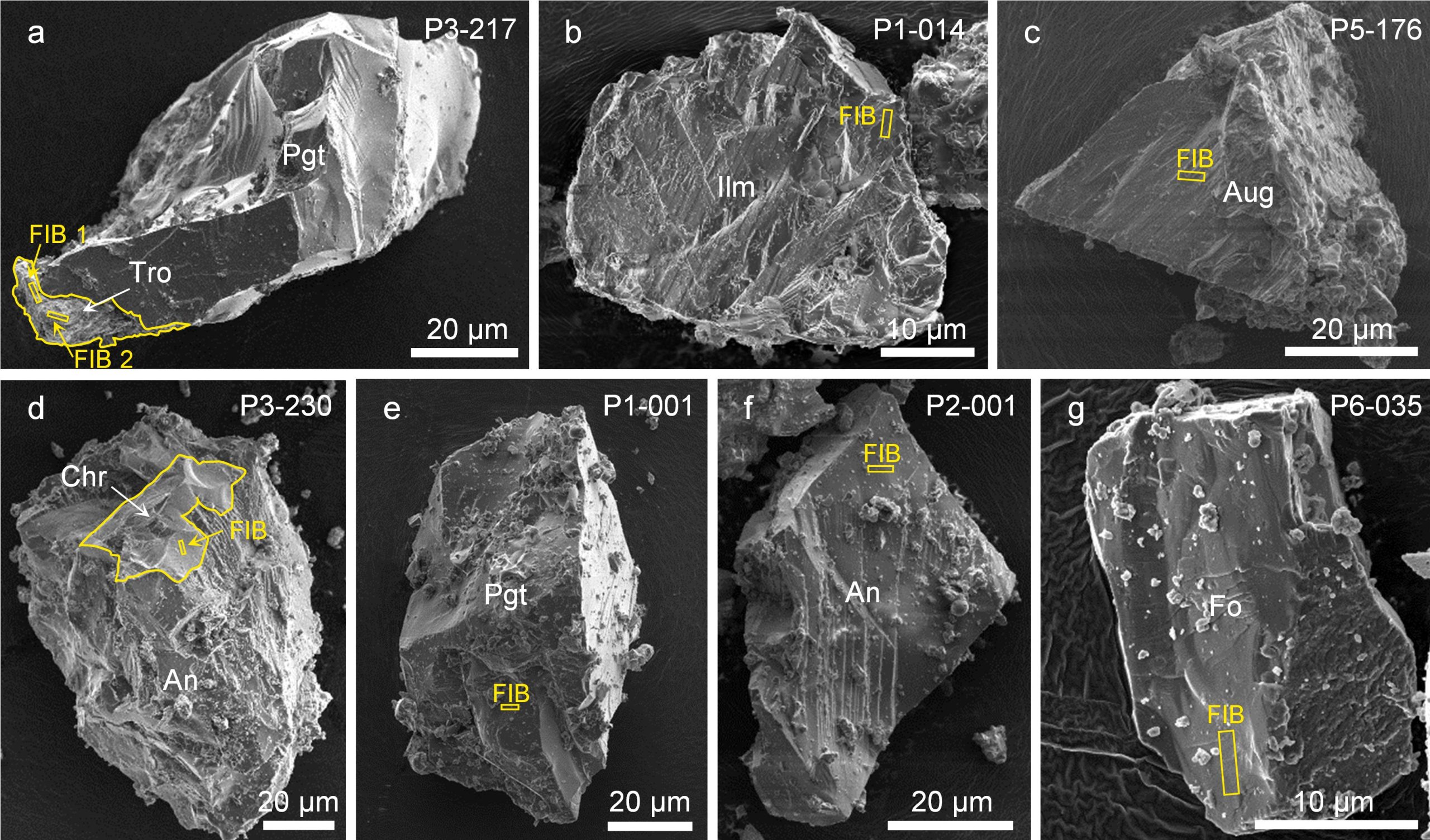
Under Dr. Xian’s supervision, graduate student Lin Jiarui at the institute’s Electron Microscopy Center conducted a detailed analysis of the samples using a scanning electron microscope (SEM). To preserve surface features, she carefully dispersed the fine-grained lunar dust onto conductive adhesive, coated it with a 10-nanometer carbon film, and examined it at a low voltage of 3 kV. After studying nearly 1,000 particles, she observed that the Chang’e-6 samples showed fewer melt droplets and splashes on their surfaces compared to previous lunar samples.
To explore the weathering effects in more detail, she used energy-dispersive spectroscopy (EDS) to select seven mineral particles with distinct compositions. Together, these particles represent the main types of lunar minerals and form the basis for a deeper investigation into how the Moon’s surface evolves under space exposure.
Discovering Differences with TEM
In subsequent transmission electron microscopy (TEM) investigations, Lin and other team members prepared a feldspar particle (designated P2‑001) using focused ion beam (FIB) techniques and discovered that its surface lacked the nanophase metallic iron (npFe⁰) particles commonly found in Apollo samples. Typically, the surface of feldspar in Apollo samples exhibits a vapor‑deposited layer generated by micrometeorite impacts that contains npFe⁰.
They further conducted EDS mapping on the other seven FIB sections under TEM, and the results showed no significant compositional differences between the edges and interiors of these minerals. All regions displaying observable space weathering features—including the amorphized layers, vesicles, and npFe⁰ grains—were consistent with the substrate mineral composition, indicating that these features can be attributed to the damage caused by solar wind radiation on the substrate minerals.
Solar Wind Exposure Tells a New Story
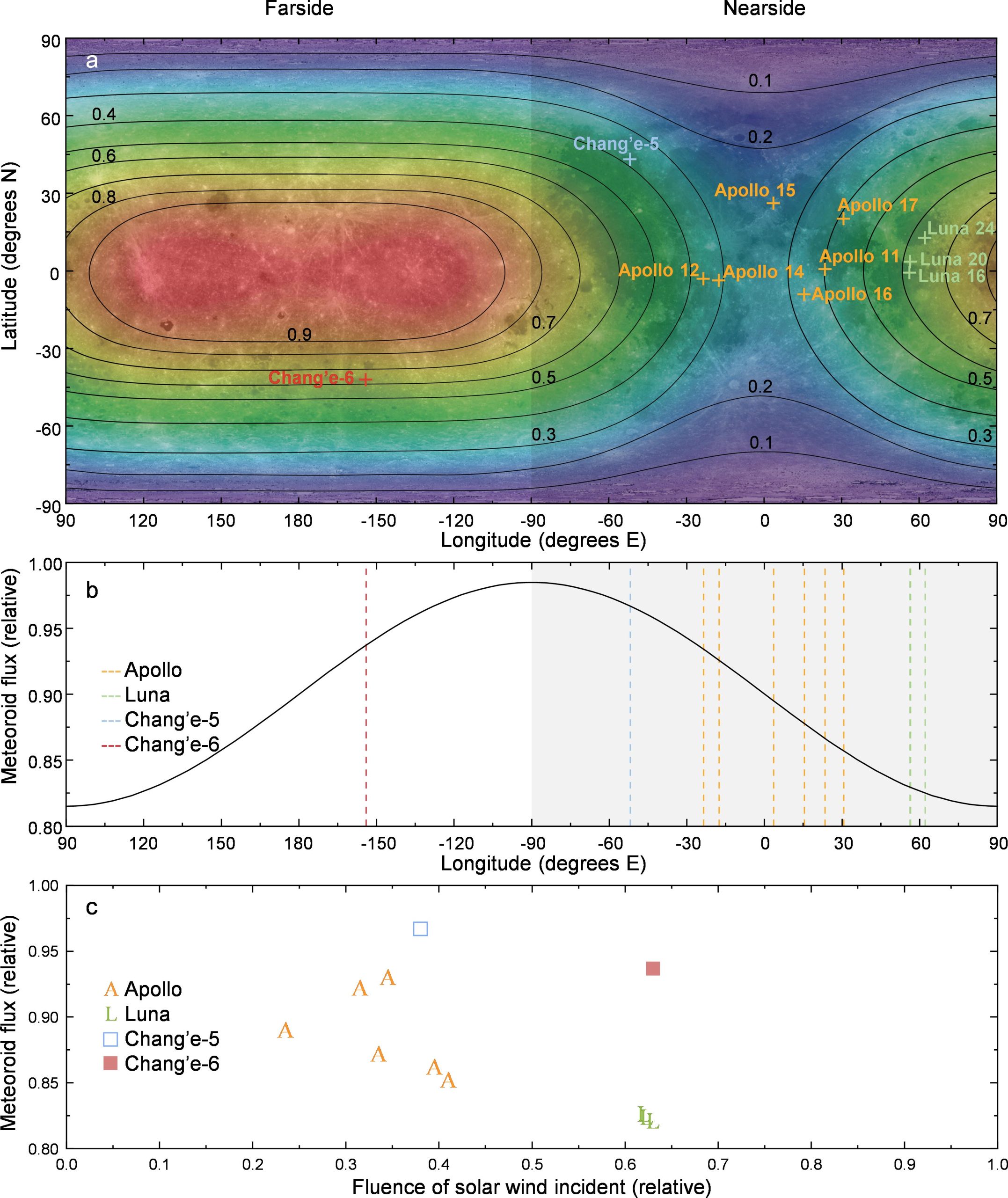
Lin further measured the thickness of the amorphized layers and the grain sizes of npFe⁰, and counted the solar wind tracks in pyroxene and olivine to estimate the solar wind exposure time of the particles. The study found that the solar wind exposure time of the Chang’e-6 samples was close to the minimum observed in the Apollo 11 samples, lower than that of the other Apollo samples, and slightly shorter than that of the Chang’e-5 samples.
However, surprisingly, the npFe⁰ grain sizes in the Chang’e-6 samples were larger. “This might suggest that solar wind radiation in this region leads to more pronounced segregation and aggregation of iron,” she noted. These exciting new results add to the growing evidence that space weathering on the lunar farside may differ from that on the nearside, and, contrary to previous findings from Apollo and Chang’e-5 samples, solar wind radiation plays a more dominant role in the space weathering process on the lunar farside.
Space Weathering Varies by Lunar Region
There are differences in the solar wind’s influence on different regions of the Moon. During each synodic month, the near side of the Moon enters Earth’s magnetotail, where the protection afforded by Earth’s magnetic field reduces its exposure to the solar wind; in contrast, the farside is continuously exposed to direct solar wind radiation.
Moreover, due to orbital dynamics, different locations on the Moon experience varying impact velocities from cometary and asteroidal meteoroids. The relative velocity between the Moon’s surface and impacting meteoroids changes with the lunar phase: during a full moon, when the Moon and meteoroids move in the same orbital direction, the relative velocity increases; the opposite occurs during a new moon.
Competing Forces of Lunar Surface Change
Micrometeoroid impacts and solar wind radiation are the two primary processes driving space weathering, but the effective sputtering rate from the solar wind and vapor deposit from micrometeorite impacts offset each other. Therefore, when discussing space weathering mechanisms, it is essential to consider the relative contributions of both factors under different space environments.
The findings from the Chang’e-6 samples indicate that on the lunar farside, the effect of the solar wind exceeds that of micrometeorite impacts, further demonstrating that the space weathering process is regulated by variations in the space environment.
Farside vs. Nearside: A New Lunar Dichotomy
Since the first images of the lunar farside were captured in 1959, it has been evident that its topography is markedly different from that of the nearside—a phenomenon known as the Moon’s “dichotomy.” However, whether the lunar space environment also exhibits a similar “dichotomy” had until now only been inferred from remote sensing spectra.
The latest analysis of the Chang’e-6 samples provides direct, sample‑based evidence for this hypothesis, highlighting the critical role of space environmental variables in the space weathering process. This discovery not only deepens our understanding of how solar wind radiation and micrometeorite impacts shape the lunar surface, but also offers important insights for studying the space weathering evolution of other airless bodies.
Reference: “Differences in space weathering between the near and far side of the Moon: Evidence from Chang’e-6 samples” by Jiarui Lin, Haiyang Xian, Yiping Yang, Shan Li, Jiaxin Xi, Xiaoju Lin, Yao Xiao, Shengdong Chen, Chenyi Zhao, Miaomiao Zhang, Akira Tsuchiyama, Jianxi Zhu, Hongping He and Yi-Gang Xu, 5 March 2025, National Science Review.
DOI: 10.1093/nsr/nwaf087
Never miss a breakthrough: Join the SciTechDaily newsletter.
Follow us on Google and Google News.