
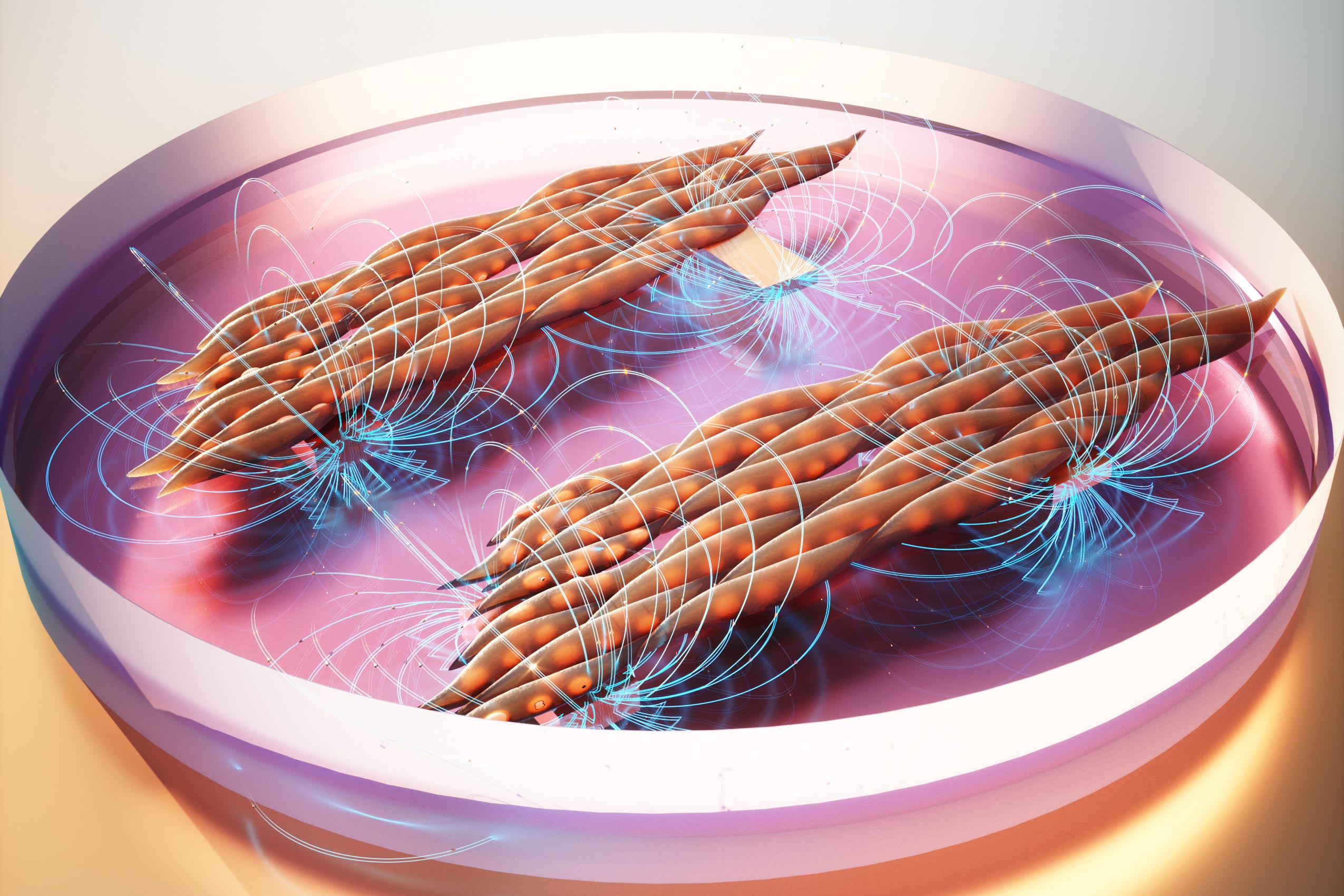
The vibrating platform could be useful for growing artificial muscles to power soft robots and testing therapies for neuromuscular diseases.
There’s no doubt that exercise does a body good, including strengthening and toning our muscles. But how exactly does exercise make this happen?
As we run and lift and stretch, our muscles experience chemical signals from surrounding cells, as well as mechanical forces from jostling against tissues. Some physiologists wonder: Is it the body’s natural chemical stimulants or the physical forces of repeated motion — or some mix of the two — that ultimately drive our muscles to grow? The answer could be the key to identifying therapies to help people recover from muscle injuries and neurodegenerative disorders.
MIT’s Innovative Workout Mat for Cells
Now, MIT engineers have designed a sort of workout mat for cells that can help scientists zero in, at the microscopic level, on exercise’s purely mechanical effects.
The new design is not so different from a yoga mat: Both are rubbery, with a bit of stretch. In the case of the MIT mat, it’s made from hydrogel — a soft, Jell-O-like material that is about the size of a quarter and is embedded with magnetic microparticles.
To activate the gel’s mechanical function, the researchers used an external magnet underneath the mat to move the embedded particles back and forth, wobbling the gel in turn like a vibrating mat. They controlled the frequency of the wobbling to mimic the forces that muscles would experience during actual exercise.
Observing Muscle Cell Response to Mechanical Exercise
They next grew a carpet of muscle cells on the gel’s surface and activated the magnet’s motion. Then, they studied how the cells responded to being “exercised” as they were magnetically vibrated.
So far, the results suggest that regular mechanical exercise can help muscle fibers grow in the same direction. These aligned, “exercised” fibers can also work, or contract, in sync. The findings demonstrate that scientists can use the new workout gel to shape how muscle fibers grow. With their new device, the team plans to pattern sheets of strong, functional muscles, potentially for use in soft robots and for repairing diseased tissues.
“We hope to use this new platform to see whether mechanical stimulation could help guide muscle regrowth after injury or lessen the effects of aging,” says Ritu Raman, the Brit and Alex d’Arbeloff Career Development Professor in Engineering Design at MIT. “Mechanical forces play a really important role in our bodies and lived environment. And now we have a tool to study that.”
She and her colleagues published their results recently in the journal Device.
Raman’s Lab: Merging Medicine and Robotics
At MIT, Raman’s lab designs adaptive living materials for use in medicine and robotics. The team is engineering functional, neuromuscular systems with an aim of restoring mobility in patients with motor disorders and powering soft and adaptable robots. To get a better understanding of natural muscles and the forces that drive their function, her group is studying how the tissues respond, at the cellular level, to various forces such as exercise.
“Here, we wanted a way to decouple the two main elements of exercise — chemical and mechanical — to see how muscles respond purely to exercise’s mechanical forces,” Raman says.
The Creation and Testing of the Hydrogel Mat
The team looked for a way to expose muscle cells to regular and repeated mechanical forces, that at the same time would not physically damage them in the process. They ultimately landed on magnets a safe and nondestructive way to generate mechanical forces.
For their prototype, the researchers created small, micron-sized magnetic bars, by first mixing commercially available magnetic nanoparticles with a rubbery, silicone solution. They cured the mixture to form a slab, then sliced the slab into very thin bars. They sandwiched four magnetic bars, each spaced slightly apart, between two layers of hydrogel — a material that is typically used to culture muscle cells. The resulting, magnet-embedded mat was about the size of a quarter.
The team then grew a “cobblestone” of muscle cells across the surface of the mat. Each cell started out as a circular shape that gradually elongated and fused with other neighboring cells to form fibers over time.
The Future of Muscle Cell Research With MagMA
Finally, the researchers placed an external magnet on a track beneath the gel mat and programmed the magnet to move back and forth. The embedded magnets moved in response, wobbling the gel and generating forces that are similar to what cells would experience during actual exercise. The team mechanically “exercised” the cells for 30 minutes a day, for 10 days. As a control, they grew cells on the same mat, but left them to grow without exercising them.
“Then, we zoomed out and took a picture of the gel, and found that these mechanically stimulated cells looked very different from the control cells,” Raman says.
The team’s experiments revealed that muscle cells that are regularly exposed to mechanical motion grew longer compared with cells that were not exercised, which tended to stay circular in shape. What’s more, the “exercised” cells grew into fibers that aligned in the same direction, whereas nonmoving cells resembled a more haphazard haystack of misaligned fibers.
Revolutionizing Muscle Stimulation Research
The muscle cells that the team used in this study were genetically engineered to contract in response to blue light. Typically, muscle cells in the body contract in response to a nerve’s electrical pulse. Electrically stimulating muscle cells in the lab, however, could potentially damage them, so the team chose to genetically manipulate the cells to contract in response to a noninvasive stimulus — in this case, blue light.
“When we shine light on the muscles, you can see the control cells are beating, but some fibers are beating this way, some that way, and overall producing very asynchronous twitch,” Raman explains. “Whereas with the aligned fibers, they all pull and beat at the same time, in the same direction.”
Raman says the new workout gel, which she dubs MagMA, for magnetic matrix actuation, can serve as a quick and noninvasive way to shape muscle fibers and study how they respond to exercise. She also plans to grow other cell types on the gel in order to study how they respond to regular exercise.
“There’s evidence from biology to suggest that a lot of types of cells are responsive to mechanical stimulation,” Raman says “And this is a new tool to study interaction.”
Reference: “Mechanically programming anisotropy in engineered muscle with actuating extracellular matrices” by Brandon Rios, Angel Bu, Tara Sheehan, Hiba Kobeissi, Sonika Kohli, Karina Shah, Emma Lejeune and Ritu Raman, 20 October 2023, Device.
DOI: 10.1016/j.device.2023.100097
This study was supported, in part, by the U.S. National Science Foundation and the Department of Defense Army Research Office.
Never miss a breakthrough: Join the SciTechDaily newsletter.
Follow us on Google and Google News.