
An engraved panel from Aswan may show one of Egypt’s earliest political elites. It reveals how rulers used art to claim space and signal power.
A recently documented rock art panel near Aswan, Egypt, may represent an early depiction of a high-ranking figure from the First Dynasty, offering new perspectives on the emergence of the Ancient Egyptian state.
The period spanning the late fourth millennium BC marked a transformative era in Egypt’s history, as regional powers began to unify, culminating in the establishment of the Egyptian state under the rule of Narmer around 3100 BC.
Despite its significance, the exact nature of how this unification occurred remains poorly understood.
“State formation in Ancient Egypt and the processes that led to it are still difficult to conceptualize,” explains Dr. Dorian Vanhulle of the Musée du Malgré-Tout, who led the study. “The rock art of the Lower Nile Valley has the potential to help identify and analyze the earliest forms of political power in this region and how the landscape was exploited to express and consolidate authority. However, the number of relevant examples is limited.”
Symbolism and boat imagery in Predynastic art
For this reason, the discovery of a petroglyph panel that may depict one of the earliest representations of an Egyptian political elite is especially valuable.
The carving is in remarkably good condition and appears to illustrate an elaborate boat being pulled by five individuals. One person stands at the rear, steering with an oar, while another remains seated atop a raised platform, which researchers interpret as a palanquin.
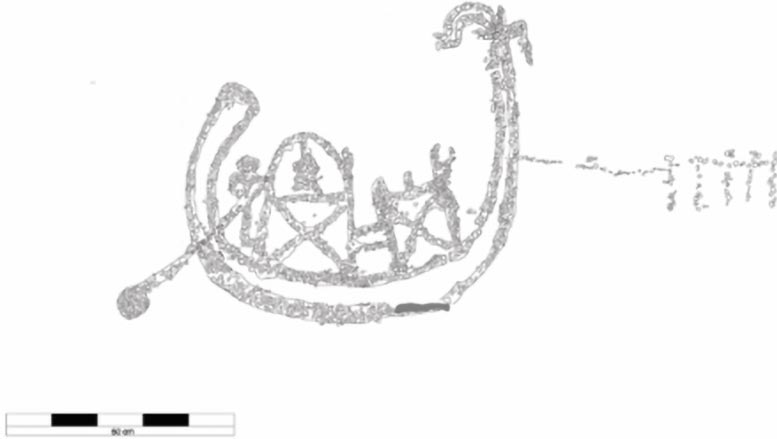
“Boats are among the most frequently recurring motifs in Egyptian iconography,” says Dr. Vanhulle. “During the Predynastic and Protodynastic periods (c. 4500-3085 BC), the periods which foreshadowed Pharaonic Egypt, the boat is ubiquitous and invested with complex ideological and symbolic meanings.”
Dating the panel to the rise of the state
To establish the approximate date of the panel, Dr. Vanhulle analyzed the petroglyph in relation to other known depictions of boats from pre-Pharaonic artistic traditions and material culture.
Based on stylistic parallels, he concluded that the carving likely dates to the transitional phase between the Protodynastic and Early Dynastic periods—a formative era in which the Egyptian state began to emerge, well before the construction of the first pyramids.
Notably, the artwork shows strong visual and symbolic similarities to state-sponsored imagery from the end of the Protodynastic period through the time of Narmer. One prominent detail is the seated figure’s elongated chin, which may allude to the artificial beards worn by Egyptian kings beginning in the First Dynasty.
This detail supports the idea that the seated figure represents a member of Egypt’s earliest ruling elite.
Rock art as a tool of authority
Furthermore, the high quality of the image suggests it was commissioned by an early political authority in Egypt, signaling that rock art was a key method by which early Egyptian elites communicated their power.
This has significant implications for our understanding of the origins of the Egyptian state.
“The rock panel is an important addition to the existing corpus of engravings that can help us to better understand the role of rock art in the crucial events that led to the formation of the Egyptian state,” Dr. Vanhulle explains. “Rock compositions became a tool for the authorities to communicate, mark the landscape, and assert their power.”
It also indicates the importance of recording the rock art as quickly as possible.
“The landscape of the valley and its desert margins is currently being irreparably altered by, among other threats, mining and quarrying activities,” concludes Dr. Vanhulle. “The urgency of conducting rescue missions such as the one that led to the discovery of the discussed panel cannot be underestimated.”
Reference: “An early ruler etched in stone? A rock art panel from the west bank of Aswan (Egypt)” by Dorian Vanhulle, 10 July 2025, Antiquity.
DOI: 10.15184/aqy.2025.60
Never miss a breakthrough: Join the SciTechDaily newsletter.
Follow us on Google and Google News.
2 Comments
“cannot be OVERestimated”.
Thank you.
There’s not enough information presented to understand with what confidence the importance of the rock-art may have had. Graffiti is quite normal – and I missed a broader contexture where formalism places a greater sociological import.