
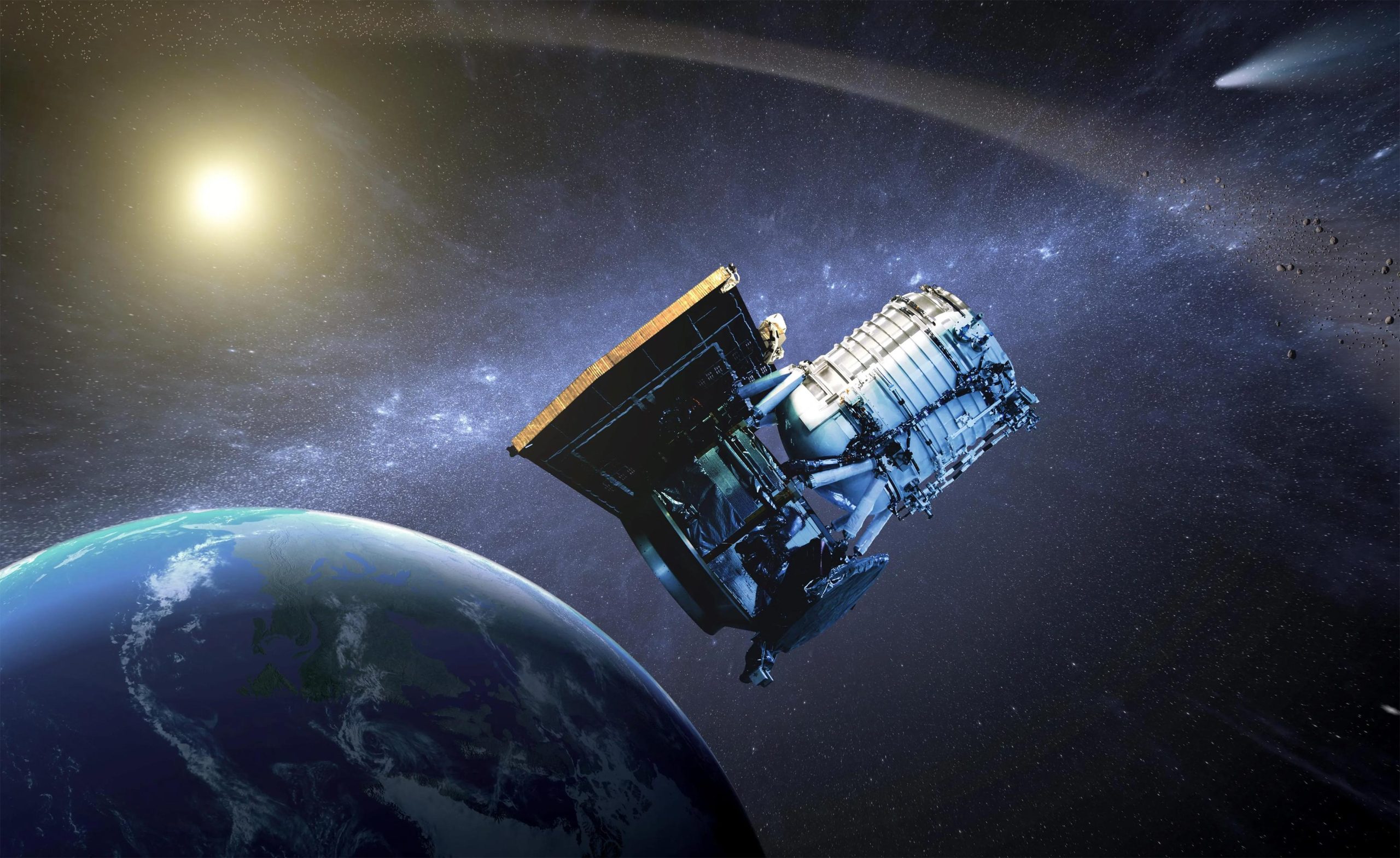
NASA is advancing its exploration of the universe with two new proposed missions observing X-ray and far-infrared wavelengths, each supported by a $5 million study, setting the stage for a 2032 launch.
These initiatives are part of the Probe Explorers class, expected to generate significant scientific and technological advancements.
NASA’s New Astrophysics Missions
NASA announced that it has selected two proposals for missions designed to observe X-ray and far-infrared wavelengths of light from space for further review. Each of the selected teams will receive $5 million to conduct a 12-month mission concept study. Following a detailed evaluation of these studies, NASA plans to choose one concept in 2026 to proceed with construction, with a scheduled launch in 2032.
The chosen mission will inaugurate a new class of NASA astrophysics missions called Probe Explorers within the agency’s established Explorers Program. This new mission class is intended to bridge the gap between flagship missions and smaller-scale endeavors, enhancing NASA’s exploration of the universe’s secrets.
Enhancing Astrophysics Exploration
“NASA’s Explorers Program brings out some of the most creative ideas for missions that help us reveal the unknown about our universe. Establishing this new line of missions – the largest our Astrophysics program has ever competed – has taken that creativity to new heights,” said Nicola Fox, associate administrator, Science Mission Directorate at NASA Headquarters in Washington. “Both of the selected concepts could enable ground-breaking science responsive to the top astrophysics priorities of the decade, develop key technologies for future flagship missions, and offer opportunities for the entire community to use the new observatory, for the benefit of all.”
Vision for the Future
The National Academies of Sciences, Engineering, and Medicine’s 2020 Decadal Survey, Pathways to Discovery in Astronomy and Astrophysics for the 2020s, recommended NASA establish this new mission class, with the first mission observing either X-ray or far-infrared wavelengths of light. Mission costs for the new Probe Explorers are capped at $1 billion each, not including the cost of the rocket, launch services, or any contributions.
NASA evaluated Probe Explorers proposals based on their scientific merit in alignment with the Decadal Survey’s recommendations, feasibility of development plans, and use of technologies that could support the development of future large missions.
The selected proposals are:
Advanced X-ray Imaging Satellite
- This mission would be an X-ray imaging observatory with a large, flat field-of-view and high spatial resolution. It would study the seeds of supermassive black holes; investigate the process of stellar feedback, which influences how galaxies evolve; and help determine the power sources of a variety of explosive phenomena in the cosmos. The observatory would build on the successes of previous X-ray observatories, capturing new capabilities for X-ray imaging and imaging spectroscopy.
- Principal investigator: Christopher Reynolds, University of Maryland, College Park
- Project management: NASA’s Goddard Space Flight Center in Greenbelt, Maryland
Probe far-Infrared Mission for Astrophysics
- This observatory would be a 5.9-foot (1.8-meter) telescope studying far-infrared wavelengths, helping bridge the gap between existing infrared observatories, such as NASA’s James Webb Space Telescope, and radio telescopes. By studying radiant energy that only emerges in the far-infrared, the mission would address questions about the origins and growth of planets, supermassive black holes, stars, and cosmic dust.
- Principal investigator: Jason Glenn, NASA Goddard
- Project management: NASA’s Jet Propulsion Laboratory in Southern California
The Explorers Program is the oldest continuous NASA program designed to provide frequent, low-cost access to space using principal investigator-led space science investigations relevant to the Science Mission Directorate’s astrophysics and heliophysics programs. Since the Explorer 1 launch in 1958, which discovered Earth’s radiation belts, the Explorers Program has launched more than 90 missions, including the Uhuru and Cosmic Background Explorer missions that led to Nobel prizes for their investigators.
The Explorers Program is managed by NASA Goddard for the Science Mission Directorate, which conducts a wide variety of research and scientific exploration programs for Earth studies, space weather, the solar system, and universe.
Never miss a breakthrough: Join the SciTechDaily newsletter.
Follow us on Google and Google News.
3 Comments
The mission would address questions about the origins and growth of planets, supermassive black holes, stars, and cosmic dust.
VERY GOOD.
Ask the researcher:
1. Do topological vortices have physical characteristics of the black holes?
2. Do topological vortices have gravitational characteristics?
3. What is the mass of a topological vortex?
When physics is passionate about studying imaginary particles and things, it is no longer much different from theology.
Scientific research guided by correct theories can help people avoid detours, failures, and exaggeration. The physical phenomena observed by researchers in experiments are always appearances, never the natural essence of things. The natural essence of things needs to be extracted and sublimated based on mathematical theories via appearances , rather than being imagined arbitrarily.
Everytime scientific revolution, the scientific research space brought by the new paradigm expands exponentially. Physics should not ignore the analyzable physical properties of topological vortices.
(1) Traditional physics: based on mathematical formalism, experimental verification and arbitrary imagination.
(2) Topological Vortex Theory: Although also based on mathematics (such as topology), it focuses more on non intuitive geometry and topological structures, challenging traditional physical intuition.
Topological Vortex Theory points out the limitations of the Standard Model in describing the large-scale structure of the universe, proposes the need to consider non-standard model components such as dark matter and dark energy, and suggests that topological vortex fields may be key to understanding these phenomena. Topological vortex theory heralds innovative technologies such as topological electronics, topological smart batteries, topological quantum computing, etc., which may bring low-energy electronic components, almost inexhaustible currents, and revolutionary computing platforms, etc.
Topology tells us that topological vortices and antivortices can form new spacetime structures via the synchronous effect of superposition, deflection, or twisting of them. Mathematics does not tell us that there must be God particles, ghost particles, fermions, or bosons present. When physics and mathematics diverge, arbitrary imagination will make physics no different from theology. Topological vortex research reflections on the philosophy and methodology of science help us understand the nature essence of science and the limitations of scientific methods. This not only has guiding significance for scientific research itself, but also has important implications for science education and popularization.
Today, so-called official (such as PRL, Nature, Science, PNAS, etc.) in physics stubbornly believes that two sets of cobalt-60 rotating in opposite directions can become two sets of objects that mirror each other, is a typical case that pseudoscience is rampant and domineering.
Please witness the exemplary collaboration between theoretical physicists and experimentalists (https://scitechdaily.com/microscope-spacecrafts-most-precise-test-of-key-component-of-the-theory-of-general-relativity/#comment-854286). Let us continue to witness together the dirtiest and ugliest era in the scientific and humanistic history of human society. The laws of nature will not change due to misleading of so-called academic publications.
The laws of nature will not change due to misleading of so-called academic publications or endorsements from certain so-called scientific awards.
The laws of nature will not change due to misleading of certain so-called academic publications or endorsements from certain so-called scientific awards.