
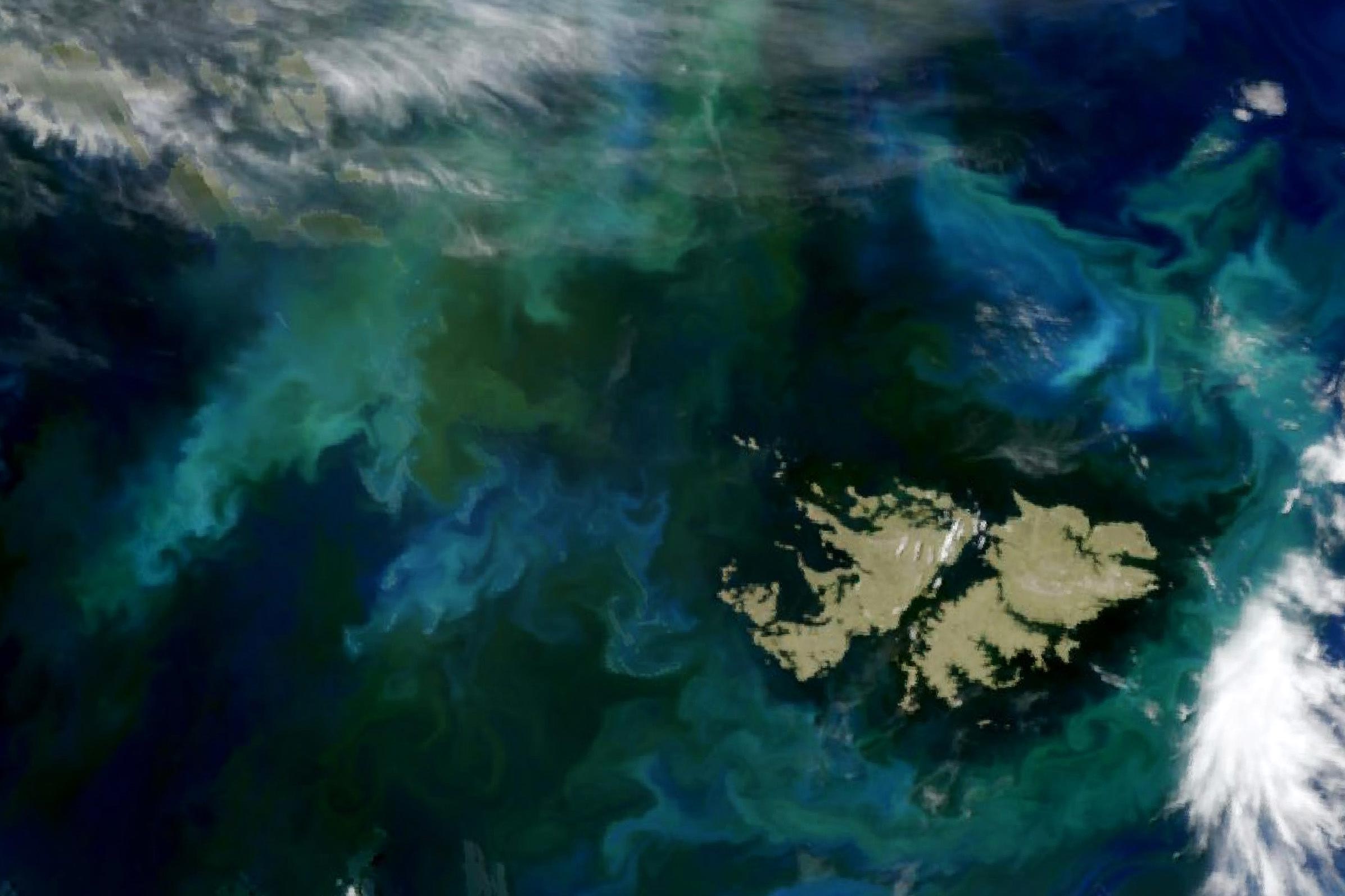
Satellite images from late December 2024 revealed a stunning phytoplankton bloom off the Patagonian Shelf, illustrating the rich aquatic diversity and productivity in the South Atlantic.
The vibrant swirls of green and blue captured by NASA’s PACE satellite not only highlight the natural beauty but also the ecological significance of these blooms in global carbon cycling and marine health.
Blossoming Seas: The Marvel of Phytoplankton
Bloom season has been underway for several months, showcasing vibrant activity in the nutrient-rich South Atlantic waters off Argentina. During austral spring 2024, satellites captured a striking image of a large phytoplankton bloom along the Patagonian Shelf. These tiny aquatic organisms thrived through the extended daylight of the Southern Hemisphere summer, coloring the ocean’s surface in vivid shades of green and blue into late December.
Technological Insight: Satellite Monitoring of Oceanic Phenomena
On December 28, 2024, the Ocean Color Instrument (OCI) aboard NASA’s PACE (Plankton, Aerosol, Cloud, ocean Ecosystem) satellite captured an intricate image of the bloom swirling around the Falkland Islands (Islas Malvinas). The Patagonian Shelf-break front, enriched by airborne dust, iron-laden currents, and deep ocean upwelling, provides an abundance of nutrients that fuel these phytoplankton communities. These microscopic sunlight harvesters not only drive the region’s rich aquatic diversity but also sustain productive fisheries.
Dynamic Shifts in Marine Life
The various colors visible in the image likely reflect a mix of phytoplankton communities. The proportions of these communities change throughout the months-long bloom based on nutrient availability and other environmental factors. In this scene, chlorophyll-rich diatoms and other phytoplankton types that color the water green may be giving way to coccolithophores, said Ivona Cetinić, an oceanographer at Morgan State University and member of NASA’s Ocean Ecology lab.
Ecological Impact: Phytoplankton’s Role in the Carbon Cycle
“Coccolithophores love long days and lots of sunshine, so they are probably dominating now,” she said. Armored with plates of highly reflective calcium carbonate, these organisms make surface waters appear a milky turquoise-blue. The coccolithophore bloom that emerges each year off Patagonia is part of the so-called Great Calcite Belt. Stretching around the planet in southern waters, the region is thought to play a major role in the planet’s carbon cycle.
The distribution of colors in the image also reveals complexities in the ocean’s surface waters. “Plankton cannot swim against currents,” Cetinić said, “so the different stripes of color indicate many different water masses containing different levels of elements needed for the growth of different phytoplankton types.”
Challenges and Advancements in Marine Research
It remains a longstanding challenge to identify what types of phytoplankton are present in a bloom using remote sensing imagery alone. But scientists are getting closer thanks to the hyperspectral (fine wavelength resolution) data acquired by the PACE satellite. Cetinić and colleagues have developed a tool that enabled them to distinguish three different phytoplankton communities based on hyperspectral signatures. The scientists find the method promising but note that it is still under development. Monitoring phytoplankton on a global scale using daily observations by PACE may help scientists and resource managers monitor fisheries health, track harmful algal blooms, and identify changes in the marine environment.
NASA Earth Observatory image by Wanmei Liang, using PACE data from NASA EOSDIS LANCE and GIBS/Worldview.
Never miss a breakthrough: Join the SciTechDaily newsletter.
Follow us on Google and Google News.