
Close Menu
    Facebook X (Twitter) Instagram
    SciTechDaily
    • Biology
    • Chemistry
    • Earth
    • Health
    • Physics
    • Science
    • Space
    • Technology
    Facebook X (Twitter) Pinterest YouTube RSS
    SciTechDaily
    Home»Space»NASA Wallops Rocket Launch Will Be Visible in the Eastern United States
    Space

    NASA Wallops Rocket Launch Will Be Visible in the Eastern United States

    By NASA’s Wallops Flight FacilityMay 7, 2021No Comments3 Mins Read
    Facebook Twitter Pinterest Telegram LinkedIn WhatsApp Email Reddit
    Share
    Facebook Twitter LinkedIn Pinterest Telegram Email Reddit
    NASA Wallops Rocket Launch Visible in Eastern United States
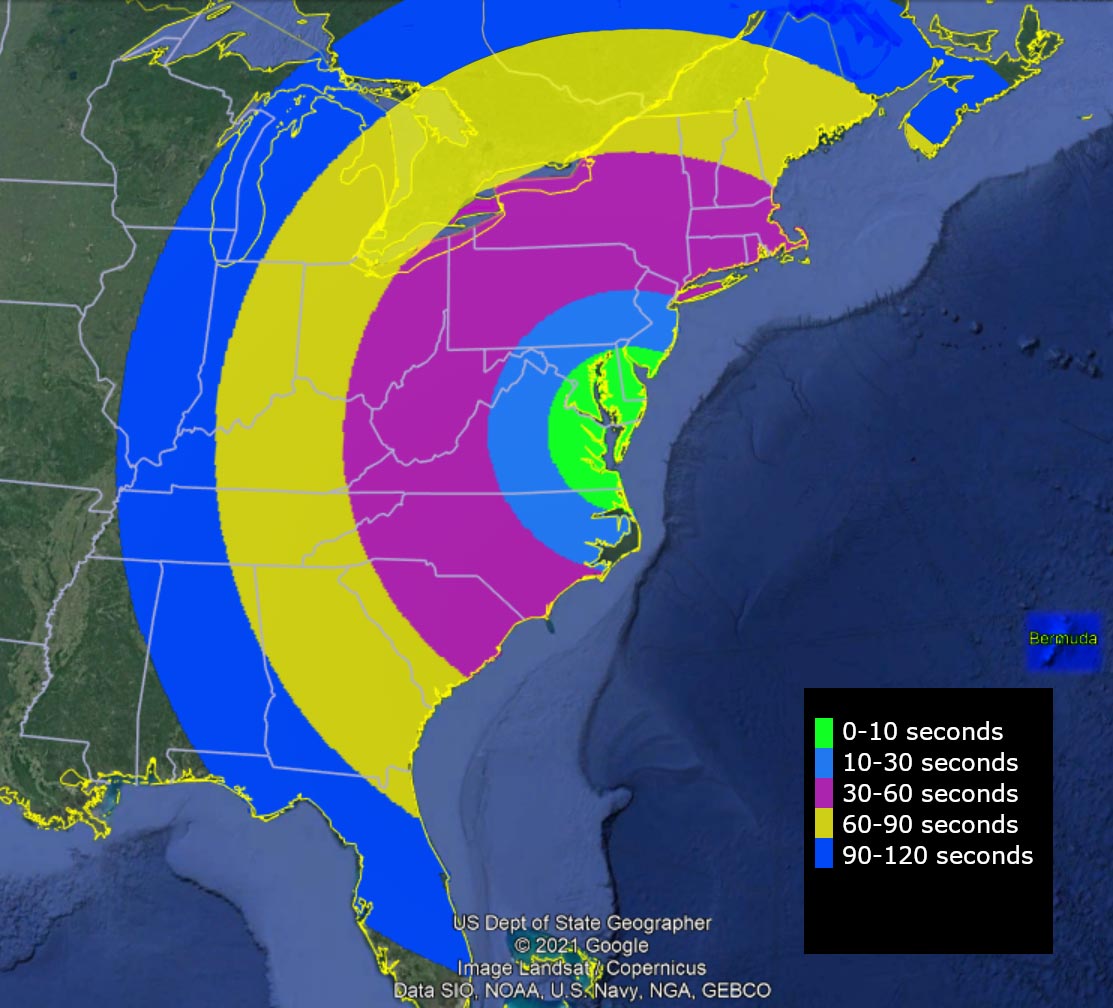
    KiNet-X Visibility Map. Credit: NASA

    NASA’s KiNet-X mission uses a suborbital rocket to study space plasma, releasing colorful vapor clouds over the Atlantic.

    A mission to explore energy transport in space using a NASA suborbital sounding rocket launching May 8, 2021, from NASA’s Wallops Flight Facility in Virginia may provide a brief light show for residents of the eastern United States and Bermuda.

    The mission is scheduled for no earlier than 8:02 p.m. EDT with a 40-minute launch window, Saturday, May 8. Backup launch days run through May 16. The launch may be visible, weather permitting, in much of the eastern United States from the Atlantic coast to the Mississippi River.

    Black Brant XII Sounding Rocket
    A four-stage Black Brant XII sounding rocket. Credit: NASA

    A four-stage Black Brant XII rocket will be used for the mission that includes the release of barium vapor that will form two green-violet clouds that may be visible for about 30 seconds. The barium vapor is not harmful to the environment or public health

    The mission, called the KiNETic-scale energy and momentum transport eXperiment, or KiNet-X, is designed to study a very fundamental problem in space plasmas, namely, how energy and momentum are transported between different regions of space that are magnetically connected?  

    The vapor will be released approximately 9 minutes and 30 seconds to around 10 minutes after launch at about 217-249 miles (349-401 kilometers) altitude over the Atlantic Ocean and 540-560 miles (869-901 kilometers) downrange from Wallops and just north of Bermuda.

    Transformation of Vapor Clouds in Space

    Immediately after release of the vapor, the spherical clouds are a mixture of green and violet, but that phase only lasts about 30 seconds when the un-ionized component of the cloud has diffused away. After exposure to sunlight the vapor clouds quickly ionize and take on a violet color. 

    The ionized portion of the cloud becomes tied to the magnetic field lines and diffuses parallel to the field lines but not perpendicular to it.  In the mid-Atlantic region latitudes, the field lines are inclined by about 45 degrees to the horizontal, so the violet clouds stretch out in a slanted orientation and look more like short trails than a cloud.  Because the motion of the neutral portion of the clouds is not constrained by the magnetic field lines, they spread out more quickly and become too thin to see with the naked eye much sooner than the ionized component.

    In general, the human eye does not see violet colors very well in darkness. The KiNET-X clouds will therefore be more difficult for the casual observer to see than some of the previous vapor missions launched from Wallops.

    Live coverage of the mission will be available on the Wallops IBM video site (previously Ustream) beginning at 7:40 p.m. on launch day. Launch status updates can be found on the Wallops Facebook and Twitter sites.

    The NASA Visitor Center at Wallops will not be open for launch viewing.

    Never miss a breakthrough: Join the SciTechDaily newsletter.
    Follow us on Google and Google News.

    NASA
    Share. Facebook Twitter Pinterest LinkedIn Email Reddit

    Related Articles

    “At First, We Thought Something Was Wrong” – NASA DART Mission Reveals a Cosmic Snowball Fight

    Astronomers Discover an Earth-Like Planet With a Dangerous Temperature Problem

    NASA Prepares Its First Crewed Moon Orbit in Over 50 Years

    A Record-Setting NASA Astronaut Says Goodbye

    NASA’s Artemis II Is on the Launch Pad and the Moon Is Next

    NASA Executes Rare Medical Evacuation From the International Space Station

    NASA Powers Up a Massive Solar Engine for the Moon

    A Massive Rocket Is Rolling and NASA’s Return to the Moon Is Getting Real

    Don’t Miss: Jupiter at Its Biggest and Brightest

    Leave A Reply Cancel Reply

    • Facebook
    • Twitter
    • Pinterest
    • YouTube

    Don't Miss a Discovery

    Subscribe for the Latest in Science & Tech!

    Trending News

    The Universe Is Expanding Too Fast and Scientists Can’t Explain Why

    “Like Liquid Metal”: Scientists Create Strange Shape-Shifting Material

    Early Warning Signals of Esophageal Cancer May Be Hiding in Plain Sight

    Common Blood Pressure Drug Shows Surprising Power Against Deadly Antibiotic-Resistant Superbug

    Scientists Uncover Dangerous Connection Between Serotonin and Heart Valve Disease

    Scientists Discover a “Protector” Protein That Could Help Reverse Hair Loss

    Bone-Strengthening Discovery Could Reverse Osteoporosis

    Scientists Uncover Hidden Trigger Behind Stem Cell Aging

    Follow SciTechDaily
    • Facebook
    • Twitter
    • YouTube
    • Pinterest
    • Newsletter
    • RSS
    SciTech News
    • Biology News
    • Chemistry News
    • Earth News
    • Health News
    • Physics News
    • Science News
    • Space News
    • Technology News
    Recent Posts
    • Scientists Overcome Major Quantum Bottleneck, Potentially Transforming Teleportation and Computing
    • Quantum Physics’ Strangest Problem May Hold the Key to Time Itself
    • Scientists Create “Liquid Gears” That Spin Without Touching
    • The Simple Habit That Could Help Prevent Cancer
    • Forgotten Medicinal Plant Shows Promise in Fighting Dangerous Superbugs
    Copyright © 1998 - 2026 SciTechDaily. All Rights Reserved.
    • Science News
    • About
    • Contact
    • Editorial Board
    • Privacy Policy
    • Terms of Use

    Type above and press Enter to search. Press Esc to cancel.