
NASA’s OSIRIS-REx mission uncovered a cosmic connection between asteroid Bennu and Earth’s Searles Lake.
Both contain minerals formed by evaporating salty water, hinting that Bennu’s parent body once had liquid reservoirs. The discovery of these minerals—and even organic molecules—suggests that the same chemical processes shaping Earth’s landscapes also occurred in deep space, billions of years ago.
Rockhounds and Space Scientists: A Common Hunt
For years, rockhounds have gathered at Searles Lake in California’s Mojave Desert, searching for eye-catching mineral deposits like halite, trona, calcite, and dolomite. Armed with crowbars and pickaxes, they dig through the dry lakebed. Meanwhile, NASA scientists are uncovering many of the same water-soluble minerals — but instead of a desert, they’re searching deep in space.
In 2016, NASA launched OSIRIS-REx, a spacecraft about the size of a van, on a mission to study a distant asteroid named Bennu. This diamond-shaped “rubble pile” asteroid orbits close to Earth every six years. Scientists believe it formed between one and two billion years ago when a larger asteroid was shattered by a massive collision.
In 2020, OSIRIS-REx briefly touched down on Bennu’s surface, collecting 4.3 ounces of loose rock and dust before safely storing the sample for its return to Earth. The video below shows what the asteroid looked like as the spacecraft approached it in December 2018.
Bringing Bennu to Earth
In September 2023, the spacecraft released a mini-fridge-sized capsule that parachuted into Utah with the sample. Since then, scientists have been running bits of the dark, powdery sample through a gauntlet of microscopes, mass spectrometers, and CT scanners.
Their findings, described in a new report in Nature, reveal evidence of sodium- and carbonate-rich salts called evaporites. These minerals likely formed when a briny liquid gradually evaporated in the subsurface of a wet, muddy protoplanet about 4.5 billion years ago in the early days of the solar system.
An Evaporite Connection
Few places on Earth produce combinations of evaporites similar to those found in the Bennu sample. “One of the best studied is Searles Lake,” said Tim McCoy, a curator of meteorites at the Smithsonian’s National Museum of Natural History and co-lead of the study.
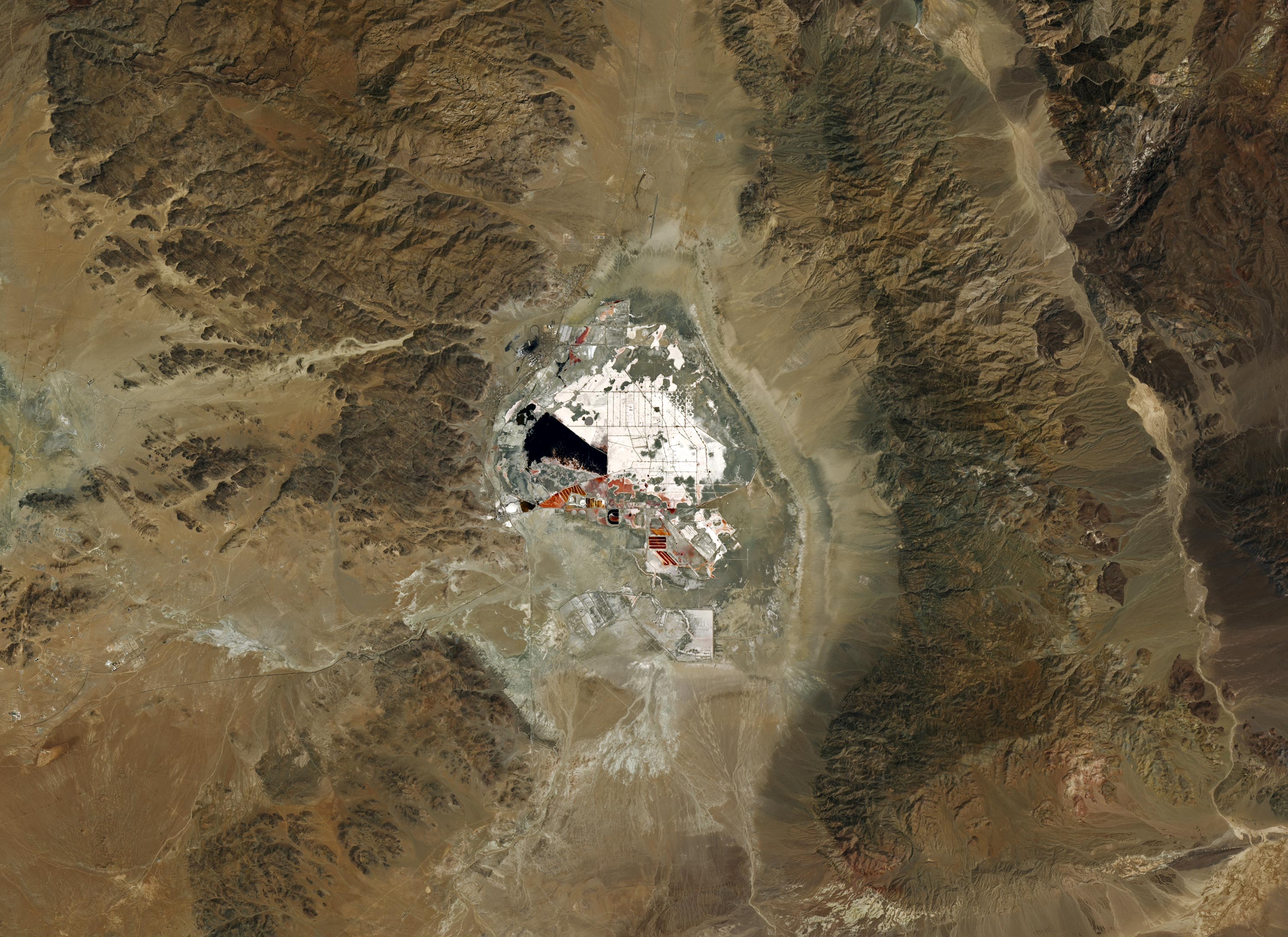
Although the minerals discovered on Bennu predate those at Searles Lake, they formed in similarly salty, wet conditions. The OLI (Operational Land Imager) on Landsat 8 captured the image at the top of this page on August 15, 2024, showing the mostly dry playa of the lake. The lake is named after John Wemple Searles, a prospector and borax miner who began hauling the white mineral from the lake in 1873 using mules.
Mining and Minerals at Searles Lake
A century and a half later, signs of mining still abound. A pit mine and various industrial facilities are visible in the northwestern corner of the image around Trona, a company town established in 1913 and a major source of potash used in gunpowder during World War I. Today, the colorful rectangular evaporation ponds still concentrate valuable minerals like soda ash, salt, and lithium from salt-rich brines.
“Soda lakes” like Searles Lake intrigue planetary geologists in part because they contain highly alkaline waters. With a mixture of sodium, carbonate, and chloride ions, their brines are rich in phosphates—a substance key to the development of organic molecules, including some involved in the formation of genetic material, cell membranes, and other components thought to be critical to the formation of life.
NASA scientists recently announced the discovery of organic molecules—including several that are among the ingredients needed for life—in the Bennu sample as well (see video above).
A Predictable Sequence of Mineral Formation
Water is a remarkably good solvent, meaning common salts like sodium chloride (NaCl) or calcium carbonate (CaCO3) dissolve easily in it. At the molecular level, salts break into positively or negatively charged ions, such as sodium (Na+), chloride (Cl–), or calcium (Ca+), and are surrounded by molecules of water when they dissolve. The opposite occurs when water is removed from brines rich with ions, which allows ions to bond and crystallize into salts.

At Searles Lake, minerals typically develop in a predictable sequence in zones akin to bathtub rings, with calcium carbonate and magnesium carbonate forming first, followed by calcium sulfate and sodium carbonate in a middle ring. The most concentrated brines deposit chlorides and fluorides of sodium and potassium in the center of the lake. Minerals can also precipitate directly from fluids without evaporation if the ion concentration is high enough, as probably happened early in the sequence.
Shared Minerals Between Earth and Bennu
“Precipitation occurred in both ways on Bennu’s parent body,” McCoy said. Researchers identified 11 minerals in the asteroid sample that likely formed in liquid water. Six of these—trona, halite, pirssonite, thénardite, calcite, and dolomite—are also found at Searles Lake. The scanning electron microscope image above shows a close-up of trona, a sodium carbonate mineral, found on Bennu. Each needle is under 1 micrometer wide and 5 to 10 micrometers long; a human hair is about 100 micrometers wide. At Searles Lake, trona is often processed to produce soda ash.
Explore Further: A Lake That Disappeared Holds Clues to Life Beyond Earth
NASA Earth Observatory images by Lauren Dauphin, using Landsat data from the U.S. Geological Survey. Bennu mineral sample photograph by Rob Wardell and Tim McCoy (Smithsonian Institution).
Never miss a breakthrough: Join the SciTechDaily newsletter.
Follow us on Google and Google News.