
Close Menu
    Facebook X (Twitter) Instagram
    SciTechDaily
    • Biology
    • Chemistry
    • Earth
    • Health
    • Physics
    • Science
    • Space
    • Technology
    Facebook X (Twitter) Pinterest YouTube RSS
    SciTechDaily
    Home»Space»NASA’s EZIE Mission: Capturing Magnetic Fingerprints of Earth’s Auroral Electrojets
    Space

    NASA’s EZIE Mission: Capturing Magnetic Fingerprints of Earth’s Auroral Electrojets

    By NASASeptember 12, 2024No Comments3 Mins Read
    Facebook Twitter Pinterest Telegram LinkedIn WhatsApp Email Reddit
    Share
    Facebook Twitter LinkedIn Pinterest Telegram Email Reddit
    NASA Electrojet Zeeman Imaging Explorer (EZIE)
    The Electrojet Zeeman Imaging Explorer (EZIE) —is a SmallSat mission that will characterize the electric currents that link Earth’s aurora to the planet’s magnetosphere. This illustration shows the three EZIE spacecraft orbiting above the aurora at one of Earth’s poles. Credit: NASA

    Set for a 2025 launch, NASA’s EZIE mission will pioneer the imaging of magnetic fingerprints associated with the intense electrical currents of the Earth’s auroral electrojets.

    Utilizing a trio of CubeSats, the mission aims to provide insights into the dynamics of the magnetosphere, enhancing the prediction models for space weather impacts. This mission is strategically timed to coincide with the Northern Hemisphere summers for optimal data collection.

    NASA’s EZIE Mission

    In 2025, NASA will launch its first mission to image the magnetic fingerprint of intense electrical currents that flow high in our atmosphere when auroras shimmer above Earth’s poles.

    The EZIE (Electrojet Zeeman Imaging Explorer) mission is designed to make groundbreaking measurements of the auroral electrojets, electrical currents about 60 miles (100 kilometers) above the ground in a layer of Earth’s atmosphere called the ionosphere, which separates Earth from surrounding space.
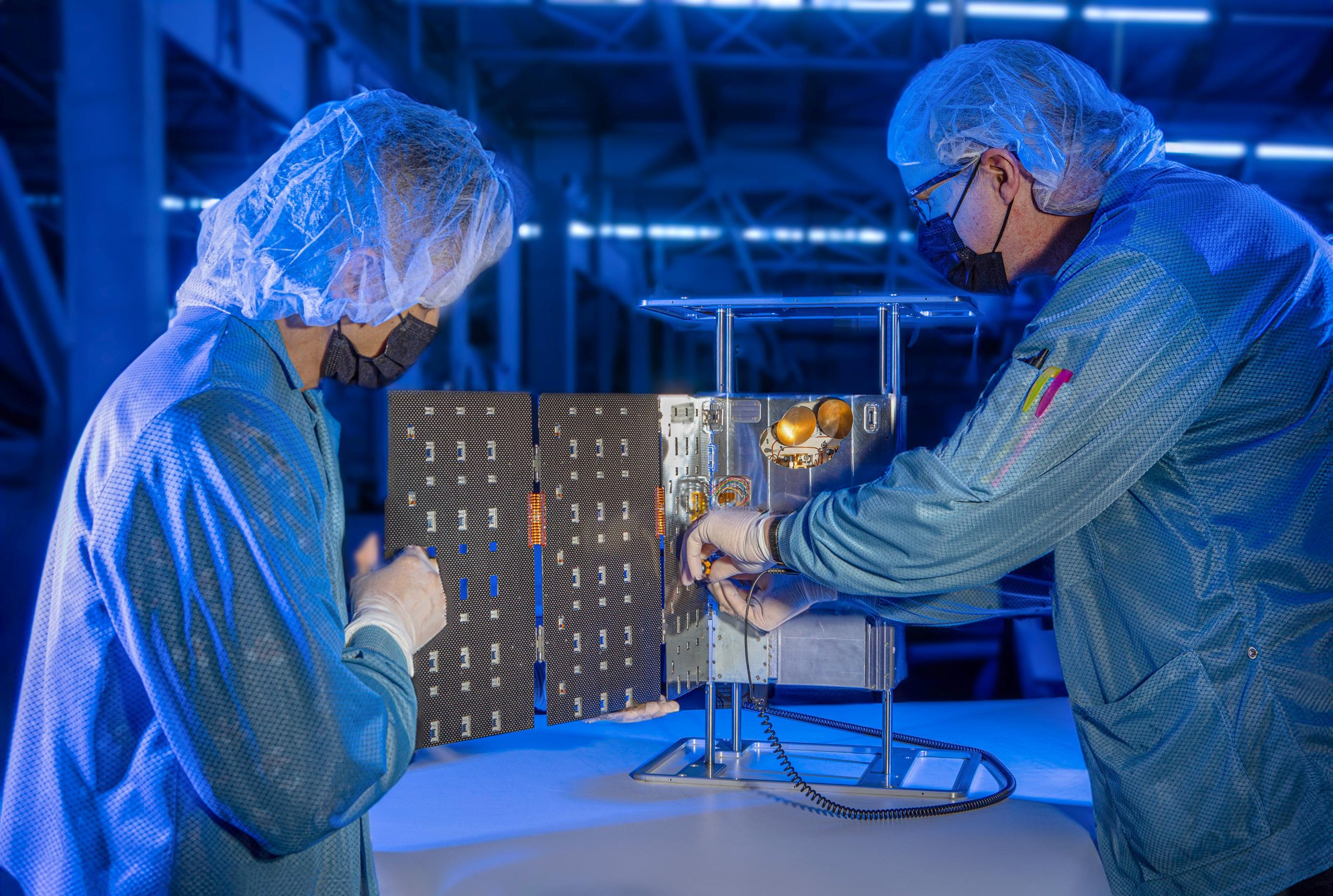
    EZIE Solar Array Attachment
    Technicians attach a solar array to one of the Electrojet Zeeman Imaging Explorer (EZIE) CubeSats. Credit: Brooks Freehill, Blue Canyon Technologies

    The mission features a trio of CubeSats, or small satellites, with an orbit that goes pole to pole to map the electrojets. Mapping the electrojets can give scientists greater insight into the physics of Earth’s magnetosphere and help create better models for predicting the effects of space weather phenomena such as geomagnetic storms and auroras in the upper atmosphere and at Earth’s surface.

    Pre-Launch Preparations and Timeline

    In August, the EZIE team completed its pre-ship review, with NASA confirming that the three spacecraft and their support systems are ready to move to their eventual launch site for liftoff in 2025.

    Previously planned for no earlier than 2024, a launch in 2025 gives EZIE the opportunity to make observations during two Northern Hemisphere summers, when EZIE’s measurements can best be coordinated with ground-based instruments and when EZIE can make far more observations of the auroral phenomenon scientists are targeting.

    Collaboration and Support

    The EZIE mission is funded by the Heliophysics Division within NASA’s Science Mission Directorate and is managed by the Explorers Program Office at NASA’s Goddard Space Flight Center in Greenbelt, Maryland. The Johns Hopkins Applied Physics Laboratory designed the EZIE spacecraft and leads and manages the mission for NASA. NASA’s Jet Propulsion Laboratory built an instrument called the Microwave Electrojet Magnetogram for each of the three satellites, and Blue Canyon Technologies in Boulder, Colorado, built the CubeSats.

    Never miss a breakthrough: Join the SciTechDaily newsletter.
    Follow us on Google and Google News.

    Atmospheric Science Aurora Johns Hopkins APL NASA NASA EZIE
    Share. Facebook Twitter Pinterest LinkedIn Email Reddit

    Related Articles

    Webb Spots Mysterious Lightshow on Jupiter That Baffles Scientists

    Webb Telescope Captures Neptune’s Long-Hidden Auroras in Stunning Detail

    NASA’s Spacecraft That Touched the Sun Just Won Aerospace’s Biggest Prize

    NASA’s EZIE Mission Launches to Uncover Earth’s Electric Secrets

    What’s Really Behind the Northern Lights? NASA Is About to Find Out

    NASA’s EZIE Mission Will Track Earth’s Hidden Electric Highways to Predict Space Storms

    The Northern Lights Hold a Shocking Secret and NASA’s EZIE Mission Will Reveal It

    EZIE Does It: NASA’s Next Step in Unraveling Earth’s Electrifying Space Connections

    Auroras Unplugged: NASA’s EZIE To Unveil the Charged Link Between Earth and Space

    Leave A Reply Cancel Reply

    • Facebook
    • Twitter
    • Pinterest
    • YouTube

    Don't Miss a Discovery

    Subscribe for the Latest in Science & Tech!

    Trending News

    Your Blood Pressure Reading Could Be Wrong Because of One Simple Mistake

    Astronomers Stunned by Ancient Galaxy With No Spin

    Physicists May Be on the Verge of Discovering “New Physics” at CERN

    Scientists Solve 320-Million-Year Mystery of Reptile Skin Armor

    Scientists Say This Daily Walking Habit May Be the Secret to Keeping Weight Off After Dieting

    New Therapy Rewires the Brain To Restore Joy in Depression Patients

    Giant Squid Detected off Western Australia in Stunning Deep-Sea Discovery

    Popular Sugar-Free Sweetener Linked to Liver Disease, Study Warns

    Follow SciTechDaily
    • Facebook
    • Twitter
    • YouTube
    • Pinterest
    • Newsletter
    • RSS
    SciTech News
    • Biology News
    • Chemistry News
    • Earth News
    • Health News
    • Physics News
    • Science News
    • Space News
    • Technology News
    Recent Posts
    • Scientists Discover Signs Africa May Be Splitting Apart Beneath Zambia
    • New Stroke Study Challenges Decades-Old Medical Beliefs
    • These Simple Plant Foods Are Linked to Lower Blood Pressure
    • Common Blood Pressure Drug Supercharges Cancer Treatment in Surprising New Study
    • Key Magic Mushroom Ingredient Increases Laziness and Reduces Aggression
    Copyright © 1998 - 2026 SciTechDaily. All Rights Reserved.
    • Science News
    • About
    • Contact
    • Editorial Board
    • Privacy Policy
    • Terms of Use

    Type above and press Enter to search. Press Esc to cancel.