
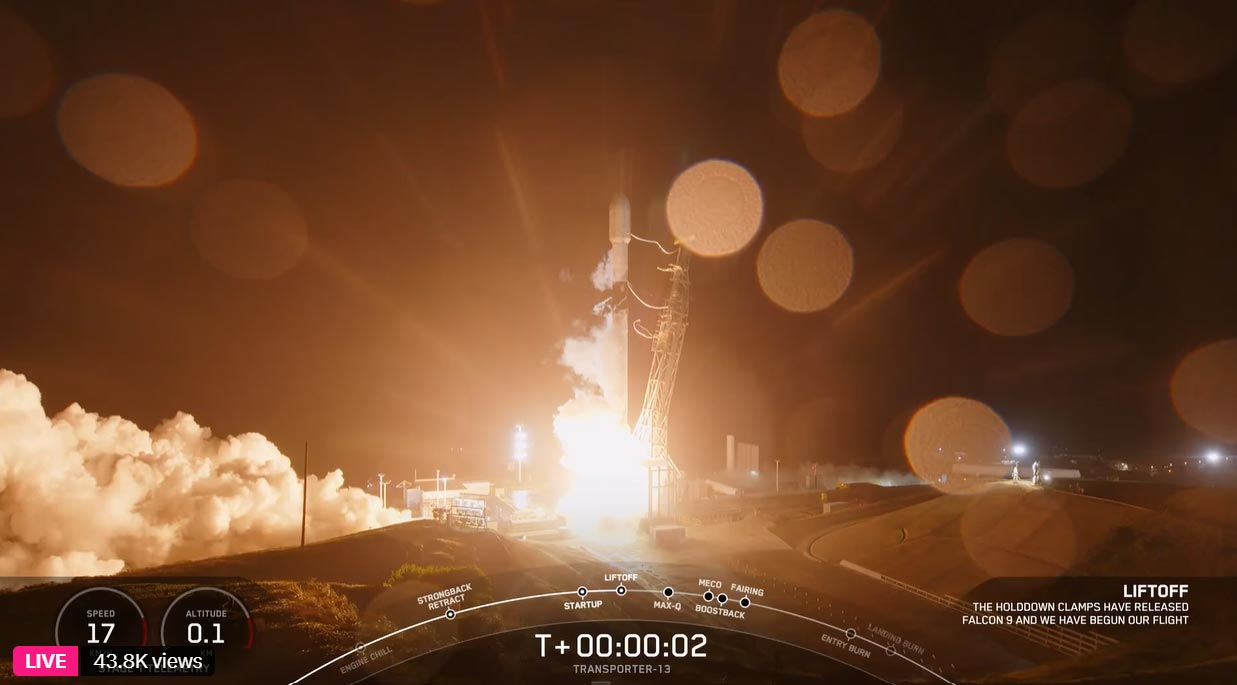
Blasting off aboard a SpaceX Falcon 9, NASA’s EZIE mission is on a groundbreaking journey to unravel the mysteries of auroral electrojets, massive currents that light up Earth’s skies during solar storms.
By flying three small satellites in a synchronized dance above the planet, the mission aims to decode the intricate physics of space weather, helping scientists predict its impact on our technology-driven world.
NASA Launches EZIE Mission to Study Auroral Currents
Under the cover of night, NASA’s EZIE (Electrojet Zeeman Imaging Explorer) mission launched aboard a SpaceX Falcon 9 rocket at 11:43 p.m. PDT on March 14 from Vandenberg Space Force Base near Santa Barbara, California.
The mission consists of three small satellites, which will travel in a pearls-on-a-string formation between 260 and 370 miles above Earth. Their goal is to map auroral electrojets, powerful electric currents that flow through the upper atmosphere in the polar regions, where auroras light up the sky.
Successful Deployment and Mission Timeline
At 2 a.m. PDT on March 15, the EZIE satellites successfully deployed into orbit. Over the next 10 days, they will transmit signals to confirm their systems are functioning properly before beginning their 18-month mission.
“NASA has leaned into small missions that can provide compelling science while accepting more risk. EZIE represents excellent science being executed by an excellent team, and it is delivering exactly what NASA is looking for,” said Jared Leisner, program executive for EZIE at NASA Headquarters in Washington.

Understanding Earth’s Space Weather
The electrojets, and their visible counterparts, the auroras, are generated during solar storms when tremendous amounts of energy get transferred into Earth’s upper atmosphere from the solar wind. Each of the EZIE spacecraft will map the electrojets, advancing our understanding of the physics of how Earth interacts with its surrounding space. This understanding will apply not only to our own planet but also to any magnetized planet in our solar system and beyond. The mission will also help scientists create models for predicting space weather to mitigate its disruptive impacts on our society.
“It is truly incredible to see our spacecraft flying and making critical measurements, marking the start of an exciting new chapter for the EZIE mission,” said Nelli Mosavi-Hoyer, project manager for EZIE at the Johns Hopkins Applied Physics Laboratory in Laurel, Maryland. “I am very proud of the dedication and hard work of our team. This achievement is a testament to the team’s perseverance and expertise, and I look forward to the valuable insights EZIE will bring to our understanding of Earth’s electrojets and space weather.”
Innovative Orbit Control Without Propulsion
Instead of using propulsion to control their polar orbit, the spacecraft will actively use drag experienced while flying through the upper atmosphere to individually tune their spacing. Each successive spacecraft will fly over the same region 2 to 10 minutes after the former.
“Missions have studied these currents before, but typically either at the very large or very small scales,” said Larry Kepko, EZIE mission scientist at NASA’s Goddard Space Flight Center in Greenbelt, Maryland. “EZIE will help us understand how these currents form and evolve, at scales we’ve never probed.”
Citizen Science with EZIE-Mag Kits
The mission team is also working to distribute magnetometer kits called EZIE-Mag, which are available to teachers, students, and science enthusiasts who want to take their own measurements of the Earth-space electrical current system. EZIE-Mag data will be combined with EZIE measurements made from space to assemble a clear picture of this vast electrical current circuit.
The EZIE mission is funded by NASA’s Heliophysics Division within the Science Mission Directorate and managed by the Explorers Program Office at NASA’s Goddard Space Flight Center.
The mission is led by the Johns Hopkins Applied Physics Laboratory on behalf of NASA. The CubeSats were built by Blue Canyon Technologies in Boulder, Colorado, while NASA’s Jet Propulsion Laboratory in Southern California developed the Microwave Electrojet Magnetogram—a key instrument on each satellite that will map the electrojets.
Never miss a breakthrough: Join the SciTechDaily newsletter.
Follow us on Google and Google News.