
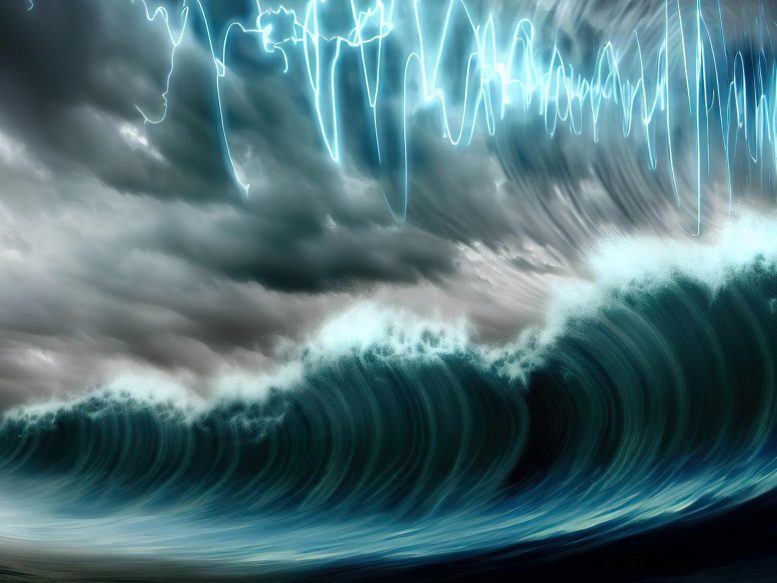
New hazard-monitoring technology uses GPS signals to go wave-hunting in the Pacific Ring of Fire. GUARDIAN’s long-term objective is to augment early warning systems.
Triggered by earthquakes, undersea volcanoes, and other Earth-shaking forces, tsunamis can devastate coastal communities. And when it comes to providing advance warning, every second counts. Scientists at NASA’s Jet Propulsion Laboratory are testing a novel approach to detect – from the far reaches of the atmosphere – the ocean’s deadliest waves.
Called GUARDIAN (GNSS Upper Atmospheric Real-time Disaster Information and Alert Network), the experimental monitoring system taps into data from clusters of GPS and other wayfinding satellites orbiting our planet. Collectively, these clusters are known as global navigational satellite systems, or GNSS. Their radio signals travel to hundreds of scientific ground stations around the world, and that data is crunched by JPL’s Global Differential GPS (GDGPS) network, which improves real-time positional accuracy down to a few inches (roughly 10 centimeters).
The new system sifts the signals for clues that a tsunami has arisen somewhere on Earth. How does it work? During a tsunami, many square miles of the ocean surface can rise and fall nearly in unison, displacing a significant amount of air above it. The displaced air ripples out in all directions in the form of low-frequency sound and gravity waves. Within several minutes, these vibrations reach the topmost layer of atmosphere: the Sun-cooked, electrically charged ionosphere. The ensuing clash of pressure waves with charged particles can distort the signals from nearby navigational satellites ever so slightly.
While navigation tools usually seek to correct for such ionospheric disturbances, scientists can use them as a lifesaving alarm bell, noted Léo Martire, a JPL scientist developing GUARDIAN. “Instead of correcting for this as an error, we use it as data to find natural hazards,” Martire said.
This animation shows how waves of energy from the Tohoku-Oki earthquake and tsunami of March 11, 2011, pierced Earth’s ionosphere in the vicinity of Japan, disturbing the density of electrons. These disturbances were monitored by tracking GPS signals between satellites and ground receivers. Credit: NASA/JPL-Caltech
Fastest Monitoring Tool of Its Kind
The technology is still maturing, said Martire, who co-chairs a task force within the United Nations’ International Committee on GNSS that is exploring the use of navigational satellite systems to enhance early warning strategies. Currently, GUARDIAN’s near-real-time output must be interpreted by experts trained to identify signs of tsunamis. But already it is one of the fastest monitoring tools of its kind: Within 10 minutes it can produce a kind of snapshot of a tsunami’s rumble reaching the ionosphere. And it could potentially provide as much as an hour of warning, depending on the distance of the tsunami origin from shore.
“We envision GUARDIAN one day complementing existing ground- and ocean-based instruments such as seismometers, buoys, and tide gauges, which are highly effective but lack systematic coverage of the open ocean,” says Siddharth Krishnamoorthy, also part of the JPL development team. Scientists affiliated with NASA’s Disasters program currently use ground-based instruments at GNSS stations for faster tsunami detection.
“When there is a large earthquake near the ocean, we want to quickly know the magnitude and characteristics of the earthquake to understand the likelihood that a tsunami will be generated, and we want to know if a tsunami was indeed generated,” said Gerald Bawden, the program scientist for Earth’s Surface and Interior at NASA Headquarters in Washington. “Today there are two ways to know if a tsunami was generated before it makes landfall – NOAA’s DART buoys and GNSS-ionosphere observations. There is a limited number of buoys and they are very expensive, so systems like GUARDIAN have the potential to complement current warning systems.”
Right now, the GUARDIAN team is focused on the Pacific Ocean’s geologically active Ring of Fire. About 78% of the more than 750 confirmed tsunamis between 1900 and 2015 occurred in this region, according to a historical database maintained by the National Oceanic and Atmospheric Administration (NOAA). GUARDIAN currently monitors a little over half of the region of interest in the Pacific.
The GUARDIAN team is developing a website to allow experts to explore the state of the ionosphere in near real time by studying individual satellite station links on the GNSS network. Users can access the data from about 90 stations around the Pacific Ring of Fire and discover signals of interest within minutes of an event occurring. The team aims to expand coverage and refine the system to a point where it could automatically flag tsunamis and other hazards, including volcanic eruptions and earthquakes.
Never miss a breakthrough: Join the SciTechDaily newsletter.
Follow us on Google and Google News.