

NASA’s HIT instrument, integral to the IMAP mission, will monitor high-energy particles from the Sun, enhancing our understanding of space weather and its effects on Earth.
Scientists and engineers at NASA’s Goddard Space Flight Center in Greenbelt, Maryland, are poised to deliver the High-energy Ion Telescope (HIT) instrument. HIT was shipped from Goddard to the Johns Hopkins University Applied Physics Laboratory (APL) in Laurel, Maryland. A group of engineers at APL have now begun the process of installing HIT onto NASA’s Interstellar Mapping and Acceleration Probe (IMAP) spacecraft.
A YouTube livestream shows the cleanroom where the spacecraft will be built and tested over the next year on Princeton University’s IMAP mission website. Viewers can watch the continuous stream to see exactly how the IMAP hardware develops from a bare-bones structure to the complex, fully operational spacecraft.
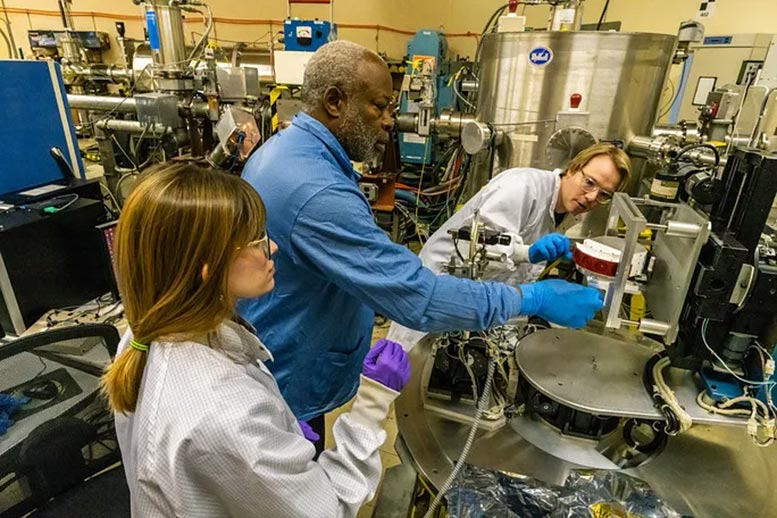
Role and Importance of HIT
HIT is the fourth of 10 IMAP instruments to arrive at APL. Over the two-year-long mission, HIT will measure high-energy solar energetic particles expelled from the Sun in the highest-energy processes in our solar system. These solar particles can produce the beautiful aurora, or northern and southern lights, but are also hazardous, posing risks to the health and safety of astronauts as well as presenting a danger to space- and ground-based assets and infrastructure. Understanding the acceleration and transport of this high-energy radiation will help us better understand our Sun and the local space weather to which these particles play a critical role.
“Solar energetic particles have been studied since the start of the space age, yet we still don’t understand their origin well enough to predict when they will be a danger,” said Eric Christian, HIT instrument lead and deputy principal investigator of the IMAP mission at NASA Goddard. “HIT, combined with other instruments on IMAP, will provide an important piece of the puzzle.”
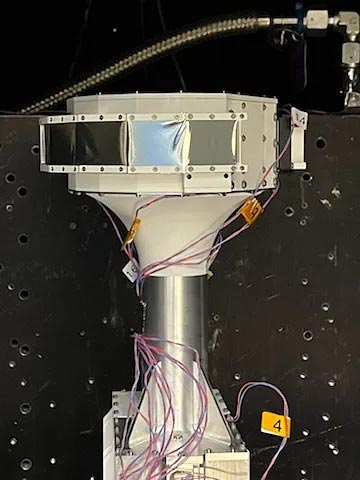
IMAP, which is led by Princeton University, is slated to launch in 2025 and will journey roughly one million miles to a point in space between Earth and the Sun called Lagrange Point 1. During the mission, HIT will measure energetic ions and electrons to help us learn more about the processes that can accelerate these particles to such high energies.
Building on Heritage
HIT builds upon techniques that are decades old but modernizes them with state-of-the-art instrumentation and clever detector design. When charged particles pass through HIT, they deposit some of their energy in layers of detector material until they finally come to rest. By looking at the energy deposited in the different layers through which the particle passed and comparing it with the energy deposited in the stopping layer, HIT can determine the type (proton, electron, or different ions) and energy of the particle.
The arrangement of 10 apertures, or openings, on HIT and the spin of the IMAP spacecraft will allow HIT to measure particles from all directions and study the energetic particle patterns when striking the instrument. HIT also measures energetic electrons, which arrive at Earth quickly and can give us an early warning of upcoming space weather events.
Team Collaboration
HIT would not be possible without its dedicated and diverse group of scientists, engineers, and technicians at NASA Goddard and the California Institute of Technology. The HIT team includes many early career scientists and engineers who got the exciting opportunity to take on leadership roles and rose to the challenge. For many, this will be the first time they will have the unique opportunity to work on something going to space.
“I am so grateful to have the opportunity to play an integral role in such an exciting mission,” said Grant Mitchell, a member of the HIT science team at NASA Goddard. “The chance to learn from world-class scientists and engineers both at Goddard and throughout the IMAP team has been instrumental in preparing me to lead my own missions one day.”
Princeton University professor David J. McComas leads the mission with an international team of 25 partner institutions. The Johns Hopkins Applied Physics Laboratory in Laurel, Maryland, builds the spacecraft and operates the mission. IMAP is the fifth mission in NASA’s Solar Terrestrial Probes (STP) Program portfolio. The Explorers and Heliophysics Project Division at NASA’s Goddard Space Flight Center in Greenbelt, Maryland, manages the STP Program for the Heliophysics Division of NASA’s Science Mission Directorate.
Never miss a breakthrough: Join the SciTechDaily newsletter.
Follow us on Google and Google News.