
Close Menu
    Facebook X (Twitter) Instagram
    SciTechDaily
    • Biology
    • Chemistry
    • Earth
    • Health
    • Physics
    • Science
    • Space
    • Technology
    Facebook X (Twitter) Pinterest YouTube RSS
    SciTechDaily
    Home»Space»NASA’s Hubble Reveals a Star-Spangled Stellar Masterpiece of 500,000 Ancient Stars
    Space

    NASA’s Hubble Reveals a Star-Spangled Stellar Masterpiece of 500,000 Ancient Stars

    By NASAJuly 4, 2026No Comments3 Mins Read
    Facebook Twitter Pinterest Telegram LinkedIn WhatsApp Email Reddit
    Share
    Facebook Twitter LinkedIn Pinterest Telegram Email Reddit
    Hubble M3 July 4
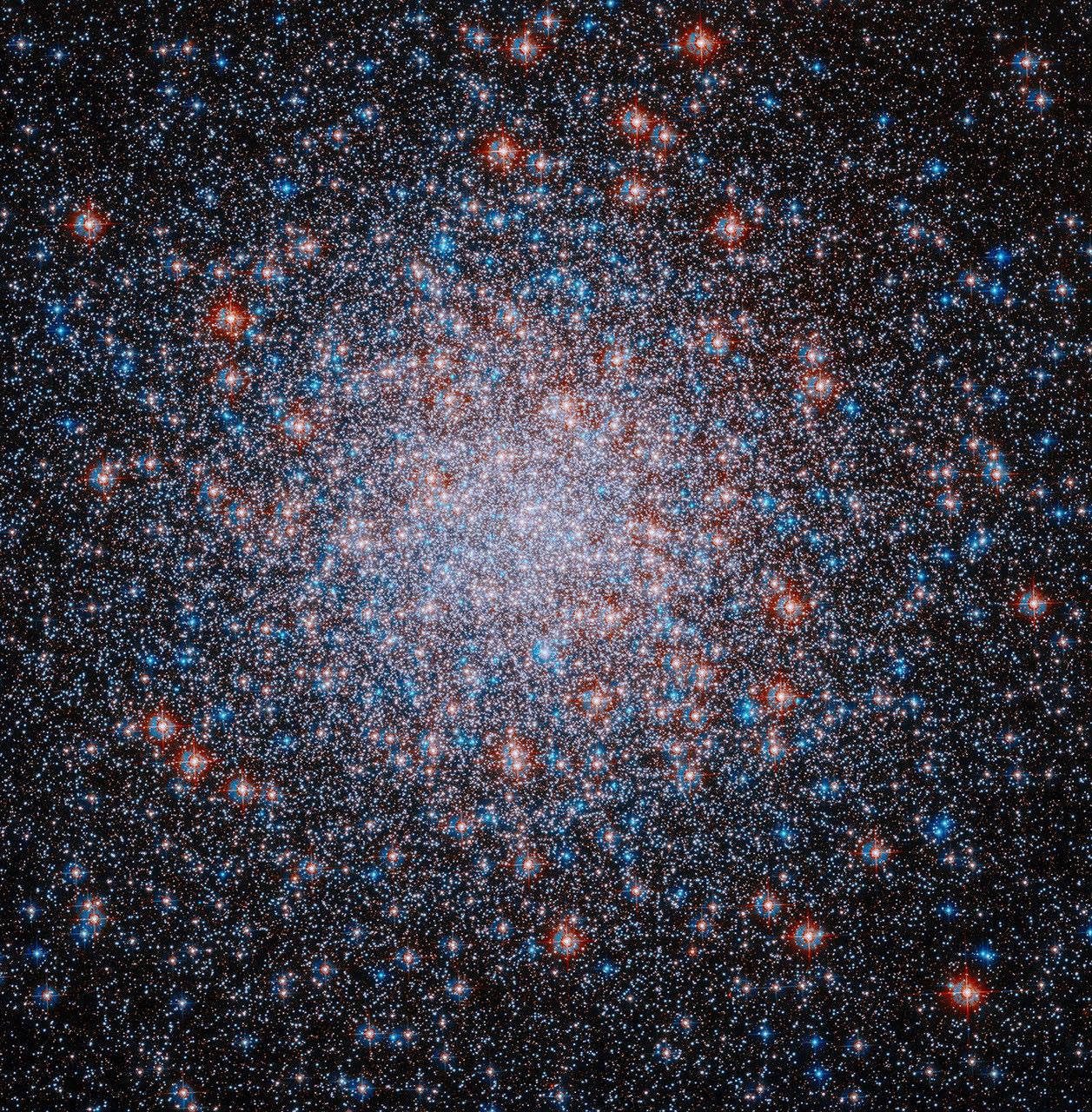
    This image from NASA’s Hubble Space Telescope shows Messier 3, a densely packed cluster of stars whose origins may be a merger between globular clusters in the early universe. Credit: NASA, ESA, and A. Sarajedini (Florida Atlantic University); Processing: Gladys Kober (NASA/Catholic University of America)

    More than 500,000 stars glow in shades of red, white, and blue in a spectacular new image captured by NASA’s Hubble Space Telescope. Released in celebration of the United States’ 250th anniversary, the image features Messier 3 (M3), one of the Milky Way’s largest globular clusters.

    Globular clusters are dense, spherical groups of stars held together by gravity. Their stars formed from the same cloud of gas at roughly the same time, making them some of the oldest stellar populations in the galaxy. Astronomers have identified about 150 globular clusters orbiting in the outer regions of the Milky Way.

    Messier 3 Stands Out Among Globular Clusters

    M3 is remarkable not only because of its enormous size but also because of its location and stellar population. It lies relatively far from the center of the Milky Way and contains more than 240 RR Lyrae variable stars, more than any other known globular cluster in our galaxy.

    These ancient variable stars are especially valuable to astronomers because their brightness changes in a predictable way. By comparing how bright they truly are with how bright they appear from Earth, scientists can accurately determine their distance. The process is similar to estimating how far away a car is at night by knowing the brightness of its headlights.

    Ancient Stars That Appear Young

    The cluster also contains about 70 identified candidates for a rare type of star known as a blue straggler. These unusually bright, blue stars appear much younger than the older, redder stars that dominate globular clusters.

    In fact, M3 was the first globular cluster where blue stragglers were discovered. Astronomers believe these stars likely gained material from nearby companion stars through gravitational interactions. That extra mass effectively rejuvenated them, causing them to shine hotter, bluer, and appear younger than they actually are.

    A Possible Cosmic Merger

    Scientists think M3’s unusual properties may be the result of an ancient merger. The cluster contains two distinct populations of stars, suggesting it may have formed when two globular clusters combined into one.

    Those two clusters are thought to have originally belonged to the same dwarf galaxy before that smaller galaxy was eventually absorbed by the Milky Way.

    Hubble Helps Reconstruct the Milky Way’s History

    Hubble has observed M3, also known as NGC 5272, multiple times over the years, allowing astronomers to study its complex structure and unusual stellar population in greater detail.

    In this latest image, blue represents shorter wavelengths of visible light, while red corresponds to longer visible wavelengths along with some near-infrared light. The colors are assigned using standard Hubble image processing methods to accurately represent the wavelengths recorded through the telescope’s filters. Because a star’s color is closely tied to its temperature, the blue stars in the image are hotter, while the red stars are cooler.

    The image is part of a Hubble Treasury program that aims to observe roughly half of the Milky Way’s known globular clusters. By studying these ancient stellar systems, astronomers hope to build a detailed timeline of how our galaxy formed and evolved.

    After more than three decades in operation, Hubble remains one of NASA’s flagship observatories. Working alongside missions such as the James Webb Space Telescope and the upcoming Nancy Grace Roman Space Telescope, it continues to help scientists assemble an increasingly complete picture of the universe.

    Never miss a breakthrough: Join the SciTechDaily newsletter.
    Follow us on Google and Google News.

    Astronomy Hubble Space Telescope NASA
    Share. Facebook Twitter Pinterest LinkedIn Email Reddit

    Related Articles

    Hubble Reveals a Star Disk Three Times Hotter Than the Sun’s Surface

    A Star’s Unexpected Heatwave: FU Orionis Challenges Astrophysics Models

    NASA’s Hubble Reveals How the LMC Defied Galactic Destruction

    Legendary Star’s Smooth Disk Mystifies Astronomers, Challenges Planet Formation Theories

    Cosmic Horror Unveiled: NASA Reveals “Blood-Soaked Eyes” Staring From Deep Space [Video]

    Spanning 248 Billion Miles: Stunning Hubble Timelapse Captures a Star’s Violent Eruptions

    Jupiter’s Great Red Spot Enigma: Unexplained Oscillations Baffle Astronomers

    Unlocking Uranus: NASA’s Dual Observations Pave the Way to Discovering New Worlds

    Astronomers Baffled by Black Hole Jets Igniting Star Explosions

    Leave A Reply Cancel Reply

    • Facebook
    • Twitter
    • Pinterest
    • YouTube

    Don't Miss a Discovery

    Subscribe for the Latest in Science & Tech!

    Trending News

    Surgeons Warn: Don’t Ignore These Colorectal Cancer Symptoms, No Matter Your Age

    Scientists Unlock Hidden DNA From 1,300-Year-Old Manuscripts

    Scientists Discover Ultrasound May Stop Arthritis Before It Starts

    Scientists Discover Why the Same Volcano Erupted in Two Completely Different Ways

    Scientists Challenge a Fundamental Assumption About Consciousness

    A Giant Scorpion the Size of a Coffee Table Is Forcing Scientists To Rethink Evolution

    Hidden Virus May Have Infected 9.4 Million People – Scientists Say We’ve Missed Most Cases

    NASA Moon Base Could Become Earth’s First Defense Against Alien Microbes

    Follow SciTechDaily
    • Facebook
    • Twitter
    • YouTube
    • Pinterest
    • Newsletter
    • RSS
    SciTech News
    • Biology News
    • Chemistry News
    • Earth News
    • Health News
    • Physics News
    • Science News
    • Space News
    • Technology News
    Recent Posts
    • NASA’s Hubble Reveals a Star-Spangled Stellar Masterpiece of 500,000 Ancient Stars
    • NASA’s Hubble Captures a Stunning Red, White, and Blue Stellar Nursery
    • NASA Celebrates July 4th With a Stunning Hubble Cosmic Sparkler From the Dawn of Time
    • This Strange Martian Rock Contains a Mineral Scientists Never Expected To Find
    • James Webb Uncovers the Atmosphere of a Hellish Lava World 41 Light-Years Away
    Copyright © 1998 - 2026 SciTechDaily. All Rights Reserved.
    • Science News
    • About
    • Contact
    • Editorial Board
    • Privacy Policy
    • Terms of Use

    Type above and press Enter to search. Press Esc to cancel.