
Close Menu
    Facebook X (Twitter) Instagram
    SciTechDaily
    • Biology
    • Chemistry
    • Earth
    • Health
    • Physics
    • Science
    • Space
    • Technology
    Facebook X (Twitter) Pinterest YouTube RSS
    SciTechDaily
    Home»Space»NASA’s New Horizons Spacecraft Observes Pluto’s Smallest Moon
    Space

    NASA’s New Horizons Spacecraft Observes Pluto’s Smallest Moon

    By NASAOctober 10, 2015No Comments2 Mins Read
    Facebook Twitter Pinterest Telegram LinkedIn WhatsApp Email Reddit
    Share
    Facebook Twitter LinkedIn Pinterest Telegram Email Reddit
    New Horizons Spacecraft Views Pluto's Moon Styx
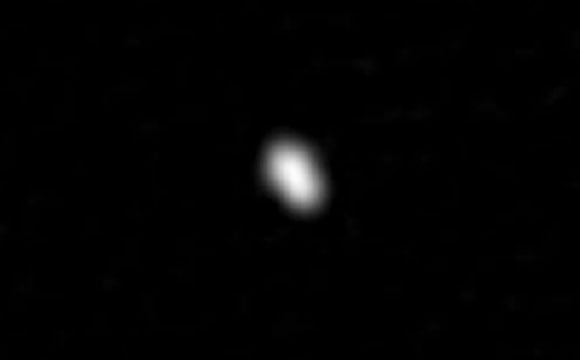
    Pluto’s smallest moon Styx.

    New images from NASA’s New Horizons Spacecraft reveal the shape and size of Pluto’s smallest moon, Styx.

    Styx – also the faintest of Pluto’s five moons – was discovered using the Hubble Space Telescope in 2012, when New Horizons was more than two-thirds into its voyage to Pluto. The Styx images downlinked on October 5, 2015, were taken by the Long Range Reconnaissance Imager (LORRI) on July 13, approximately 12.5 hours before New Horizons’ closest approach to Pluto.

    At that time, the spacecraft was still 391,000 miles (631,000 kilometers) from Styx, making it difficult even for the powerful LORRI camera to see details on such a small moon. “Although it may not look like much, the new composite image of Styx reveals a highly-elongated satellite, roughly 4.5 miles [7 kilometers] across in its longest dimension and 3 miles [5 kilometers] in its shortest dimension,” said New Horizons Project Scientist Hal Weaver, of the Johns Hopkins University Applied Physics Laboratory, Laurel, Maryland.
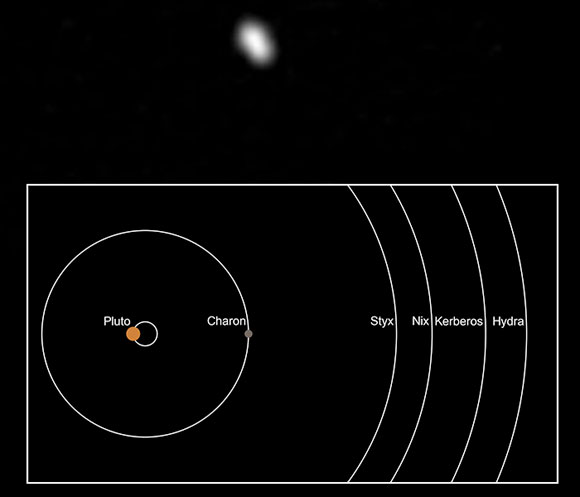
    NASA Spacecraft Observes Pluto’s Smallest Moon Styx
    This Long Range Reconnaissance Imager (LORRI) composite image of Pluto’s smallest moon, Styx, was taken July 14, 2015, when the New Horizons spacecraft was 391,000 miles (631,000 kilometers) from the tiny moon. The image reveals a highly-elongated satellite, roughly 4.5 miles [7 kilometers] across in its longest dimension and 3 miles [5 kilometers] in its shortest dimension. For context, the orbits of Pluto’s moons are shown above. Credit: NASA/JHUAPL/SwRI
    Styx’s measured brightness, combined with this new size estimate, suggest this tiny moon has a highly reflective, icy surface, similar to what was previously found for two of Pluto’s other small moons, Nix and Hydra.

    Using these new images, together with the many measurements of Styx’s brightness taken over several months during New Horizons’ approach to Pluto, the science team hopes to unravel more details about this small moon’s shape and rotational properties. “Ultimately, we hope to learn more about all four of Pluto’s small moons, to understand their similarities and differences, how they formed, and how they evolved,” says New Horizons Principal Investigator Alan Stern, of the Southwest Research Institute, Boulder, Colorado.

    Never miss a breakthrough: Join the SciTechDaily newsletter.
    Follow us on Google and Google News.

    Astronomy NASA New Horizons Planetary Science Pluto Styx
    Share. Facebook Twitter Pinterest LinkedIn Email Reddit

    Related Articles

    New Horizons Pluto Flyby Reveals More Than 50 Exciting Discoveries

    New Horizons Views Pluto’s Moon Kerberos

    Astrophysicist Scott Kenyon Shares His Thoughts and Reactions on New Horizons’ Flyby of Pluto

    NASA’s New Horizons Spacecraft Reveals First Close-Up View of Pluto

    New Horizons Measures Size of Pluto, Settles Decades-Long Debate

    New Horizons Spots Small Moons Orbiting Pluto

    New Horizons Spacecraft Awakens for Encounter with Pluto System

    New ScienceCast Video Previews What New Horizons May See on Pluto

    New ScienceCast Video – Countdown to Pluto

    Leave A Reply Cancel Reply

    • Facebook
    • Twitter
    • Pinterest
    • YouTube

    Don't Miss a Discovery

    Subscribe for the Latest in Science & Tech!

    Trending News

    Your Blood Pressure Reading Could Be Wrong Because of One Simple Mistake

    Astronomers Stunned by Ancient Galaxy With No Spin

    Physicists May Be on the Verge of Discovering “New Physics” at CERN

    Scientists Solve 320-Million-Year Mystery of Reptile Skin Armor

    Scientists Say This Daily Walking Habit May Be the Secret to Keeping Weight Off After Dieting

    New Therapy Rewires the Brain To Restore Joy in Depression Patients

    Giant Squid Detected off Western Australia in Stunning Deep-Sea Discovery

    Popular Sugar-Free Sweetener Linked to Liver Disease, Study Warns

    Follow SciTechDaily
    • Facebook
    • Twitter
    • YouTube
    • Pinterest
    • Newsletter
    • RSS
    SciTech News
    • Biology News
    • Chemistry News
    • Earth News
    • Health News
    • Physics News
    • Science News
    • Space News
    • Technology News
    Recent Posts
    • Hidden Warm Water Beneath Antarctica Could Rapidly Raise Global Sea Levels
    • Scientists Revive Ancient Chemistry Trick To Engineer Next-Generation Glass
    • Scientists Use AI To Supercharge Ultrafast Laser Simulations by More Than 250x
    • Scientists Just Found a Surprising Way To Destroy “Forever Chemicals”
    • Popular Supplement Ingredient Linked to Shorter Lifespan in Men
    Copyright © 1998 - 2026 SciTechDaily. All Rights Reserved.
    • Science News
    • About
    • Contact
    • Editorial Board
    • Privacy Policy
    • Terms of Use

    Type above and press Enter to search. Press Esc to cancel.