
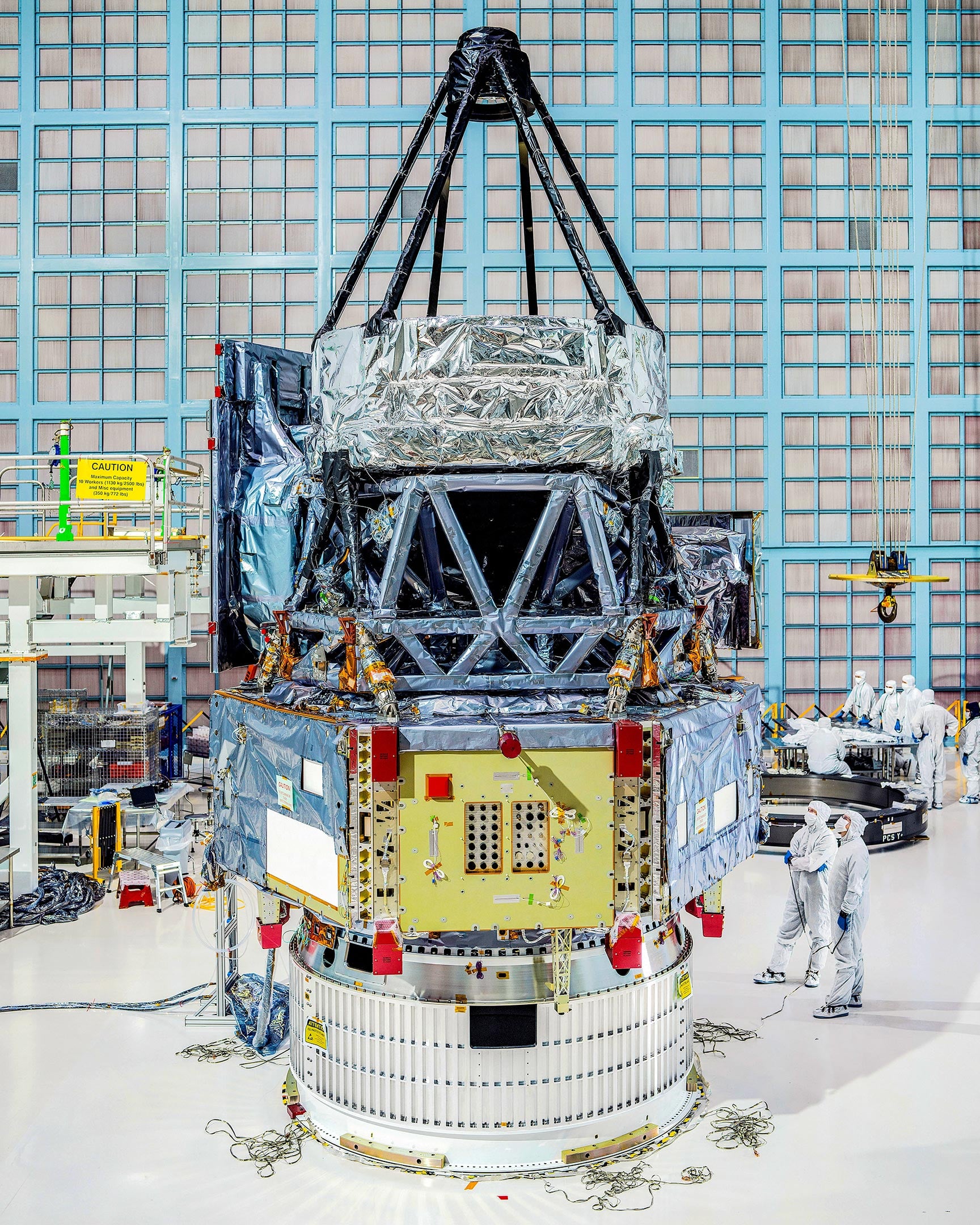
The Roman Space Telescope is nearing completion with its recent integration into the launch spacecraft. This sets the stage for a series of rigorous tests designed to guarantee its operational success in the harsh conditions of space, with its mission launch anticipated by May 2027.
Technicians have successfully integrated the key components of NASA’s Nancy Grace Roman Space Telescope — its telescope, instrument carrier, and two scientific instruments — into the spacecraft that will transport and support the observatory in space.
“With this incredible milestone, Roman remains on track for launch, and we’re a big step closer to unveiling the cosmos as never before,” said Mark Clampin, acting deputy associate administrator for the Science Mission Directorate at NASA Headquarters in Washington. “It’s been fantastic to watch the team’s progress throughout the integration phase. I look forward to Roman’s transformative observations.”

The newly joined space hardware will now undergo extensive testing. The first test will ensure each major element operates as designed when integrated with the rest of the observatory and establish the hardware’s combined performance. Then environmental tests will subject the payload to the electromagnetic, vibration, and thermal vacuum environments it will experience during launch and on-orbit operations. These tests will ensure the hardware and the launch vehicle will not interfere with each other when operating, verify the communications antennas won’t create electromagnetic interference with other observatory hardware, shake the assembly to make sure it will survive extreme vibration during launch, assess its performance across its expected range of operating temperatures, and make sure the instruments and mirrors are properly optically aligned.
Meanwhile, Roman’s deployable aperture cover will be integrated with the outer barrel assembly, and then the solar panels will be added before spring. Then the structure will be joined to the payload and spacecraft this fall.
The Roman mission remains on track for completion by fall 2026 and launch no later than May 2027.
The Nancy Grace Roman Space Telescope, named in honor of NASA’s first Chief of Astronomy, is a next-generation observatory designed to explore the mysteries of the universe. Scheduled for launch by 2027, this powerful telescope will investigate some of the most profound questions in astrophysics, including the nature of dark energy, the structure of the universe, and the search for exoplanets. Equipped with advanced wide-field imaging capabilities, the Roman Telescope will provide panoramic views of the cosmos with unparalleled clarity. Its innovative design combines cutting-edge technology with a mission to deepen humanity’s understanding of the universe.
Never miss a breakthrough: Join the SciTechDaily newsletter.
Follow us on Google and Google News.