
Close Menu
    Facebook X (Twitter) Instagram
    SciTechDaily
    • Biology
    • Chemistry
    • Earth
    • Health
    • Physics
    • Science
    • Space
    • Technology
    Facebook X (Twitter) Pinterest YouTube RSS
    SciTechDaily
    Home»Space»NASA’s Solar Dynamics Observatory Sees Three Solar Flares
    Space

    NASA’s Solar Dynamics Observatory Sees Three Solar Flares

    By Karen C. Fox, NASA's Goddard Space Flight Center,June 11, 2014No Comments2 Mins Read
    Facebook Twitter Pinterest Telegram LinkedIn WhatsApp Email Reddit
    Share
    Facebook Twitter LinkedIn Pinterest Telegram Email Reddit
    NASAs SDO Sees Three Solar Flares
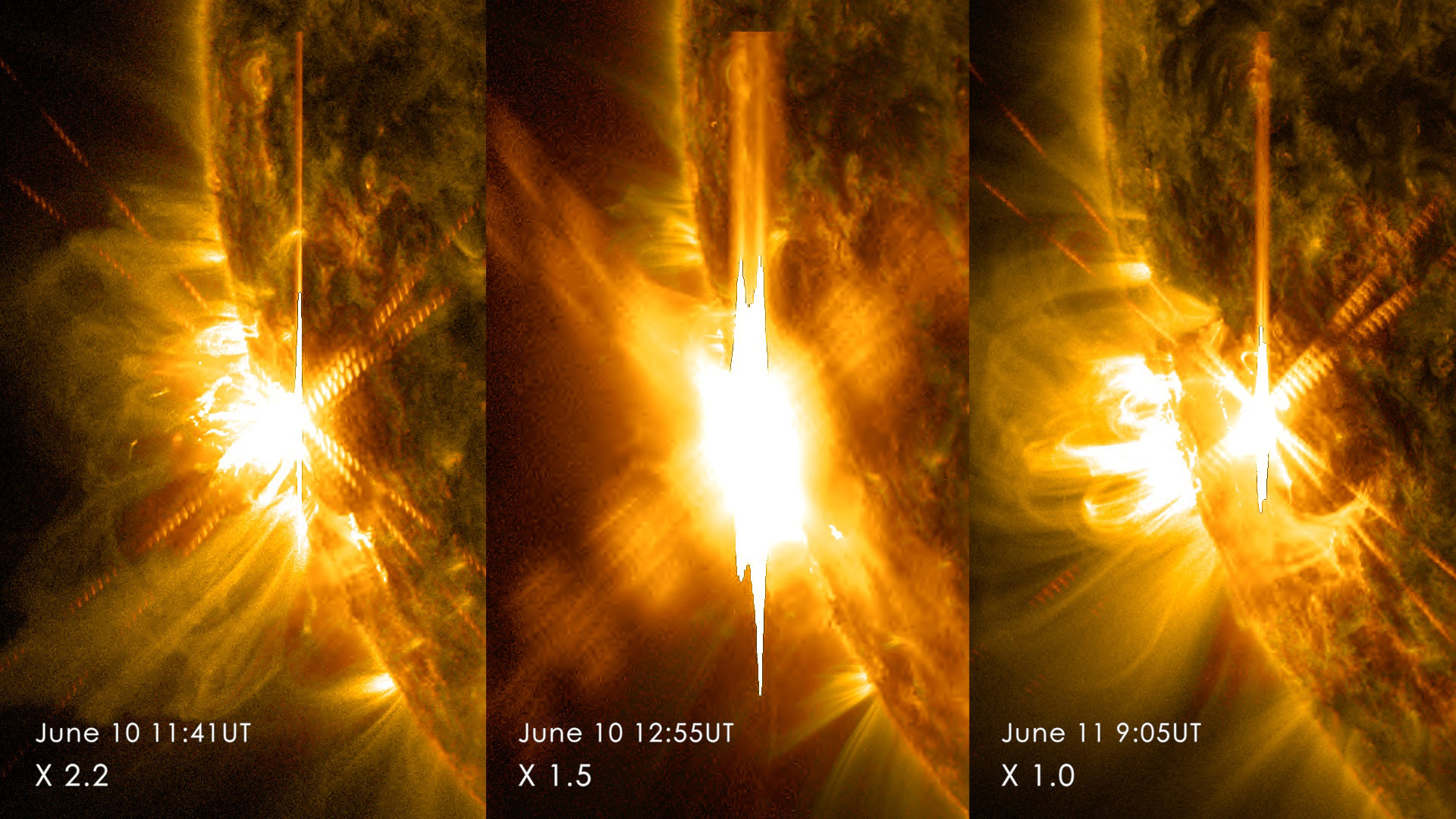
    Three X-class flares erupted from the left side of the sun on June 10-11, 2014. These images are from NASA’s Solar Dynamics Observatory and show light in a blend of two ultraviolet wavelengths: 171 and 131 angstroms. The former is colorized in yellow; the latter, in red. Credit: NASA/SDO

    NASA’s Solar Dynamics Observatory has recorded three X-class flares emitted from the Sun in the last two days.

    The sun emitted a significant solar flare, peaking at 7:42 a.m. EDT on June 10, 2014. NASA’s Solar Dynamics Observatory – which typically observes the entire sun 24 hours a day – captured images of the flare.

    This flare is classified as an X2.2 flare. X-class denotes the most intense flares, while the number provides more information about its strength. An X2 is twice as intense as an X1, an X3 is three times as intense, etc.

    About one hour later, the sun released a second X-class flare, peaking at 8:52 a.m. EDT on June 10, 2014. This is classified as an X1.5 flare.

    On June 11, 2014, the sun erupted with its third X-class flare in two days. The flare was classified as an X1.0 and it peaked at 5:06 a.m. EDT. Images of the flare were captured by NASA’s Solar Dynamics Observatory. All three flares originated from an active region on the sun that recently rotated into view over the left limb of the sun.

    Solar flares are powerful bursts of radiation. Harmful radiation from a flare cannot pass through Earth’s atmosphere to physically affect humans on the ground. However, when intense enough, they can disturb the atmosphere in the layer where GPS and communications signals travel.

    To see how this event may affect Earth, please visit NOAA’s Space Weather Prediction Center at http://spaceweather.gov, the U.S. government’s official source for space weather forecasts, alerts, watches, and warnings.

    Never miss a breakthrough: Join the SciTechDaily newsletter.
    Follow us on Google and Google News.

    Astronomy NASA SDO Solar Flares
    Share. Facebook Twitter Pinterest LinkedIn Email Reddit

    Related Articles

    NASA’s Solar Dynamics Observatory Spots Burst of Light and Energy on the Sun: A B-Class Flare

    NASA’s Solar Dynamics Observatory Views M-Class Solar Flare

    New Technique Provides Near Real-Time Mapping of the Sun’s Interior

    NASA’s SDO Reveals Images of X4.9-Class Solar Flare

    NASA’s Solar Dynamics Observatory Views Two New Solar Flares

    NASA Looks at the Impacts of Strong Solar Flares

    New Measurements Show Sun’s Shape Unaffected by Solar Cycle Variability

    The Sun Celebrates Independence Day With Solar Flare

    Fermi Detects the Highest-Energy Light Ever Associated With an Eruption on the Sun

    Leave A Reply Cancel Reply

    • Facebook
    • Twitter
    • Pinterest
    • YouTube

    Don't Miss a Discovery

    Subscribe for the Latest in Science & Tech!

    Trending News

    The Universe Is Expanding Too Fast and Scientists Can’t Explain Why

    “Like Liquid Metal”: Scientists Create Strange Shape-Shifting Material

    Early Warning Signals of Esophageal Cancer May Be Hiding in Plain Sight

    Common Blood Pressure Drug Shows Surprising Power Against Deadly Antibiotic-Resistant Superbug

    Scientists Uncover Dangerous Connection Between Serotonin and Heart Valve Disease

    Scientists Discover a “Protector” Protein That Could Help Reverse Hair Loss

    Bone-Strengthening Discovery Could Reverse Osteoporosis

    Scientists Uncover Hidden Trigger Behind Stem Cell Aging

    Follow SciTechDaily
    • Facebook
    • Twitter
    • YouTube
    • Pinterest
    • Newsletter
    • RSS
    SciTech News
    • Biology News
    • Chemistry News
    • Earth News
    • Health News
    • Physics News
    • Science News
    • Space News
    • Technology News
    Recent Posts
    • Scientists Overcome Major Quantum Bottleneck, Potentially Transforming Teleportation and Computing
    • Quantum Physics’ Strangest Problem May Hold the Key to Time Itself
    • Scientists Create “Liquid Gears” That Spin Without Touching
    • The Simple Habit That Could Help Prevent Cancer
    • Forgotten Medicinal Plant Shows Promise in Fighting Dangerous Superbugs
    Copyright © 1998 - 2026 SciTechDaily. All Rights Reserved.
    • Science News
    • About
    • Contact
    • Editorial Board
    • Privacy Policy
    • Terms of Use

    Type above and press Enter to search. Press Esc to cancel.