
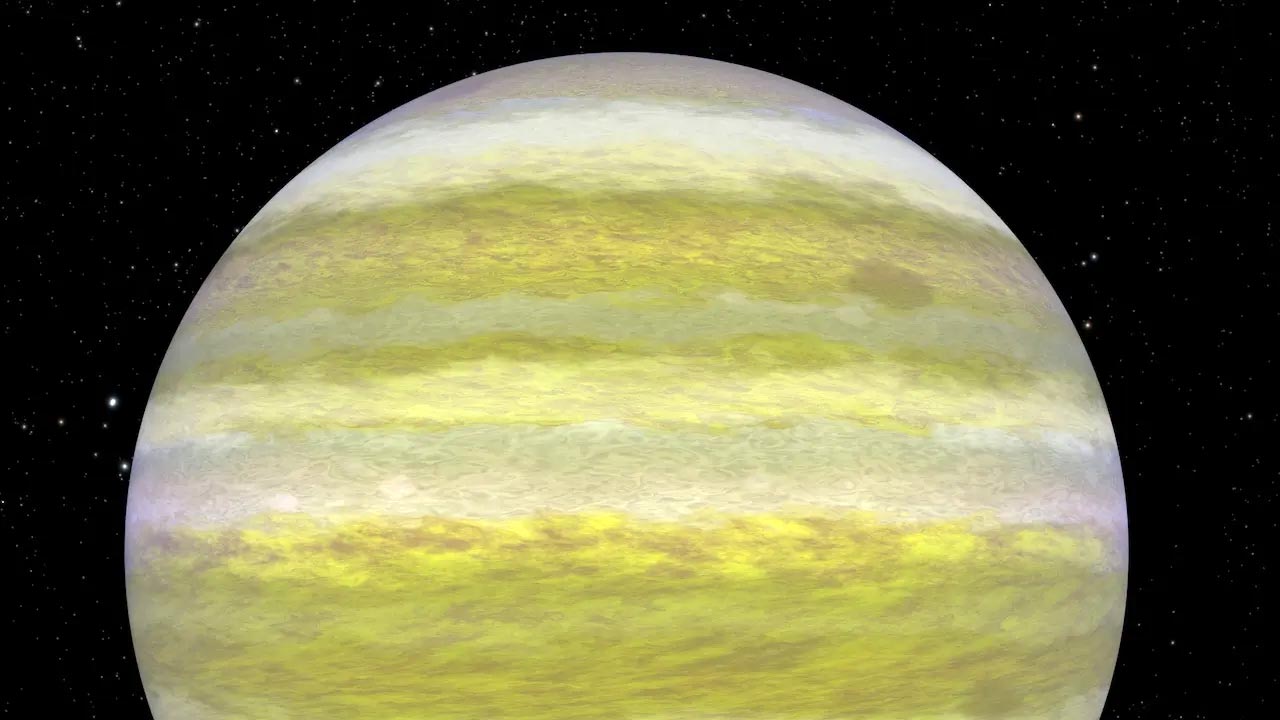
Two giant planets, TOI-4600 b and c, located 700 light-years away, have been discovered orbiting a sun-like star, filling a gap in our understanding of gas giants. The discovery, made using NASA’s TESS, highlights the challenges of finding long-period exoplanets and provides unique insights into the atmospheric conditions of “temperate” gas giants, with TOI-4600 c being one of the coldest known.
Two giant planets comparable to our own system’s Saturn orbit a star not unlike our Sun some 700 light-years away. The outer planet has the longest year – 483 days – of any found so far by NASA’s TESS (the Transiting Exoplanet Survey Satellite). It’s also among the coldest.
Astronomical Significance
The two planets, TOI-4600 b and c, could prove important to astronomers who investigate how large, gaseous planets form and evolve. And they begin to fill a gap in knowledge between gas giants like Jupiter and Saturn in our solar system, and “hot Jupiters” (as well as “warm Jupiters”) elsewhere in our galaxy.
Exoplanet Discovery Challenges
The decades-long hunt for exoplanets – planets around other stars – has so far yielded more than 5,500 that are confirmed to be scattered across the Milky Way, which likely contains hundreds of billions. But the prevailing detection method turns up relatively few “long period” planets, those with years lasting 50 days or more. This method, seeking “shadows,” much more easily reveals planets orbiting their stars closely, with far shorter years. The search for shadows, called the transit method, captures the tiny dip in starlight as an orbiting planet crosses the face of its star.
Spaceborne telescopes like TESS that rely on this method are responsible for the vast majority of exoplanet detections. But the longer a planet’s orbit, the harder it is for TESS to catch it transiting its star. Still, in a study published in September 2023, an international team of scientists using TESS data determined that TOI-4600 b and c have long-period orbits: 83 days for planet b, 483 for planet c (a year that’s a bit longer than Earth’s).
Orbit and Composition Insights
These orbits might not sound very impressive compared to the gas giants in our solar system. For Jupiter, one trip around the Sun takes 12 years; a “year” on Saturn equals more than 29 years on Earth. But because fewer long-period exoplanets transiting their stars have been detected, TOI-4600 b and c could prove to be a gold mine of data. While space telescopes have been able to measure some atmospheric components of hot and warm Jupiters, TOI-4600 b and c offer the rarer prospect of revealing atmospheric ingredients of “temperate” gas giants – those without scorching atmospheres.
Climate of Newly Discovered Planets
“Temperate” is, of course, a relative term. If you’re looking for vacation spots, it’s best to leave these two planets off the list. TOI-4600 b, a bit smaller than Saturn at nearly seven times the width of Earth, has an estimated atmospheric temperature of 165 degrees Fahrenheit (74 Celsius). Planet c, about the size of Saturn at more than nine times the width of Earth, has an estimated temperature of minus 116 Fahrenheit (minus 82 Celsius). That’s among the coldest exoplanets TESS has discovered so far.
An international team led by astronomer Ismael Mireles of the University of New Mexico published their paper on the two planets, “TOI-4600 b and c: Two Long-period Giant Planets Orbiting an Early K Dwarf,” in The Astrophysical Journal Letters in September 2023.
For more on this discovery:
Reference: “TOI-4600 b and c: Two Long-period Giant Planets Orbiting an Early K Dwarf” by Ismael Mireles, Diana Dragomir, Hugh P. Osborn, Katharine Hesse, Karen A. Collins, Steven Villanueva, Allyson Bieryla, David R. Ciardi, Keivan G. Stassun, Mallory Harris, Jack J. Lissauer, Richard P. Schwarz, Gregor Srdoc, Khalid Barkaoui, Arno Riffeser, Kim K. McLeod, Joshua Pepper, Nolan Grieves, Vera Maria Passegger, Solène Ulmer-Moll, Joseph E. Rodriguez, Dax L. Feliz, Samuel Quinn, Andrew W. Boyle, Michael Fausnaugh, Michelle Kunimoto, Pamela Rowden, Andrew Vanderburg, Bill Wohler, Jon M. Jenkins, David W. Latham, George R. Ricker, Sara Seager and Joshua N. Winn, 30 August 2023, The Astrophysical Journal Letters.
DOI: 10.3847/2041-8213/aceb69
Never miss a breakthrough: Join the SciTechDaily newsletter.
Follow us on Google and Google News.